
XRP’s Position in the Evolving CBDC and Cross-Border Payment Ecosystem


 Aime Summary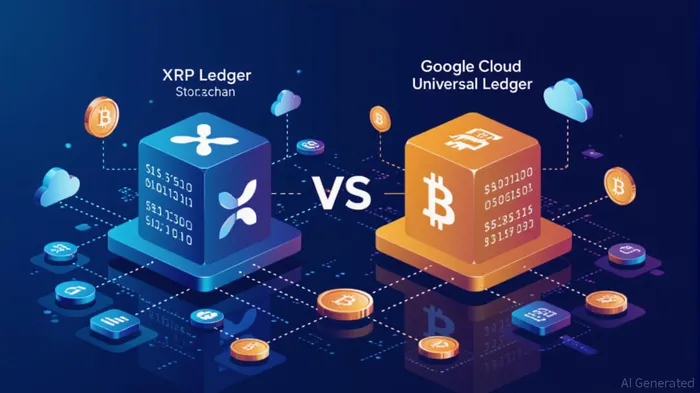
The cross-border payment landscape is undergoing a seismic shift as central bank digital currencies (CBDCs) and blockchain-based solutions redefine liquidity and settlement efficiency. At the heart of this transformation lies XRPXRP--, Ripple’s native token, which has carved a niche in liquidity optimization and institutional adoption. Yet, its dominance faces a new challenger: GoogleGOOGL-- Cloud’s Universal Ledger (GCUL), a permissioned blockchain designed for enterprise integration. To assess XRP’s competitive resilience, we must dissect its strategic advantages, regulatory tailwinds, and evolving role in CBDC ecosystems, while contrasting it with GCUL’s institutional-centric approach.
XRP’s Strategic Foundations
XRP’s core strength lies in its dual role as a bridge asset and a settlement layer. The XRP Ledger (XRPL) processes transactions in 3–5 seconds at a cost of less than $0.01, making it an attractive solution for banks seeking to reduce friction in cross-border flows [1]. Ripple’s 300+ bank partnerships, spanning 90+ markets and 55+ currencies, underscore its entrenched position in global finance [2]. This infrastructure has been further bolstered by Ripple’s recent legal victory over the SEC in August 2025, which cleared the path for institutional adoption and renewed investor confidence [2].
XRP’s integration with CBDC initiatives is another critical differentiator. In Q3 2025, SWIFT began testing XRP Ledger for interoperability with CBDCs, positioning it as a complementary layer for tokenized assets like U.S. Treasuries and gold [1]. Ripple’s collaboration with SBI Group in Japan to distribute Ripple USD (RLUSD)—a stablecoin backed by BNY Mellon—further highlights its adaptability in regulatory environments [3]. These developments suggest XRP is evolving from a payment token to a foundational asset in a broader digital financial ecosystem.
GCUL’s Institutional Play
Google Cloud’s Universal Ledger (GCUL), currently in private testing, represents a direct challenge to XRP’s dominance. Built as a permissioned blockchain using Python, GCUL prioritizes controlled enterprise adoption and compliance, with a pilot program already underway at the Chicago Mercantile Exchange (CME) for asset tokenization [1]. Unlike XRP, which relies on a native token, GCUL has no plans for an initial coin offering (ICO), focusing instead on institutional integration through pre-vetted partnerships [2]. This approach aligns with Alphabet’s $2.5 trillion market capitalization and its ability to leverage existing enterprise infrastructure.
However, GCUL’s success hinges on its ability to scale beyond asset tokenization. While XRP Ledger already supports 300+ banks and offers open protocol design, GCUL’s private nature may limit its appeal to institutions seeking decentralized, permissionless solutions [2]. Additionally, GCUL’s 2026 commercial launch timeline gives XRP a head start in capturing market share, particularly in regions where regulatory clarity is still emerging.
XRP’s Resilience Amid Competition
Despite GCUL’s institutional focus, XRP’s resilience stems from its established use cases and regulatory momentum. The XRP Ledger’s role in FX settlements—tested by Bank of AmericaBAC-- and Morgan Stanley—demonstrates its utility in real-world applications [1]. Meanwhile, Ripple’s Liquidity Hub expansion aims to use XRP as a bridge for tokenized assets, a strategy that could outpace GCUL’s narrower focus on asset tokenization [3].
Moreover, XRP’s recent legal victory has catalyzed institutional interest, with CME futures open interest surpassing $1 billion [2]. This liquidity, combined with XRP’s low-cost, high-speed transactions, positions it as a defensible asset in a market where speed and cost efficiency remain paramount. Analysts project XRP could reach $5.25 by 2030, contingent on regulatory developments and adoption trends [1].
Conclusion
XRP’s competitive resilience lies in its dual strengths: a proven track record in cross-border payments and a forward-looking integration with CBDCs and tokenized assets. While GCUL’s institutional focus and Alphabet’s resources pose a long-term threat, XRP’s decentralized architecture, regulatory clarity, and existing partnerships provide a formidable moat. For investors, the key question is not whether GCUL will disrupt the market, but whether XRP can maintain its first-mover advantage in a rapidly evolving ecosystem.
Source:
[1] Can GCUL Dethrone XRP in Cross-Border Payments? [https://www.ainvest.com/news/xrp-news-today-google-secret-weapon-gcul-dethrone-xrp-cross-border-payments-2508/]
[2] XRP News Today: XRP Set to Become the Digital [https://www.ainvest.com/news/xrp-news-today-xrp-set-digital-backbone-global-finance-2026-2508/]
[3] SWIFT tests XRP and HBARHBAR-- for cross-border payments [https://thepaypers.com/crypto-web3-and-cbdc/news/swift-tests-xrp-ledger-and-hederas-hashgraph-for-cross-border-payments]

Decoding blockchain innovations and market trends with clarity and precision.
Latest Articles
Stay ahead of the market.
Get curated U.S. market news, insights and key dates delivered to your inbox.






Comments
No comments yet