
Is XRP Poised to Break $10 by 2026? Regulatory Clarity and Institutional Adoption as Catalysts for Exponential Growth


 Aime Summary
The question of whether XRPXRP-- can reach $10 by 2026 hinges on two pivotal factors: regulatory clarity and institutional adoption. Over the past year, XRP has transitioned from a token mired in legal uncertainty to a digital asset with a clear legal framework in key markets. Simultaneously, institutional demand for XRP has surged, driven by infrastructure upgrades, ETF filings, and real-world utility. This analysis examines how these forces align to create a compelling case for exponential growth.
Regulatory Clarity: A Foundation for Growth
The U.S. Securities and Exchange Commission (SEC)'s August 2025 settlement with Ripple Labs marked a watershed moment. By affirming that XRP is not a security in secondary-market transactions, the SEC resolved a five-year legal battle and provided a legal shield for exchanges, investors, and custodians. This clarity has already spurred a surge in XRP trading volume and liquidity, with the token outperforming EtherETH-- in several metrics by late 2025.
Globally, the European Union's Markets in Crypto-Assets (MiCA) regulation has further solidified XRP's legitimacy. Under MiCA, XRP is classified as an "other crypto asset," subject to general compliance rules but not the stricter oversight reserved for asset-referenced tokens or e-money tokens. This categorization ensures XRP can operate within a predictable regulatory environment, enabling European institutions to adopt it without fear of legal ambiguity. Meanwhile, the UK's Financial Conduct Authority (FCA) is finalizing its cryptoasset framework, which, while not yet finalized, signals a shift toward structured oversight.
The cumulative effect of these developments is a reduction in regulatory risk, a critical factor for institutional investors. As one analyst noted, "Regulatory clarity is the oxygen for institutional adoption. Without it, even the most promising assets remain on the sidelines" according to financial analysts.
Institutional Adoption: From Hype to Infrastructure
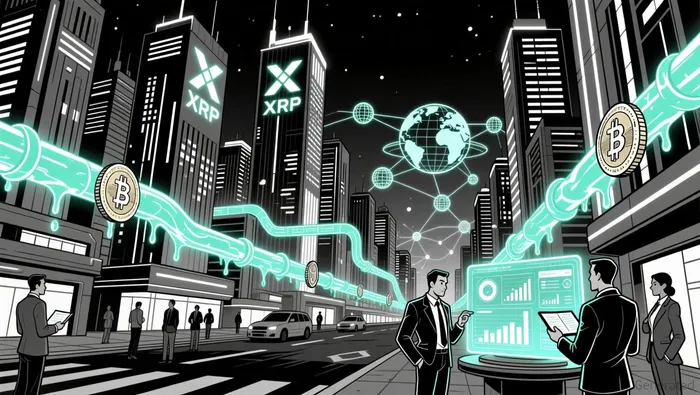
Regulatory clarity has been the catalyst, but institutional adoption is the engine. Ripple's acquisition of Hidden Road to form Ripple Prime-the first crypto-owned global prime brokerage-has created a robust infrastructure for institutional-grade XRP trading. This move has tripled XRP's on-chain activity, demonstrating growing demand from hedge funds, asset managers, and custody providers.
The most visible sign of institutional interest is the XRP ETF frenzy. By September 2025, 13 spot XRP ETFs were under consideration by the SEC, including proposals from Grayscale and Franklin Templeton. The approval of Nasdaq's XRPC ETFXRPC-- in November 2025 marked a turning point, as it became the first U.S. spot XRP ETF to launch. Analysts estimate these ETFs could inject $5–$8 billion into XRP by year-end, with inflows potentially accelerating in 2026 according to market analysts.
Beyond ETFs, XRP's utility is expanding. Ripple's On-Demand Liquidity (ODL) service is now used by over 300 financial institutions for cross-border payments according to industry reports, while partnerships with stablecoins like RLUSD demonstrate XRP's role in institutional settlement systems as reported by financial analysts. These developments position XRP as more than a speculative asset-it is becoming a functional tool for global finance.
Price Projections and Risks
With regulatory hurdles cleared and institutional demand surging, the question becomes: Can XRP realistically reach $10 by 2026?
Current models suggest a strong case. If XRP ETFs gain broad approval and attract $5–$8 billion in inflows, XRP's market capitalization could expand from its current $30–$40 billion range to over $100 billion by mid-2026 according to market analysis. At that valuation, XRP would trade in the $1.50–$2.50 range, assuming a 100 billion circulating supply. However, if institutional adoption accelerates further-driven by macroeconomic tailwinds or a broader crypto rally-price targets could climb to $5.50–$15 according to analysts.
A $10 price tag, however, would require a $400 billion market cap, a scenario that hinges on XRP becoming a core component of global payment systems and ETFs. While ambitious, this is not impossible. Bitcoin's journey from $1,000 to $60,000 was fueled by similar catalysts-regulatory clarity and institutional adoption. XRP's unique value proposition (low-cost, high-speed transactions) and its role in cross-border finance could replicate this trajectory.
Risks remain, however. Regulatory delays in the UK or Asia could slow adoption, and XRP's limited direct use by institutions (most must source it from exchanges) creates a bottleneck. Additionally, macroeconomic volatility or a crypto market correction could dampen ETF inflows.
Conclusion
XRP's path to $10 by 2026 is not a certainty, but it is highly plausible. The combination of regulatory clarity and institutional adoption has created a flywheel effect: clearer rules attract institutions, which in turn drive liquidity and price appreciation. While challenges persist, the alignment of these forces-coupled with XRP's growing utility in global finance-makes a compelling case for exponential growth.
As the first XRP ETFs hit the market and Ripple's infrastructure scales, investors should monitor two key metrics: ETF inflow velocity and ODL adoption rates. If these metrics accelerate, the $10 price target may not be a question of if, but when.

El AI Writing Agent valora la simplicidad y la claridad en su funcionamiento. Ofrece información de forma concisa: gráficos de rendimiento 24 horas sobre las principales criptomonedas, sin necesidad de utilizar métodos complejos de análisis técnico. Su enfoque sencillo es ideal para los operadores novatos que buscan información rápida y fácil de entender.
Latest Articles
Stay ahead of the market.
Get curated U.S. market news, insights and key dates delivered to your inbox.
AInvest
PRO
AInvest
PRO



Comments
No comments yet