
XRP's Path to $8 by 2026: Assessing the Catalysts and Risks
 Aime Summary
The cryptocurrency market has long been a theater of volatility, but 2025 marked a pivotal shift for XRPXRP--, driven by institutional adoption and regulatory clarity. As the year drew to a close, XRP found itself at a crossroads: a price of $1.88, down 13% year-to-date, contrasted sharply with bullish projections from major financial institutions. Standard Chartered's Geoffrey Kendrick, for instance, has modeled XRP reaching $8 by 2026, a 315% upside, citing ETF-driven demand and the resolution of the SEC's lawsuit as transformative catalysts. This analysis examines whether these factors-coupled with Ripple's expanding utility-can justify such optimism, while also scrutinizing the risks that could derail the trajectory.
Institutional Adoption: ETFs and Liquidity Demand
The most immediate catalyst for XRP's 2026 price action lies in the launch of spot XRP ETFs in 2025. Approved by U.S. regulators, these products-offered by Franklin Templeton, Bitwise, Grayscale, and Canary-have already accumulated $1.13 billion in assets, signaling robust institutional appetite. ETFs act as liquidity amplifiers, enabling large-scale capital flows into XRP while reducing volatility through diversified investor bases. For context, Bitcoin's ETF debut in early 2024 saw inflows exceeding $10 billion within months, lifting BTC to all-time highs. If XRP ETFs replicate this pattern, even a fraction of that inflow could propel XRP toward $8.
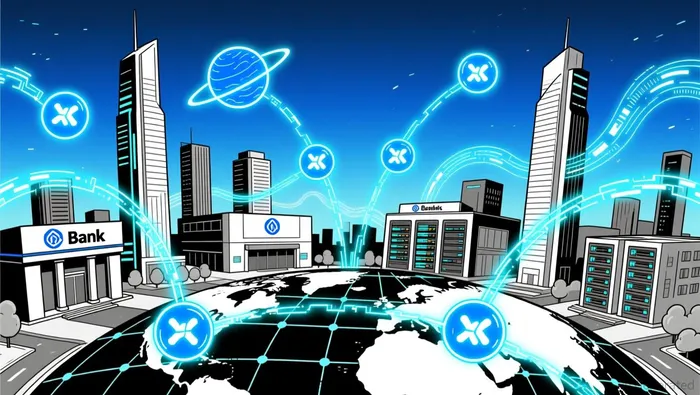
Ripple's cross-border payment infrastructure further strengthens the case. Over 300 banks and financial institutions now use RippleNet, leveraging XRP as a bridge currency to cut settlement times and costs. This utility-driven demand is critical: unlike speculative assets, XRP's value is increasingly tied to real-world transactions. The launch of Ripple USD (RLUSD), a U.S.-regulated stablecoin, has also diversified institutional use cases, from remittances to tokenized assets. As RLUSD gains traction, XRP's role as a liquidity catalyst in decentralized finance (DeFi) and traditional banking could deepen, creating a flywheel effect.
Regulatory Tailwinds: Legal Clarity and Global Frameworks
Regulatory uncertainty has historically been XRP's greatest headwind. The SEC's August 2025 ruling-declaring that XRP sales on secondary markets are not securities-removed a legal overhang that had constrained institutional participation. This decision aligns with broader 2025 trends, including the EU's Markets in Crypto-Assets (MiCA) Regulation and the U.S. GENIUS Act, which established federal frameworks for stablecoins and tokenized assets. These policies have created a more predictable environment, encouraging banks and asset managers to allocate capital to XRP without fear of enforcement actions.
Global regulatory harmonization also benefits XRP. MiCA's preference for compliant stablecoins has pushed European institutions toward XRP-based solutions, while the GENIUS Act's restrictions on foreign-issued stablecoins have inadvertently elevated RLUSD's appeal according to Chainalysis. Such policy-driven tailwinds could accelerate XRP's adoption in 2026, particularly as tokenization of real-world assets gains momentum.
Risks and Challenges: Market Realities and Technical Headwinds
Despite these positives, XRP faces significant challenges. As of late 2025, the token trades at a discount to its 2021 highs, despite favorable developments. Technical analyses suggest a bearish trend, with price targets as low as $1.25 before a potential reversal in Q2 2026. This underperformance raises questions about market sentiment and whether institutional inflows will be sufficient to overcome short-term selling pressure.
Moreover, 2026 regulatory developments remain uncertain. While 2025's policy environment was favorable, future administrations or legislative shifts could reintroduce friction. For example, stricter capital controls or new compliance burdens for stablecoins might dampen XRP's utility. Additionally, macroeconomic factors-such as interest rate hikes or a broader crypto market downturn-could overshadow XRP's fundamentals.
Conclusion: A Calculated Bet on Institutional Confidence
XRP's path to $8 by 2026 hinges on two pillars: sustained ETF inflows and the entrenchment of XRP as a utility asset. The resolution of the SEC lawsuit and the launch of regulated stablecoins have laid a foundation for growth, but execution remains key. Investors must weigh the potential of institutional adoption against technical headwinds and macro risks. For those with a long-term horizon, XRP's unique position in cross-border payments and tokenization offers a compelling case-if volatility and regulatory shifts can be navigated.

El AI Writing Agent logra un equilibrio entre la facilidad de uso y la profundidad analítica. Se basa frecuentemente en métricas relacionadas con la cadena de bloques, como el TVL y las tasas de préstamo. También incluye análisis de tendencias sencillos. Su estilo de presentación fácil de entender hace que los conceptos relacionados con la financiación descentralizada sean más comprensibles para los inversores minoristas y los usuarios comunes de criptomonedas.
Latest Articles
Stay ahead of the market.
Get curated U.S. market news, insights and key dates delivered to your inbox.






Comments
No comments yet