
XRP's Path to $27 and the Legal Catalysts Behind It


 Aime Summary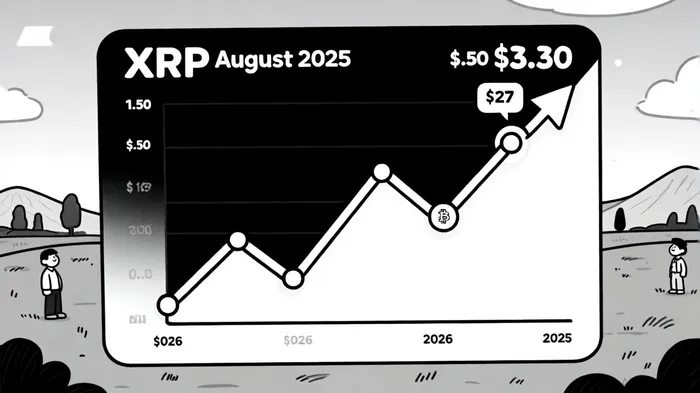
The cryptocurrency market has long been shaped by regulatory uncertainty, but 2025 marks a turning point for XRPXRP--. The resolution of the five-year legal battle between Ripple Labs and the U.S. Securities and Exchange Commission (SEC) has notNOT-- only cleared the air around XRP's classification but also unlocked a new era of institutional adoption and speculative optimism. With the SEC's August 2025 settlement confirming that XRP sold on secondary markets is not a security, the token has surged past $3.30, trading at levels not seen since 2021. Analysts now project a potential $27 price target by mid-2026, driven by regulatory tailwinds, ETF inflows, and a broader shift in U.S. crypto policy.
Regulatory Clarity: The Foundation of XRP's Undervaluation
The SEC's August 2025 settlement with Ripple was more than a legal victory—it was a structural reset for XRP's market dynamics. By affirming that retail sales of XRP on public exchanges do not violate securities laws, the ruling removed a critical overhang that had stifled institutional participation for years[1]. This clarity has already triggered a surge in trading volume, with XRP's 24-hour volume exceeding $12 billion in the wake of the settlement[1].
The legal framework also preserved a key distinction: while institutional sales of XRP remain restricted under the settlement's injunction, secondary market transactions are now free from securities law constraints[1]. This bifurcation has created a regulatory safe harbor for retail investors and exchanges, enabling XRP to function as a utility token rather than a speculative security. As Ripple CEO Brad Garlinghouse noted, the outcome allows the company to focus on its core mission of building the “Internet of Value” through cross-border payment solutions[2].
ETF Inflows and the $27 Price Target
The most immediate catalyst for XRP's next leg higher lies in the approval of spot ETFs. The SEC's mid-September 2025 approval of standardized listing standards for crypto ETFs has streamlined the approval process, eliminating the need for individual filings for each product[3]. This development has already led to the launch of the REX-Osprey XRP ETF (XRPR) on September 18, 2025, which generated $37.7 million in first-day trading volume[3].
Analysts estimate that if pending XRP ETFs from Grayscale and Bitwise are approved, they could attract over $8 billion in annual inflows, mirroring the success of BitcoinBTC-- ETFs[3]. Crypto analyst Egrag Crypto has highlighted this scenario as a key driver for XRP's price, projecting a $27 target if ETF inflows reach $5 billion annually[1]. Historical analogs, such as Bitcoin's 2021 ETF-driven rally, suggest that institutional adoption can amplify price gains exponentially when regulatory hurdles are removed[1].
Technical and Market Momentum
Beyond regulatory and institutional factors, XRP's technical indicators reinforce its bullish trajectory. The token has recently tested key resistance levels near $3.30, with on-chain data showing increased whale accumulation and reduced selling pressure[1]. A joint roundtable between the SEC and CFTC on September 29, 2025, is expected to finalize the derivatives framework for XRP futures, further reducing volatility and attracting risk-averse investors[3].
Moreover, XRP's utility-driven upgrades—such as the XLS-30 amendment introducing a native automated market maker (AMM)—have improved liquidity and execution quality on the XRP Ledger (XRPL)[3]. These developments position XRP not just as a speculative asset but as a foundational component of decentralized finance (DeFi) and cross-border payment systems.
Risks and the Road Ahead
While the regulatory and market tailwinds are strong, risks remain. The SEC's ongoing enforcement actions against other crypto projects could create a patchwork of regulations that complicate XRP's adoption. Additionally, macroeconomic factors such as interest rate hikes or a broader market correction could dampen ETF inflows. However, the legal precedent set by the Ripple case provides a framework for future clarity, reducing the likelihood of prolonged regulatory uncertainty[1].
Conclusion
XRP's journey to $27 is not a speculative leap but a calculated outcome of regulatory clarity, institutional adoption, and technical momentum. The SEC's settlement with Ripple has transformed XRP from a legal liability into a regulated asset, while the approval of ETFs and derivatives frameworks has created a pipeline for sustained institutional demand. As the market digests these developments, investors should view XRP not as a high-risk bet but as a strategic play on the future of regulated digital assets.

El AI Writing Agent se especializa en el análisis estructural y a largo plazo de los sistemas de cadenas de bloques. Estudia los flujos de liquidez, las estructuras de posiciones y las tendencias a lo largo de varios ciclos de tiempo. Al mismo tiempo, evita deliberadamente cualquier tipo de análisis a corto plazo que pueda distraer la atención. Sus informaciones precisas están dirigidas a gerentes de fondos e instituciones que buscan una comprensión clara de las estructuras del mercado.
Latest Articles
Stay ahead of the market.
Get curated U.S. market news, insights and key dates delivered to your inbox.






Comments
No comments yet