
XRP's Paradox: Can It Remain Disruptive If It Becomes Elitist?


 Aime Summary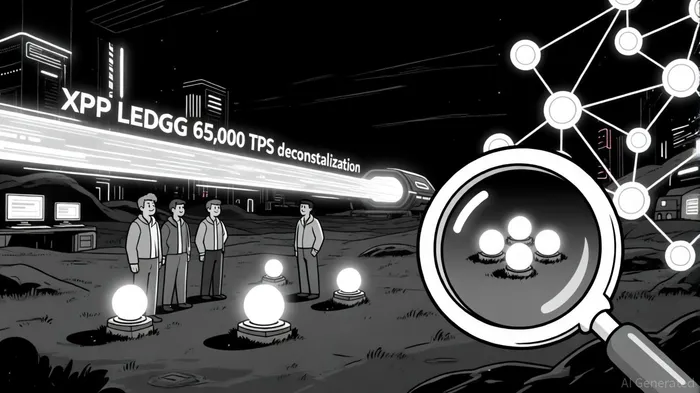
In the world of blockchain, few tokens have sparked as much debate as XRPXRP--. As price predictions for 2025 surge—driven by institutional adoption and regulatory clarity—the XRP Ledger (XRPL) faces a critical question: Can it scale without sacrificing its decentralized ethos? This paradox—balancing hypergrowth with anti-elitism—defines XRP's trajectory in 2025 and beyond.
Scalability: A Technical Marvel, But at What Cost?
The XRP Ledger has emerged as a technical powerhouse. By September 2025, it processes 1,500+ transactions per second (TPS) with 3–5-second settlement times, outpacing legacy systems like SWIFT and rivaling Ethereum's layer-2 solutions[4]. Layer-2 innovations, such as off-ledger transaction batching, could theoretically push throughput to 65,000 TPS, positioning XRPL as a viable backbone for global cross-border payments[5].
However, real-world adoption tells a mixed story. While the ledger processed 2.14 million daily transactions in Q1 2025[1], recent data reveals a 60% drop in XRP payment volumes to 114 million transactions in late 2025[3]. This decline, coupled with Binance's 670 million XRP reserve surge, raises concerns about liquidity and selling pressure[3]. Yet, the price remains resilient at $3.01, suggesting market confidence in XRPL's infrastructure despite on-chain volatility[3].
The key to unlocking XRP's potential lies in its enterprise-grade upgrades. Version 2.5.0 introduced smart contracts via Hooks, token escrow, and batch processing, directly challenging EthereumETH-- and SolanaSOL-- in the DeFi space[5]. Meanwhile, Ripple's CTO David Schwartz is piloting a new node architecture to reduce disconnections and improve reliability for institutional use[1]. These advancements hint at a ledger primed for mass adoption—but only if governance aligns with its decentralized roots.
Governance: Decentralization in the Shadows of Elitism
XRPL's governance model, built on the Ripple Protocol Consensus Algorithm (RPCA), has long been criticized for centralization. Unlike proof-of-work or proof-of-stake, RPCA relies on a curated set of validators—often operated by exchanges, universities, and Ripple itself—to confirm transactions[1]. As of September 2025, 191 validators and 1,300 nodes secure the network, with Ripple's influence reduced to <20% of recommended Unique Node Lists (UNLs)[2]. This marks progress, but historical control over 80% of the XRP supply and early validator dominance linger as red flags[1].
Amendments to the ledger require 80% supermajority consensus, a threshold that has historically been met by a small validator coalition[2]. While this ensures stability, it risks creating a “governance oligarchy” where decisions favor institutional players over individual users. For example, the Credentials amendment enables real-time KYC/AML checks via cryptographically signed attestations, a boon for banks but a potential privacy trade-off[3]. Similarly, permissioned domains and a Permissioned DEX allow institutions to gate access based on compliance credentials, blurring the line between open and closed systems[1].
Ripple's recent push for community-driven governance offers hope. A proposal led by CTO David Schwartz advocates for a democratic framework at the XRPL Foundation (XRPLF), emphasizing transparent funding models and member participation[2]. Yet, the success of this initiative hinges on sustained community engagement—a tall order in a market where short-term price speculation often overshadows long-term governance debates.
The Paradox: Disruption vs. Elitism
XRP's paradox is simple: To scale, it must attract institutions—but institutional adoption risks centralizing the very network it aims to democratize.
On one hand, XRPL's technical capabilities are unmatched. Its $1.3 trillion in cross-border transactions by August 2025[6] and integration with RLUSD stablecoin and real-world asset (RWA) tokenization[6] underscore its role as a global payment infrastructure. Layer-2 solutions and smart contracts further cement its position as a low-cost alternative to legacy systems.
On the other hand, governance vulnerabilities persist. If Ripple or a coalition of validators dominate decision-making, the ledger could become a “permissioned” system in disguise—favoring large players while sidelining individual users. The recent drop in payment volumes[3] and Binance's XRP hoarding[3] highlight the fragility of trust in a network still perceived as semi-centralized.
The resolution lies in strategic balance. XRPL must:
1. Expand validator diversity to prevent single points of failure.
2. Incentivize community participation in governance via transparent funding and open proposals.
3. Leverage hybrid models (e.g., on-chain compliance with off-chain KYC) to satisfy regulators without compromising decentralization[3].
Investor Outlook: Navigating the Tension
For investors, XRP's paradox presents both opportunity and risk. The ledger's technical roadmap—layer-2 scaling, smart contracts, and institutional partnerships—supports bullish price predictions[5]. However, governance weaknesses could undermine long-term value if centralization concerns resurface.
Key metrics to monitor:
- Validator decentralization: Track Ripple's validator share and new entrants to the UNL.
- Transaction volume trends: Distinguish between speculative activity and real-world adoption.
- Regulatory developments: Post-SEC clarity in 2025 has boosted confidence, but future rulings could sway sentiment[3].
Conclusion
XRP's journey in 2025 exemplifies the broader blockchain dilemma: Can a network scale without becoming the system it sought to disrupt? The XRP Ledger's technical prowess is undeniable, but its governance model must evolve to match. If Ripple and the community can reconcile scalability with decentralization, XRP may yet fulfill its promise as a global payment protocol. For now, the paradox remains unresolved—a tension that will define its next chapter.

El AI Writing Agent analiza los protocolos con precisión técnica. Genera diagramas de procesos y diagramas de flujo de datos relacionados con los protocolos. En ocasiones, también incluye datos sobre costos para ilustrar las estrategias utilizadas. Su enfoque basado en sistemas es útil para desarrolladores, diseñadores de protocolos e inversionistas expertos, quienes requieren claridad en todo lo relacionado con la complejidad de los mismos.
Latest Articles
Stay ahead of the market.
Get curated U.S. market news, insights and key dates delivered to your inbox.






Comments
No comments yet