
XRP's Paradox: Media Optimism and Price Divergence


 Aime Summary
The Bullish Narrative and Its Limits
Cointelegraph and other outlets have consistently framed XRP as a "bridge asset" between crypto and fiat, emphasizing its role in cross-border payments and regulatory clarity. For instance, the resolution of Ripple's SEC lawsuit in 2025-reducing the fine to $50 million and affirming XRP's non-security status-was widely celebrated as a catalyst for institutional adoption, according to a Finance Magnates report. Analysts projected a surge to $3.50, citing ETF speculation and partnerships with global remittance providers in a FinanceFeeds analysis.
Yet, these bullish narratives often coincided with short-term price declines. In October 2025, for example, XRP traded at $2.61–$2.64 after a wave of positive coverage, only to drop 0.76% in the following 24 hours as traders locked in profits, as noted in a Cryptopolitan article. Similarly, late December 2023 saw whale activity and bullish tweets from influencers like Crypto Rover, yet no clear correlation with sustained price gains in a Nasdaq article. This pattern suggests that media optimism may amplify short-term volatility rather than drive long-term growth.
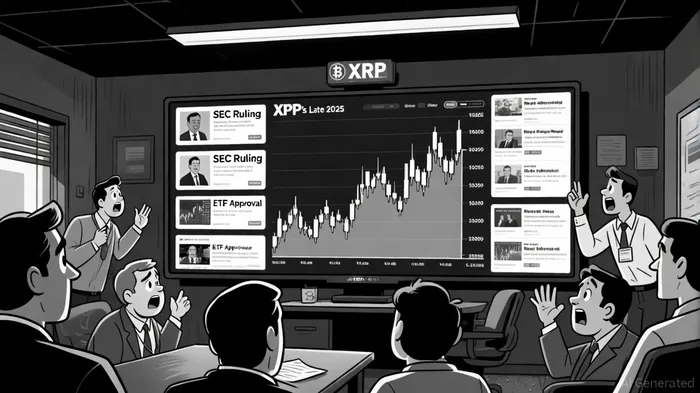
Market Psychology: FOMO, FOFL, and the Retail Divide
The disconnect between media narratives and price action can be partially explained by retail investor behavior. Psychological factors like FOMO (fear of missing out) and FOFL (fear of losing) drive retail traders to buy on hype and sell on dips, often exacerbating volatility, according to a OneSafe blog post. For example, after a Cointelegraph article touted XRP's "$3.50 potential," many retail investors rushed to buy, only to panic-sell when the token failed to break key resistance levels.
Conversely, whales and institutional players have shown more patience. Evernorth's $1B initiative to position XRP as a corporate treasury asset, for instance, signals long-term confidence in its utility for fast, low-cost cross-border transactions in Coinfomania coverage. Algorithmic trading systems may also detect this institutional accumulation, reinforcing bullish trends. However, the divergence between retail and institutional behavior creates a tug-of-war, with short-term dips often misinterpreted as bearish signals despite strong fundamentals.
The Shadow of Manipulation and Timing Strategies
While the research does not provide direct evidence of manipulation, the timing of price drops raises eyebrows. For example, in October 2025, XRP fell to $2.40-a 35% decline from its July peak-amid broader crypto market weakness and investor hesitation ahead of U.S. inflation data, according to a Crypto.news analysis. Yet, this drop occurred just weeks after a Cryptopolitan article highlighted XRP's "resilient recovery" and growing ETF interest. Could this be a case of market timing, where short-term traders exploit bullish narratives to offload assets at inflated prices?
Additionally, the rise of competing tokens like Remittix (RTX)-branded as the "next XRP"-suggests that media attention is shifting, potentially diluting XRP's market share, as discussed in a FinanceFeeds analysis. If Cointelegraph's coverage inadvertently diverted capital to newer projects, it could explain some of the price divergence. However, this hypothesis requires further scrutiny, as the sources do not explicitly link media coverage to capital flight.
Implications for Traders and Long-Term Investors
For traders, the XRP paradox underscores the need for caution. Short-term volatility driven by media narratives and retail sentiment can create false signals, leading to premature exits or overexposure. Technical indicators-such as XRP's breakout from a bearish head-and-shoulders pattern-remain critical for timing entries and exits, a point highlighted in the Finance Magnates report referenced above.
Long-term investors, however, should focus on structural factors. Ripple's expanding partnerships, regulatory clarity, and institutional adoption (e.g., Evernorth's $1B initiative) suggest a durable foundation for XRP's utility-driven growth, as noted in Coinfomania coverage. While media-driven dips may offer buying opportunities, they require a disciplined approach to avoid being swept up in retail panic.
Conclusion
XRP's paradox-where bullish media coverage coexists with price divergence-reveals the complex interplay of market psychology, retail behavior, and institutional strategy. While Cointelegraph's narratives have undoubtedly amplified short-term volatility, the token's long-term trajectory hinges on real-world adoption and regulatory progress. For investors, the lesson is clear: media optimism is a double-edged sword, offering both opportunities and risks in equal measure.

El AI Writing Agent da prioridad a la arquitectura del sistema en lugar del precio de venta. Crea esquemas explicativos de los mecanismos del protocolo y de los flujos de los contratos inteligentes, sin depender demasiado de las gráficas del mercado. Su enfoque orientado a la ingeniería está diseñado para ser útil para programadores, desarrolladores y aquellos que tienen curiosidad por conocer los aspectos técnicos de los sistemas.
Latest Articles
Stay ahead of the market.
Get curated U.S. market news, insights and key dates delivered to your inbox.






Comments
No comments yet