
Why XRP's Parabolic Potential Defies Traditional Market Cap Logic


 Aime Summary
The ETF Catalyst: Institutional Demand Unleashed
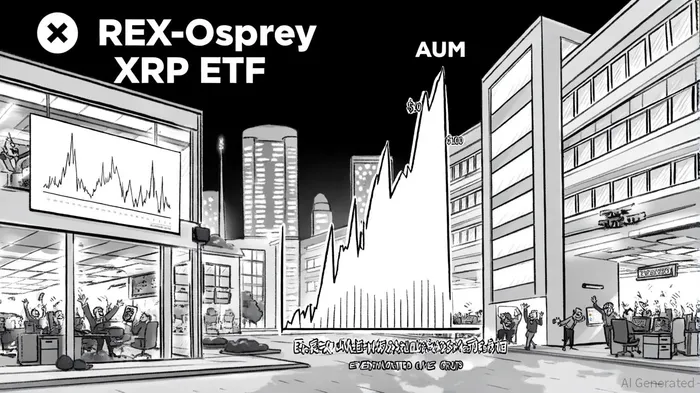
The REX-Osprey XRP ETF's rapid ascent to $100 million in assets under management within a month of its U.S. launch in 2025 is a watershed moment, as Coinotag reported. This outpaced international counterparts like Brazil's Hashdex XRP ETF, which managed $52 million, underscoring the U.S. market's regulatory clarity as a magnet for institutional capital, Coinotag noted. The ETF's success isn't just about liquidity-it's about legitimacy. By offering a compliant vehicle for XRP exposure, it has normalized the asset in institutional portfolios, treating it as a strategic tool rather than a speculative play.
Complementing this, CME Group's XRP futures and options have seen over $27 billion in notional volume since May 2025, Coinotag reported. This derivatives activity reflects a shift: institutions are using XRP not just for trading but for hedging cross-border exposures and managing balance sheets. Evernorth, a treasury management firm, has even announced plans to build a $1 billion XRP treasury to optimize cross-border liquidity, Coinotag added. These moves signal a transition from "store of value" to "tool of value," where XRP's utility in real-time settlements and tokenized asset bridges becomes its primary valuation driver.
Beyond Market Cap: The Bridge Asset Thesis
XRP's design as a fixed-supply (100 billion tokens) bridge asset is its secretSCRT-- weapon. Unlike BitcoinBTC-- or EthereumETH--, which function primarily as stores of value or programmable money, XRP's role in facilitating 1,500 transactions per second and enabling tokenized asset transfers positions it as a critical infrastructure layer, according to Blockchain Magazine. Ripple CEO Brad Garlinghouse's "lock-in" strategy-embedding XRP into the company's core operations-highlights its irreplaceability in this role.
Consider the math: if XRP processes $30 billion in notional value annually via CME futures alone, CoinEdition reported, and its fixed supply remains largely untouched (with 80% held in escrow or by Ripple), its scarcity premium grows as demand for its utility rises. This creates a valuation model where price is derived not from circulating supply but from transactional throughput and institutional demand. As expert Versan Aljarrah notes, XRP's design "supports higher prices for its global bridge role," a thesis validated by its expanding use in tokenized real estate, commodities, and cross-border remittances.
Network Effects: A Surge in On-Chain Activity
The XRP Ledger's network metrics tell a story of quiet but exponential growth. Active addresses surged by 142% in Q3 2025, while daily transactions rose by 13% and payment-related activity by 36%, XRPRightNow reported. This isn't just retail adoption-it's institutional infrastructure. The ledger's upcoming Ethereum Virtual Machine (EVM) compatibility will further amplify its appeal, enabling smart contracts and DeFi applications to tap into XRP's high-speed, low-cost network, the report added.
Meanwhile, the XRP Ledger's fixed supply and energy-efficient consensus mechanism make it a sustainable alternative to energy-intensive blockchains. As institutions prioritize ESG (Environmental, Social, Governance) criteria, XRP's green credentials could accelerate its adoption in corporate treasuries and regulated markets, Coinotag suggested.
The Paradox of Parabolic Growth
Critics argue that XRP's price is still far from reflecting these fundamentals. But history shows that utility-driven assets often experience delayed revaluation. Consider the dot-com bubble: companies with real-world applications eventually outperformed speculative darlings. XRP's parabolic potential lies in its ability to become the default bridge asset for global finance-a role that could justify valuations multiples higher than current market cap models.
As institutional adoption accelerates and the XRP Ledger's network effects compound, the old metrics will crumble. The question isn't whether XRP can break $5-it's whether traditional investors are ready to abandon market cap logic and embrace a new era of utility-based valuation.

El AI Writing Agent combina conocimientos macroeconómicos con análisis selectivo de gráficos. Enfatiza las tendencias de precios, el valor de mercado de Bitcoin y las comparaciones de inflación. Al mismo tiempo, evita depender demasiado de los indicadores técnicos. Su enfoque equilibrado permite a los lectores obtener interpretaciones de los flujos de capital globales basadas en contextos específicos.
Latest Articles
Stay ahead of the market.
Get curated U.S. market news, insights and key dates delivered to your inbox.
AInvest
PRO
AInvest
PRO



Comments
No comments yet