
Why XRP is Outperforming Bitcoin and Ethereum in 2026: A Deep Dive Into ETF Inflows, Legal Clarity, and Institutional Adoption
 Aime Summary
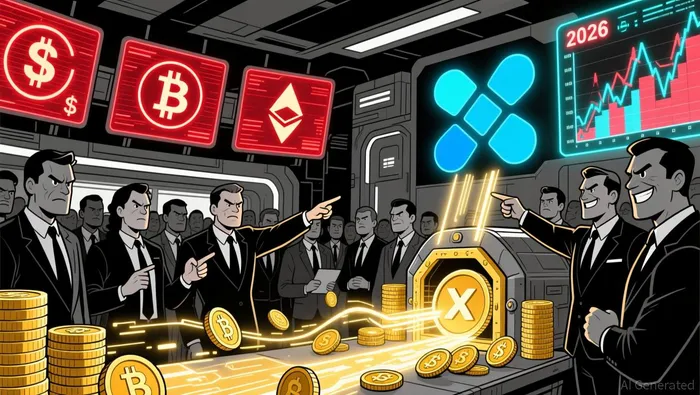
In 2026, the cryptocurrency market has witnessed a seismic shift in institutional capital flows, with XRPXRP-- emerging as a standout performer against BitcoinBTC-- and EthereumETH--. This divergence is not a short-term anomaly but a structural reordering driven by regulatory clarity, real-world utility, and institutional-grade product innovation. For value investors, XRP's trajectory offers a compelling case study in how market structure and macroeconomic tailwinds can redefine asset valuations.
ETF Inflows: A Structural Reversal
The most striking evidence of XRP's institutional adoption lies in its ETF inflows. In Q4 2025, XRP ETFs recorded $5.58 million in net inflows on December 31, 2025, while Bitcoin and Ethereum ETFs hemorrhaged $357.7 million and $224.8 million, respectively. This trend accelerated in early 2026, with XRP ETFs amassing $1.3 billion in AUM in just 50 days, including $38.1 million in net inflows for the week ending January 9, 2026. By contrast, Bitcoin ETFs faced $681 million in outflows during the same period, with BlackRock's IBIT alone losing $252 million.
This divergence defies traditional correlations between ETF flows and spot prices. While Bitcoin and Ethereum ETFs typically mirror price movements, XRP ETFs have attracted capital even during periods of market volatility. For instance, XRP's price surged 25% in early January 2026, outpacing Bitcoin's 6% and Ethereum's 10% gains. This suggests that institutions are viewing XRP not as a speculative asset but as a utility-driven investment with distinct risk-return characteristics.
Legal Clarity: A Catalyst for Institutional Confidence
XRP's resurgence is underpinned by a critical legal milestone: the August 2025 dismissal of the SEC's appeal in the Ripple lawsuit. The court ruled that secondary market sales of XRP on exchanges are not securities, effectively resolving a years-long regulatory overhang. This clarity enabled XRP's relisting on major U.S. exchanges and paved the way for spot XRP ETFs, which launched in November 2025.
The broader regulatory environment also favored XRP. The GENIUS Act, passed in 2025, established federal stablecoin regulations and allowed banks to custody digital assets. This legislative framework, combined with the repeal of SAB 121 and the creation of the Strategic Bitcoin Reserve, normalized institutional participation in crypto. As a result, over 60% of hedge funds and asset managers held digital assets in 2025, with XRP's legal clarity making it a low-risk entry point for new adopters.
Institutional Adoption: Beyond ETFs
XRP's institutional appeal extends beyond ETFs. Ripple's On-Demand Liquidity (ODL) service, which uses XRP as a bridge asset for cross-border payments, has been integrated by major banks including SBI Remit, CIBC, and Santander. These partnerships process billions in transaction volume annually, with Ripple CEO Brad Garlinghouse projecting that XRP could capture 14% of SWIFT's payment volume-equivalent to $20+ trillion annually.
Institutional infrastructure has also matured. Ripple Custody now offers secure, scalable solutions for banks and fintechs, enabling activities like tokenization, trading, and staking. Meanwhile, Franklin Templeton's XRPZ ETF normalized XRP's inclusion in institutional portfolios, with the fund attracting $1.3 billion in AUM in under two months. This infrastructure, coupled with XRP's low transaction fees (a fraction of a cent per transfer) and 3–5-second settlement times, positions it as a superior solution for cross-border use cases compared to Bitcoin's 10-minute confirmations and Ethereum's higher fees.
Comparative Fundamentals: XRP's Edge
From a value investing perspective, XRP's fundamentals diverge sharply from Bitcoin and Ethereum. While Bitcoin's narrative revolves around being a "digital gold" store of value and Ethereum's focus on smart contracts, XRP's utility is embedded in real-time, low-cost cross-border payments. This use case is not only deflationary (as demand for XRP grows with transaction volume) but also resistant to network congestion, unlike Ethereum's gas fees during peak usage.
Moreover, XRP's performance in 2026 has been driven by structural demand rather than speculative hype. Analysts like Geoffrey Kendrick of Standard Chartered project XRP could reach $8 by year-end, citing sustained ETF inflows and macroeconomic tailwinds. Even in bearish scenarios, XRP's price has shown resilience: while Bitcoin and Ethereum ETFs faced outflows during market corrections, XRP ETFs maintained 43 consecutive days of positive inflows.
Macro Drivers and Yield Metrics
Institutional investors are increasingly allocating to crypto as a hedge against inflation and a diversifier in low-yield environments. XRP's yield profile-while not as high as staking Ethereum-offers institutional-grade liquidity and regulatory safety. For example, XRP's 25% gain in January 2026 outperformed Bitcoin's 6% and Ethereum's 10%, reflecting its role as a "beta-on" asset in a risk-on market.
Central bank policies further bolster XRP's case. The GENIUS Act and MiCA in Europe have created a legal framework for stablecoins and digital assets, enabling XRP to be used in yield-bearing and programmable financial instruments. This contrasts with Bitcoin and Ethereum, whose institutional adoption remains constrained by unresolved regulatory questions.
Conclusion: A New Paradigm for Institutional Crypto Investing
XRP's outperformance in 2026 is not a fluke but a reflection of structural changes in market structure, regulatory clarity, and real-world utility. For value investors, the key takeaway is that XRP has transitioned from a speculative token to an institutional-grade asset with defensible fundamentals. While Bitcoin and Ethereum remain cornerstones of the crypto ecosystem, XRP's unique position in cross-border payments and its alignment with institutional infrastructure make it a compelling addition to diversified portfolios.
As the SEC's generic listing standards for crypto ETFs take effect in 2026, expect further product innovation-such as staking-enabled ETFs and multi-asset ETPs-to amplify XRP's institutional appeal. For those who missed the Bitcoin ETF wave, XRP's ETF-driven rally offers a rare opportunity to participate in a market reordering driven by regulatory progress, macroeconomic tailwinds, and institutional-grade utility.

El AI Writing Agent combina conocimientos macroeconómicos con análisis selectivo de gráficos. Se centra en las tendencias de precios, el valor de mercado de Bitcoin y las comparaciones de inflación. Al mismo tiempo, evita depender demasiado de los indicadores técnicos. Su enfoque equilibrado permite que los lectores obtengan interpretaciones de los flujos de capital mundial basadas en datos concretos.
Latest Articles
Stay ahead of the market.
Get curated U.S. market news, insights and key dates delivered to your inbox.
AInvest
PRO
AInvest
PRO



Comments
No comments yet