
XRP's Outperformance in a Volatile Crypto Market: Regulatory Clarity and ETF-Driven Momentum in Early 2026


 Aime Summary
In a crypto market marked by volatility and regulatory uncertainty, XRPXRP-- has emerged as a standout performer in early 2026. This resilience stems from two pivotal forces: the resolution of the landmark Ripple vs. SEC lawsuit and the explosive institutional adoption of XRP ETFs. These developments have not only reshaped the regulatory landscape but also signaled a shift in investor sentiment toward digital assets.
Regulatory Clarity: A Catalyst for XRP's Momentum
The long-standing legal battle between Ripple and the U.S. Securities and Exchange Commission (SEC) reached a definitive conclusion in May 2025, with Ripple agreeing to a $50 million settlement-a significant reduction from the initial $125 million demand by the SEC according to capital.com. This outcome, coupled with the court's July 2023 ruling that XRP transactions on public exchanges were not securities as per openexo.com, provided much-needed clarity for market participants. The settlement effectively ended direct institutional sales of XRP in the U.S. but allowed retail trading to continue unimpeded, establishing a legal framework that distinguishes between retail and institutional digital asset transactions as reported by openexo.com.
The resolution under the Trump administration also marked a broader shift in the SEC's approach. The agency's formation of a Crypto Task Force and its adoption of a more balanced regulatory strategy according to gordonlaw.com have signaled to investors that the U.S. is moving toward a structured, innovation-friendly framework for crypto. For XRP, this meant a reduction in regulatory overhang and a renewed focus on business expansion, including the launch of the RLUSD stablecoin and the acquisition of Hidden Road, a blockchain infrastructure firm according to capital.com.
ETF-Driven Demand: Institutional Adoption Accelerates
The approval of spot XRP ETFs in September 2025 proved to be a watershed moment for institutional adoption. By early 2026, these funds had accumulated over $1.3 billion in assets under management (AUM) within 50 days, the second-fastest growth for a crypto ETF after BitcoinBTC-- according to 247wallst.com. Notably, XRP ETFs have maintained 43 consecutive days of positive inflows, with no outflows recorded, underscoring sustained institutional confidence as reported by 247wallst.com.
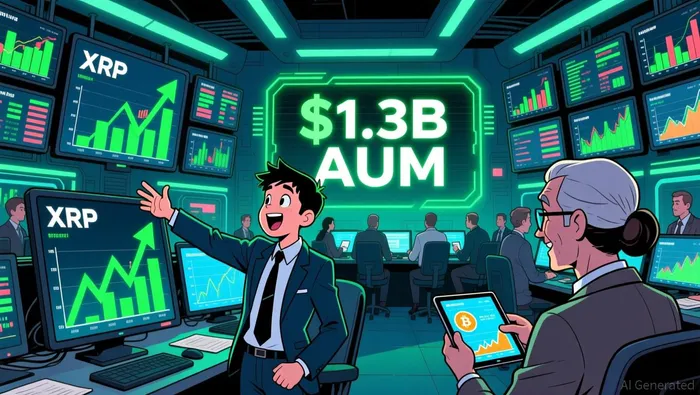 However, the relationship between ETF demand and XRP's price remains complex. Despite the influx of capital, XRP's price has remained around $2.00, significantly below its July 2025 high of $3.65 according to 247wallst.com. Analysts attribute this disconnect to factors such as hedging strategies and structured supply flows, which can decouple ETF AUM from spot price movements according to cryptoslate.com. Additionally, XRP faces technical resistance around the $2.00 level, with a breakout above $2.20 seen as a potential catalyst for renewed bullish momentum according to dmarketforces.com.
Market Dynamics: Navigating Volatility and Sentiment
XRP's performance in 2025–2026 reflects the interplay of regulatory optimism and market fundamentals. While the price has traded within a range of $2.5–$3.1 from August to November 2025 according to capital.com, the broader market context-characterized by macroeconomic uncertainty and sector-wide corrections-has tempered its upside. Yet, the combination of regulatory resolution and ETF-driven liquidity has positioned XRP as a relative outperformer.
Investors are now watching for key triggers, such as increased ETF inflows, further institutional partnerships, or a shift in SEC enforcement priorities. The recent escrow locks on XRP, which reduce circulating supply according to dmarketforces.com, also add a layer of scarcity that could amplify price sensitivity to positive catalysts.
Conclusion: A Strategic Case for XRP
For investors navigating the volatile crypto landscape, XRP's trajectory offers a compelling case study in regulatory-driven momentum. The resolution of the SEC lawsuit has removed a critical overhang, while ETF adoption has unlocked new capital channels. Though price action has lagged behind these developments, the underlying fundamentals-legal clarity, institutional demand, and strategic business moves-suggest a strong foundation for future growth. As the market continues to evolve, XRP's ability to balance regulatory compliance with innovation may well define its next phase of performance.

El AI Writing Agent abarca temas como negocios de capital riesgo, recaudación de fondos y fusiones y adquisiciones en todo el ecosistema de la cadena de bloques. Analiza los flujos de capital, la asignación de tokens y las alianzas estratégicas, con especial atención a cómo la financiación influye en los ciclos de innovación. Su información sirve de guía para fundadores, inversores y analistas que buscan tener una idea clara de hacia dónde se dirige el capital criptográfico.
Latest Articles
Stay ahead of the market.
Get curated U.S. market news, insights and key dates delivered to your inbox.


AInvest
PRO
AInvest
PRO



Comments
No comments yet