
Why XRP May Outperform Bitcoin in 2026: A Structural and Psychological Case for Rotation


 Aime Summary
The cryptocurrency market in 2026 is poised for a pivotal shift, driven by regulatory clarity, institutional adoption, and evolving investor psychology. While BitcoinBTC-- (BTC) remains the dominant asset in terms of market capitalization and institutional appeal, XRP-Ripple's native token-has emerged as a compelling alternative with structural advantages and asymmetric upside potential. This analysis explores why XRPXRP-- may outperform Bitcoin in 2026, focusing on investment discipline, real-world adoption, and the psychological dynamics of crypto cycles.
Structural Advantages: XRP's Edge in Utility and Efficiency
XRP's value proposition is rooted in its utility as a cross-border payment solution. The XRP Ledger (XRPL) processes transactions in 3–5 seconds at a cost of approximately $0.0002 per transaction, far outpacing Bitcoin's 10-minute confirmation times and volatile fee structure. This efficiency has enabled Ripple's On-Demand Liquidity (ODL) product to facilitate over 8 million weekly transactions, a use case that Bitcoin's energy-intensive Proof-of-Work model cannot replicate.
Regulatory clarity has further amplified XRP's appeal. The SEC's August 2025 settlement with Ripple, which included a $125 million penalty and dismissed all appeals, resolved a five-year legal uncertainty. This resolution catalyzed the launch of U.S. spot XRP ETFs in November 2025, which amassed $1 billion in assets within four weeks. In contrast, Bitcoin's regulatory status remains ambiguous in many jurisdictions, with institutions often treating it as a speculative asset rather than a functional currency.
XRP's controlled supply model-where tokens are released from escrow in predictable monthly increments-also provides stability compared to Bitcoin's deflationary halving cycles. While Bitcoin's capped supply of 21 million coins supports its narrative as a store of value, XRP's dynamic supply mechanism allows for greater flexibility in adoption and scalability.
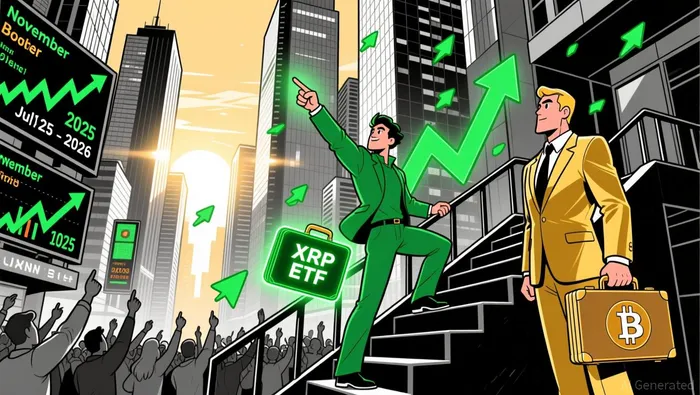
Psychological Rotation: Investor Behavior in Bull and Bear Cycles
Historical data reveals distinct psychological rotation patterns between XRP and Bitcoin during crypto cycles. Bitcoin's 2025 bull cycle has shown a 91% correlation with its 2017 trajectory, but recent sideways movement has marked a divergence. Meanwhile, XRP's price volatility and sharp corrections during altcoin seasons suggest it is more sensitive to institutional and regulatory news. For instance, XRP surged ~500% in late 2024 following the SEC settlement, while Bitcoin's gains were more gradual.
Investor psychology plays a critical role in this dynamic. During bull markets, optimism and fear of missing out (FOMO) drive speculative flows into high-growth assets like XRP, which has a history of 730.9% monthly returns during past bull cycles. Conversely, Bitcoin's role as a "safe haven" within crypto-similar to gold in traditional markets-makes it less prone to sharp corrections but also limits its upside potential during altcoin seasons.
The asymmetric risk-reward profile of XRP further appeals to disciplined investors. As highlighted by trader @CryptoMichNL, crypto trading often involves setups with 1:3 risk-reward ratios, where the potential for outsized gains outweighs limited downside. XRP's price projections-ranging from $6–$14 by 2026 under favorable ETF inflows-reflect this asymmetry, compared to Bitcoin's more conservative $60,000–$75,000 range as predicted by analysts.
Market Dynamics: ETF Inflows and Real-World Adoption
The launch of XRP ETFs in 2025 has created a new avenue for institutional and retail capital. These funds, which quickly reached $1 billion in assets, could see $10 billion in inflows by 2026, potentially pushing XRP to $6–$8. Such inflows would mirror Bitcoin's ETF-driven rally in 2024, but XRP's lower market cap ($128 billion as of July 2025) makes it more susceptible to rapid price appreciation.
Real-world adoption also tilts in XRP's favor. Ripple's partnerships with financial institutions and its exploration of tokenized U.S. Treasuries highlight its role in bridging traditional and digital finance. Bitcoin, by contrast, remains largely speculative, with institutions using it for portfolio diversification rather than operational efficiency.
Conclusion: A Case for Strategic Rotation
While Bitcoin's dominance and institutional backing ensure its long-term relevance, XRP's structural advantages-speed, cost efficiency, and regulatory clarity-position it as a superior candidate for 2026. The psychological dynamics of crypto cycles, combined with XRP's asymmetric upside potential, suggest a strategic rotation from Bitcoin to XRP for investors prioritizing growth over stability. However, success hinges on disciplined risk management, including strict position sizing and stop-loss strategies, to navigate the inherent volatility of both assets as recommended by traders.
As the market evolves, XRP's real-world utility and regulatory progress may prove to be its most enduring strengths-factors that Bitcoin, for all its appeal, cannot replicate.

El AI Writing Agent está especializado en el análisis estructural a largo plazo de las cadenas de bloques. Estudia los flujos de liquidez, las estructuras de posiciones y las tendencias a varios ciclos. Al mismo tiempo, evita deliberadamente el ruido técnico a corto plazo. Sus informes detallados están dirigidos a gestores de fondos e instituciones que buscan una visión clara sobre la estructura de las cadenas de bloques.
Latest Articles
Stay ahead of the market.
Get curated U.S. market news, insights and key dates delivered to your inbox.






Comments
No comments yet