
XRP News Today: XRP's SWIFT Replacement Dream vs. Volatility, Fading Adoption


 Aime Summary
Ripple's XRPXRP-- faces a pivotal moment as the cryptocurrency grapples with market volatility, regulatory developments, and ambitious claims about its potential to disrupt global financial systems. On November 21, 2025, XRP's price fell to $1.85, marking a significant drop below the $2 threshold and contributing to an 18% decline in the broader crypto market cap. The downturn came as institutional investors sought exposure to XRP through newly launched exchange-traded funds (ETFs), with Bitwise Asset Management's spot XRP ETFXRPI-- generating $22 million in trading volume and $105 million in inflows within hours of its NYSE Arca debut. Meanwhile, Grayscale's XRP Trust ETFXRPI-- received approval to launch on the New York Stock Exchange, signaling a shift in the firm's strategy toward exchange-traded products.
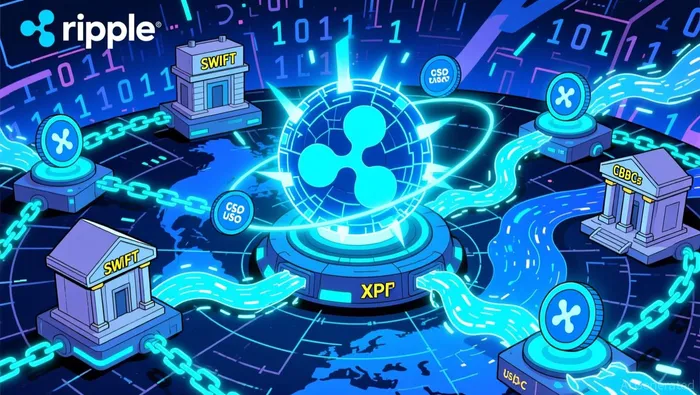 Ripple's chief technology officer, David Schwartz, has argued that XRP was designed to replace traditional cross-border payment systems like SWIFT, a claim that has gained renewed scrutiny amid the token's recent price struggles. In a bold forecast, Ripple posits that XRP could capture 14% of SWIFT's $150 trillion annual market by 2030, a target that would require channeling $21 trillion through the XRP Ledger (XRPL) annually. Such a scenario hinges on a liquidity pool of $700 billion, assuming each XRP token turns over 30 times a year, which would theoretically push the token's price to around $11.90. However, achieving this vision faces significant hurdles.
The XRPL's user activity has plummeted, with active addresses collapsing by 94% from 105,000 to 6,000 by June 2025, despite Ripple's institutional partnerships. This decline highlights the gap between high-level deals and everyday adoption. Competitors like SWIFT are testing alternatives, including Hedera's Hashgraph and stablecoins such as USDCUSDC--, which offer instant settlement without crypto's volatility. Central bank digital currencies (CBDCs) also pose a threat, as regulators increasingly favor stable, low-risk solutions for large-scale treasury operations. Meanwhile, other blockchain networks, including StellarXLM-- and Visa's private tokenization platforms, are vying for institutional traction with similar value propositions.
Ripple's strategy relies on XRP's utility as a liquidity bridge, with fees burned and tokens locked for liquidity to drive long-term value. Yet, the token's annualized volatility of 91% in 2025 remains a critical barrier. For XRP to succeed, it must scale adoption while maintaining decentralization and proving its cost-efficiency against legacy systems. The next few years will determine whether Ripple's vision is a realistic roadmap or an aspirational narrative.

Stay ahead of the market.
Get curated U.S. market news, insights and key dates delivered to your inbox.
AInvest
PRO
AInvest
PRO



Comments
No comments yet