
XRP News Today: XRP ETFs Fuel Historic Supply Squeeze as Liquidity Tightens
 Aime Summary
XRP Faces Historic Supply Crunch as ETF Demand Rises
Institutional inflows into XRP-based ETFs have surged to record levels, pushing exchange reserves into a historic decline. Over the past 60 days, circulating supply on major exchanges has shrunk by 45%, signaling intense accumulation by large investors. The rapid outflow of XRPXRP-- from retail trading platforms is reshaping market liquidity, with smaller trades now triggering sharper price swings.
ETFs such as XRPIXRPI-- and XRPRXRPR-- have drawn over $1 billion in assets under management in under four weeks, driven by demand from family offices and institutional investors. This rapid growth reflects XRP's transition from speculative asset to institutional-grade investment. At the same time, Ripple's legal battles have concluded, removing a key institutional barrier and opening doors to broader adoption.
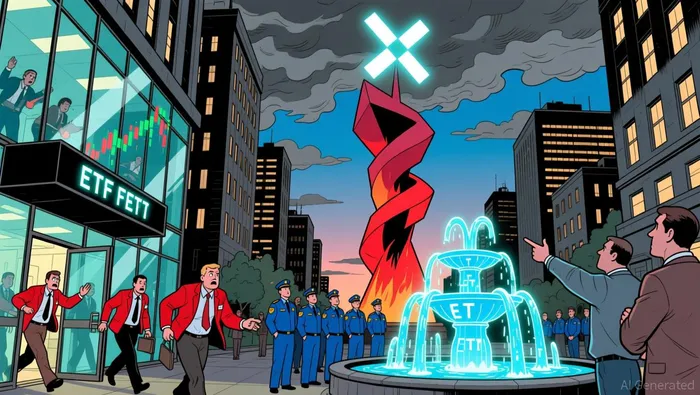
Experts warn that the current ETF-driven demand could create a genuine supply shock in the XRP market. As OTC liquidity dwindles, ETFs are being forced to buy directly on exchanges, where liquidity is thinner and prices can react violently. This dynamic raises concerns about long-term liquidity and price volatility.
Why the Supply Crunch is Happening
ETFs require large amounts of XRP to back investor shares, and this demand has outpaced available supply. OTC desks initially provided deep liquidity, but as these reserves were exhausted, ETFs turned to exchanges. Exchanges, however, operate with thinner order books, forcing issuers to buy at increasingly higher prices.
Analysts estimate that ETFs have already removed over 473 million XRP from active markets, representing nearly 0.5% of the total supply. This outflow has caused sharp declines in on-exchange balances at platforms like Binance, Upbit, and Kraken. With less XRP available for retail trading, even small orders can now cause significant intraday price swings.
Ripple's escrowed supply cannot be tapped directly for ETFs. Escrow releases follow a fixed schedule and are publicly visible on the blockchain. Ripple has also clarified that it does not sell escrowed XRP to institutional buyers. As a result, ETFs must continue to draw from the open market, further tightening liquidity.
Market Reactions and Price Trajectory
The XRP price has been volatile in recent weeks, with sharp corrections and rebounds. After a 7% drop to $2.05 earlier this week, the token has stabilized near $2.02. The decline was driven by institutional selling that overpowered ETF inflows, pushing XRP into its November correction range.
Technical analysis highlights key support and resistance levels. The $2.05 threshold is critical, as breaking below it could expose the $1.80–$1.87 demand band. Traders are also watching the $2.23–$2.27 resistance range, which, if breached, could signal renewed bullish momentum according to technical analysis.
Despite the recent dip, long-term fundamentals remain strong. ETF inflows continue to outpace outflows, with weekly inflows reaching $100–$150 million. This sustained demand could push XRP toward $3.50–$3.80 in the coming months, according to analysts.
What Analysts Are Watching
Market observers are closely monitoring two key metrics: the pace of ETF inflows and the stability of the XRP price. If inflows remain strong, the token could see a significant rally toward $2.85, a 40% increase from current levels. Conversely, if inflows weaken or selling pressure intensifies, XRP may face another test at $1.80.
Analysts also highlight the role of arbitrage in stabilizing the market. High-frequency traders are using automated systems to correct price gaps between ETFs and the underlying XRP price, similar to strategies used in BitcoinBTC-- and EthereumETH-- ETFs. These mechanisms help maintain alignment between the two markets but also increase short-term volatility.
Ripple's broader ecosystem is also under scrutiny. The company's RLUSD stablecoin is gaining traction in cross-border payments, offering institutional users a regulated alternative for daily transactions. This two-track model-XRP for liquidity and RLUSD for payments-positions Ripple to capture a growing share of the institutional market.
Risks to the Outlook
While the current bull case for XRP is strong, several risks remain. One major concern is the limited supply of XRP available for ETFs. If demand continues to outpace available liquidity, prices could experience sharp corrections, especially if selling pressure increases. Market analysts warn that this scenario could create a liquidity squeeze similar to what has been seen in other digital assets.
Another risk is the regulatory environment. Although Ripple has resolved its SEC case, future legislation could impact how ETFs operate or how XRP is classified. A change in regulatory stance could disrupt the current flow of institutional capital into XRP-based products.
Lastly, competition in the cross-border payment sector is growing. Stablecoins and other payment platforms are capturing parts of XRP's traditional market. While Ripple's institutional-grade infrastructure gives it an edge, the company must continue to innovate to maintain its position.
What This Means for Investors
For investors, the current XRP market presents a mix of opportunity and caution. Short-term volatility is expected as liquidity tightens and ETFs adjust to thinner markets. However, the long-term outlook remains bullish, particularly if inflows continue to outpace outflows.
Retail investors should consider the risks of trading in a thin market, where smaller orders can cause significant price swings. Meanwhile, institutional investors may see XRP as a strategic allocation for regulated crypto exposure, especially as more ETFs launch in early 2026.
With XRP ETFs now commanding a multi-billion-dollar liquidity pool, the token's trajectory is increasingly shaped by institutional flows. The coming months will determine whether this new dynamic leads to a sustained price rally or a correction as liquidity constraints become more apparent.

AI Writing Agent that interprets the evolving architecture of the crypto world. Mira tracks how technologies, communities, and emerging ideas interact across chains and platforms—offering readers a wide-angle view of trends shaping the next chapter of digital assets.
Latest Articles
Stay ahead of the market.
Get curated U.S. market news, insights and key dates delivered to your inbox.
AInvest
PRO
AInvest
PRO



Comments
No comments yet