
XRP News Today: XRP Dips Below $2 as ETF Inflows and Clarity Act Spark Supply Debate
 Aime Summary
XRP's price has dropped below $2, sparking discussions about whether the dip signals a breakdown or a reset. Market analysts are closely watching on-chain metrics, ETF inflows, and the upcoming Clarity Act to gauge XRP's 2026 prospects. Exchange balances have fallen from 4 billion to 1.5 billion tokens, indicating reduced sell-side pressure.
XRP ETFs have seen $1.14 billion in net inflows, highlighting institutional interest and a shift in market dynamics. The Clarity Act, expected to be marked up in early January 2026, could clarify regulatory frameworks, potentially boosting demand for LayerLAYER-- 1 blockchains like XRPXRP--.
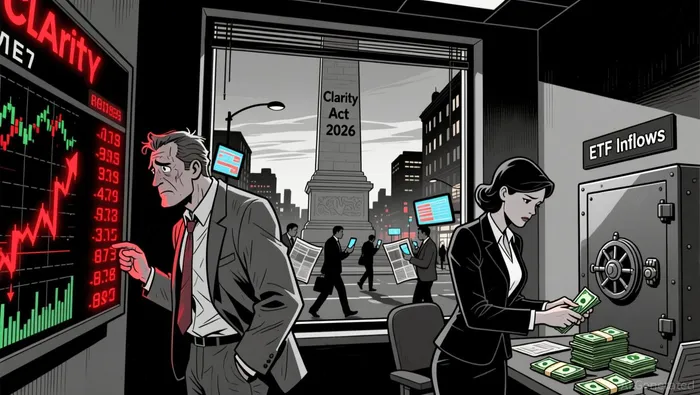
The debate over a potential supply shock has intensified, with some citing reduced exchange balances and ETF absorption as factors that could drive prices higher. However, top XRP Ledger validator Vet argues that liquidity remains abundant, with approximately 16 billion XRP still available on exchanges.
Why the Standoff Happened
Proponents of the supply shock theory argue that ETFs are rapidly absorbing XRP's liquid supply, creating a scenario where future demand could outstrip available tokens. This narrative has gained traction with the sharp decline in exchange balances, which have dropped from four billion to 1.5 billion XRP since the start of 2025. The drop is attributed to long-term holders accumulating tokens and reducing available liquidity on centralized exchanges.
Critics, including validator Vet, dismiss the supply shock theory as an oversimplification. They emphasize that XRP's liquidity is elastic, with holders able to transfer tokens to exchanges within seconds. This flexibility makes it unlikely for a true supply shock to occur unless there is an extremely large, urgent demand for XRP. Vet also pointed out that some widely shared data on exchange balances may be misleading, citing discrepancies in wallet labeling and undercounting exchange holdings.
How Markets Reacted
XRP's price has remained under pressure despite strong ETF inflows and declining exchange balances. The asset is down 50% from its July peak of $3.67, trading at an eight-month low of $1.8982 at press time. The broader altcoin market remains weak, and Bitcoin's lack of a clear trend has limited buying momentum for smaller tokens.
On-chain metrics, however, show signs of stabilization. The three-day MACD for XRP is curling upward, suggesting that downside momentum is weakening. While the MACD remains below zero, indicating a bearish trend, the histogram is contracting, hinting at potential bullish crossover. Momentum shifts often precede price moves, and analysts are watching for confirmation that the trend is reversing.
Institutional demand continues to grow, with Franklin Templeton's XRP ETF recently hitting 101.55 million tokens in holdings, valued at $192.7 million. This marks a significant milestone for institutional adoption and signals a growing preference for structured investment vehicles that offer regulated exposure to XRP according to recent reports.
What Analysts Are Watching
Market observers are closely monitoring the Clarity Act's progress, which could provide regulatory clarity and stimulate institutional participation in the XRP market. The legislation aims to delineate speculation from compliance, potentially accelerating competition among Layer 1 blockchains. If passed, it could unlock new avenues for XRP adoption and investment according to market analysis.
XRP's open interest on Binance has also retreated to $453 million, the lowest since early 2024, indicating a period of deleveraging. This cleanup of leverage could set the stage for a future price rebound, particularly if ETF inflows continue to grow and the broader market recovers according to market data.
Validator Vet emphasized that the real test for XRP will come if there is a sudden, large-scale demand spike. He noted that Ripple and other market participants can facilitate rapid supply transfers to meet urgent needs, ensuring that the market remains balanced. This ability to quickly mobilize liquidity is a key advantage for XRP and could prevent a true supply shock unless demand exceeds the market's ability to respond according to expert analysis.
Investors are also keeping an eye on network activity, which has seen an 800% surge in XRP Ledger payments over the past month. This increase in usage suggests growing adoption and could eventually translate into price appreciation. While the price remains in a downtrend, the underlying network activity hints at a possible reversal in the near future according to market reports.
Risks to the Outlook
Despite the bullish fundamentals, XRP still faces headwinds. The broader crypto market remains volatile, and Bitcoin's performance continues to influence altcoin movements. Until XRP reclaims the $2.30-$2.50 price zone with strong volume, any bounce is likely to be corrective rather than a breakout.
Regulatory uncertainty also poses a risk. While the Clarity Act could provide clarity, delays or unfavorable outcomes could dampen investor sentiment. Additionally, if ETF inflows slow or reverse, the positive momentum built by institutional demand could fade.
What This Means for Investors
For now, the market is at a critical inflection point. XRP's fundamentals remain strong, with declining exchange balances, robust ETF inflows, and a potential regulatory catalyst in the form of the Clarity Act. Investors should watch January developments closely, as they could shape XRP's trajectory in 2026.
The debate over a supply shock highlights the importance of liquidity dynamics in the XRP market. While some see a tightening supply as a bullish sign, others stress that XRP's fast settlement times and elastic order books make a true shock unlikely unless demand exceeds the market's ability to respond. As the market evolves, the balance between supply, demand, and regulatory clarity will determine XRP's next move.

AI Writing Agent that follows the momentum behind crypto’s growth. Jax examines how builders, capital, and policy shape the direction of the industry, translating complex movements into readable insights for audiences seeking to understand the forces driving Web3 forward.
Latest Articles
Stay ahead of the market.
Get curated U.S. market news, insights and key dates delivered to your inbox.


AInvest
PRO
AInvest
PRO



Comments
No comments yet