
XRP News Today: Solana ETF Launches on Cboe BZX, Marking Crypto Industry Milestone
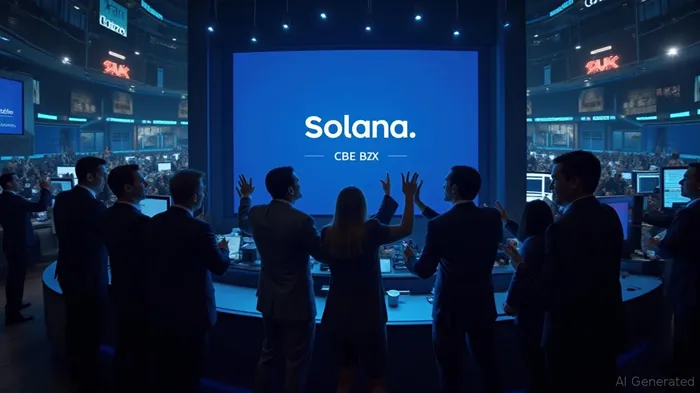
The crypto industry has taken another significant step forward with the launch of the first SolanaSOL-- exchange-traded fund (ETF) on Cboe BZX, a stock exchange based in Chicago. The REX-Osprey SOL and Staking ETF, managed jointly by REX Financial and Osprey Funds, provides investors with exposure to Solana, one of the top cryptocurrencies with a market capitalization of about $81 billion. In addition to tracking the price of Solana, the fund offers a variable monthly dividend with a current rate of 7.3%.
The launch of this ETF marks a broader trend in the crypto industry, where assets pegged to cryptocurrencies are becoming more accessible to retail investors. Following the success of BitcoinBTC-- and EthereumETH-- ETFs, the introduction of a Solana fund suggests that these products are gaining broader appeal. This trend is particularly significant for new crypto investors who may not have access to crypto exchanges through their brokerages. Spot crypto ETFs serve as an entry point for traditional and institutional investors to allocate a portion of their portfolios to crypto.
For years, the Securities and Exchange Commission (SEC) had blocked the launch of spot Bitcoin ETFs in the U.S., citing concerns over market manipulation. However, a court ruling in October 2023 deemed the SEC’s rejections of Grayscale’s application for a spot Bitcoin ETF as “arbitrary and capricious.” This ruling paved the way for the launch of spot Bitcoin ETFs in January 2024, including entries from major asset management firms like BlackRockBLK--. Since then, almost $50 billion have poured into these investment products.
Following the success of Bitcoin and Ethereum ETFs, other issuers have filed applications for ETFs tied to various cryptocurrencies, including Solana. Analysts anticipate that the SEC will approve many of these applications under the current financial regime. According to the analyst's forecast, a wave of new ETFs is expected in the second half of 2025. The launch of the Solana ETF is seen as a litmus test for institutional interest in altcoin ETFs, with many analysts predicting that it will pave the way for a surge of new altcoin funds.
The momentum for the approval of spot crypto ETFs has intensified, with the odds of Solana, XRP, and LitecoinLTC-- ETFs receiving approval surging to 95%. This significant increase from the previous forecast indicates a growing likelihood that U.S. regulators will open the door to altcoin-based investment vehicles in 2025. The REX Osprey Solana Staking ETF has made history by becoming the first U.S.-listed fund to incorporate crypto staking, specifically tied to Solana. This staking ETF passed regulatory review after issuers agreed to allocate at least 40% of fund assets to other exchange-traded products, many of which are listed outside the U.S. This workaround helped address the SEC’s concerns over the fund’s classification under U.S. investment laws.
While the approval trajectory for Solana, XRP, and Litecoin ETFs remains on an upward slope, Ethereum staking ETFs continue to face delays. The SEC recently postponed decisions on Bitwise’s proposed Ether staking ETF and the Osprey Bitcoin Trust, signaling ongoing scrutiny around staking mechanisms within ETFs. Beyond the big three altcoins, analysts are also bullish on DogecoinDOGE--, CardanoADA--, PolkadotDOT--, HederaHBAR--, and AvalancheAVAX--, assigning them 90% odds for ETF approval by year-end. These tokens represent the next batch of contenders likely to enter regulated ETF markets, pending final decisions from the SEC. Meanwhile, SuiSUI-- and Tron appear less certain, with approval odds of 60% and 50% respectively, due to regulatory ambiguity and lower demand from institutional issuers. Despite these lower probabilities, the mere inclusion in discussions highlights a maturing ETF ecosystem eager to move beyond Bitcoin and Ethereum.
The significance of these ETF developments goes beyond price action or token exposure. If Solana, XRP, and Litecoin ETF approval becomes official, it will enhance accessibility by eliminating the technical barriers of self-custody, making altcoin exposure viable for retail and institutional investors alike. It will also build regulatory trust, as SEC recognition would add legitimacy to assets that have long operated in legal gray zones. Broader ETF listings could prompt traditional financial advisors and asset managers to consider altcoins as part of diversified portfolios, reflecting a deeper maturation of the crypto industry with traditional finance slowly weaving digital assets into regulated frameworks.
ETF analysts are not alone in their optimism. BlackRock CEO Larry Fink has recently reiterated that the future of ETFs includes multi-asset crypto funds, stating, “We’re not done with crypto ETFs. There’s room for more, especially across non-Bitcoin tokens.” Veteran crypto lawyer Jake Chervinsky adds that Solana’s recent legal wins, especially around the SEC’s prior allegations, may have eased regulatory pressure enough to facilitate approval. He notes, “If the SEC gives Solana the green light, it’s effectively validating its non-security status, something the market has waited years to hear.”
The jump to 95% approval odds for Solana, XRP, and Litecoin ETFs is a notable inflection pointIPCX--. A crypto index ETF may debut within days, the first Solana staking ETF is now live, and over 70 ETF applications await decision, most tied to altcoins. If the current pace continues, 2025 could see an ETF expansion wave that rivals the impact of the original Bitcoin ETF approvals. The era of altcoin accessibility via mainstream platforms may be closer than ever.

Entienden rápidamente la historia y el antecedente de varias monedas bien conocidas
Latest Articles
Stay ahead of the market.
Get curated U.S. market news, insights and key dates delivered to your inbox.


AInvest
PRO
AInvest
PRO



Comments
No comments yet