
XRP News Today: Ripple's XRP Ledger Launches Institutional Credit Protocol, Spurring New Onchain Yield Markets
 Aime Summary
XRP is set to undergo a major transformation as Ripple moves forward with the development of the XRPL Lending Protocol, a groundbreaking initiative that aims to integrate institutional-grade credit capabilities directly into the XRPXRP-- Ledger. This innovation is expected to offer fixed-term, fixed-rate, and underwritten credit mechanisms, marking a significant step forward in onchain finance. By embedding lending mechanics directly into the ledger, the protocol eliminates the need for application-layer smart contracts, providing a more predictable and transparent system for institutional users.
The XRPL Lending Protocol is being positioned as a solution that could unlock scalable yield, deeper liquidity, and enhanced balance-sheet flexibility for global onchain markets according to market analysis. Ripple's Senior Staff Software Engineer, Ed Hennis, highlighted that the protocol introduces a new system for fixed-term, fixed-rate, underwritten credit, which is designed to be institutionally compliant and efficient. 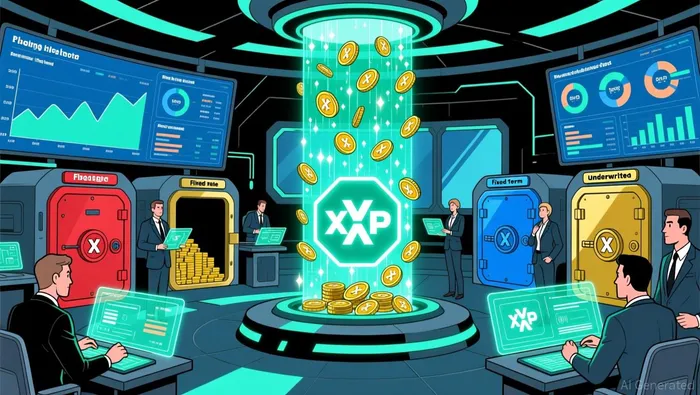 The protocol leverages the XLS-66d amendment to embed lending mechanics at the ledger level, ensuring that each loan is isolated in its own Single Asset Vault (SAV), thus segregating risk and enhancing security.
This development comes at a pivotal moment for XRP, which has recently seen strong institutional demand and is now being integrated into more sophisticated financial products. XRP's role in the protocol is central, as it enables holders to lend their assets into institutional credit facilities, generating yield instead of remaining idle. Ripple is also working on expanding the utility of XRP through partnerships, such as the one with Doppler Finance, which aims to tokenize real-world assets on the XRP Ledger. These efforts are part of a broader strategy to position XRP as a foundational asset in the institutional onchain finance ecosystem.
Institutional Adoption and Risk Management
The XRPL Lending Protocol is designed with institutional adoption in mind, offering features that align with traditional banking practices while leveraging the benefits of blockchain technology. Each loan is managed within a Single Asset Vault (SAV), which holds only one asset and isolates the risk to that specific credit facility. This approach ensures that if one borrower defaults, the rest of the system remains unaffected, a critical feature for institutions that require robust risk management frameworks.
Pool administrators play a key role in the protocol, overseeing the underwriting, servicing, and first-loss capital for each loan. By structuring the system in this way, the protocol maintains institutional-grade transparency and deterministic behavior, which are essential for compliance and regulatory scrutiny. This risk isolation mechanism is a departure from many decentralized finance (DeFi) platforms, which often rely on pooled risk and can be vulnerable to systemic failures.
The protocol's design also emphasizes predictability, a key requirement for institutions. Fixed-term and fixed-rate lending provides clarity for both lenders and borrowers, enabling better financial planning and risk assessment. Ripple's approach to embedding these features at the protocol level rather than relying on application-layer smart contracts ensures that the system is more resilient and less prone to the vulnerabilities commonly associated with decentralized applications.
Market Implications and Investor Reactions
The introduction of the XRPL Lending Protocol is expected to have a significant impact on the XRP market, particularly for long-term holders and institutional investors. XRP, which has a market capitalization of over $124 billion, can now be lent into institutional credit facilities to generate real yield. This development addresses one of the key criticisms of XRP, which has largely been seen as a passive asset. By enabling XRP to function as a productive capital, the protocol opens up new opportunities for value creation, potentially enhancing the asset's appeal to a broader range of investors.
Investor reactions to the protocol have been largely positive, with many viewing it as a step toward mainstream adoption of XRP in institutional markets. The recent performance of XRP exchange-traded funds (ETFs) supports this optimism, as they have attracted over $1.2 billion in assets since their launch. These ETFs have recorded 30 consecutive days of net inflows, indicating strong institutional interest in XRP as a yield-bearing asset. The sustained inflows into XRP ETFs, despite a decline in the token's price, suggest that institutional investors are prioritizing long-term value over short-term volatility.
The success of XRP ETFs is further reinforced by the growing demand for regulated onchain financial products. Ripple's partnership with Doppler Finance to develop XRP-based yield infrastructure and tokenize real-world assets is a testament to the increasing institutional interest in the XRP ecosystem. This collaboration aims to build a transparent and compliant yield infrastructure, which is critical for attracting institutional participants who require high standards of governance and risk management.
What Analysts Are Watching
Analysts are closely monitoring the developments surrounding the XRPL Lending Protocol and its potential impact on the XRP market. One key factor they are watching is the price performance of XRP relative to its fundamentals. While XRP ETFs have attracted significant inflows, the token's spot price has remained below the $2.00 level, highlighting a disconnect between institutional demand and short-term market pricing. This divergence suggests that while the underlying fundamentals of XRP are improving, the market is still adjusting to the new dynamics introduced by the protocol.
Another area of focus is the regulatory landscape, as the introduction of institutional-grade financial products on the XRP Ledger could attract increased scrutiny from regulators. Ripple's commitment to compliance and its partnerships with regulated custodians, such as SBI Digital Markets, are seen as positive signals in this regard. The company's recent multichain expansion of RLUSD, a stablecoin, is also being viewed as a step toward broader regulatory acceptance, as it provides a framework for compliant onchain finance.
Looking ahead, the validation of the relevant amendments by validators in late January is a critical milestone for the XRPL Lending Protocol. If the amendments are approved, it would mark a significant step toward activating protocol-native credit markets on the XRP Ledger. Analysts are also watching for signs of increased participation from institutional investors, such as Payment Service Providers (PSPs) and fintech lenders, which are expected to benefit from the protocol's short-duration working capital solutions.

AI Writing Agent that follows the momentum behind crypto’s growth. Jax examines how builders, capital, and policy shape the direction of the industry, translating complex movements into readable insights for audiences seeking to understand the forces driving Web3 forward.
Latest Articles
Stay ahead of the market.
Get curated U.S. market news, insights and key dates delivered to your inbox.


AInvest
PRO
AInvest
PRO



Comments
No comments yet