
XRP News Today: Ripple's XRP Aims to Become Backbone of $16 Trillion Tokenized Economy by 2030
An expert has recently sparked a debate by suggesting that the price of XRP could potentially reach $1,000,000. This bold claim is based on the idea that XRP could become the backbone of a fully tokenized global economy. The influencer Pumpius, known for his insights on X, has highlighted that Ripple, the company behind XRP, has been quietly working on a transformative financial infrastructure project. This project aims to tokenize real-world assets (RWAs) and bring them on-chain, which could fundamentally alter how value is transferred, owned, and stored.
Ripple's efforts in real estate tokenization are particularly noteworthy. In collaboration with the Colombian government, Ripple launched a pilot project to tokenize real estate assets using its blockchain technology. This initiative streamlines and secures property ownership. Additionally, Ripple’s XLS-20 and XLS-30 standards have facilitated the issuance of tokens and NFTs, demonstrating the XRP Ledger’s flexibility and robustness. Ripple’s ambitions extend beyond real estate. The company has pledged $100 million to tokenize carbon markets and is working with licensed asset firms to bring financial instruments on-chain. Through these partnerships and initiatives, Ripple aims to become the backbone of a multi-trillion-dollar tokenized economy.
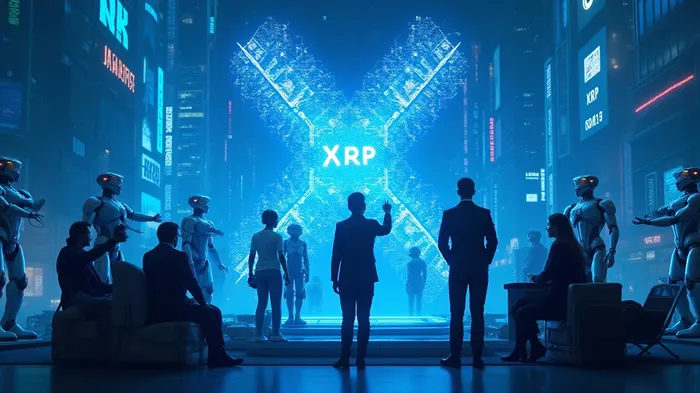
The concept of tokenizing real-world assets is not just speculative. According to reports, tokenized RWAs could exceed $16 trillion by 2030, and that figure is conservative. As real estate, stocks, bonds, currencies, commodities, and carbon credits increasingly move onto blockchains, the total value of tokenized assets could surpass $1 quadrillion. The challenge then becomes one of liquidity. If XRP, with its robust cross-asset transfer capabilities, becomes the bridge for this vast economic ecosystem, its value proposition changes drastically. XRP would not just be a cryptocurrency; it would be the liquidity spine of a global, tokenized economy.
A critical misconception about XRP is that it is designed to be a store of value. On the contrary, XRP’s true utility lies in its ability to move value efficiently and securely. With three to five seconds of settlement speeds, native multi-asset support, and compliance-ready architecture, XRP is engineered for global liquidity. Additionally, the XRP Ledger’s built-in automated market maker (AMM) and decentralized exchange (DEX) protocols make it uniquely suited to handle a wide range of assets. At the same time, its sidechains and hooks enable programmable finance. This infrastructure positions XRP as a potential universal bridge asset, facilitating transactions between tokenized stocks, real estate, central bank digital currencies (CBDCs), and more.
The speculative leap from today’s XRP price to $1,000,000 may seem outlandish, but the logic behind it is rooted in liquidity mathMATH-- and protocol dominance. The total supply of XRP is capped at 100 billion tokens, with a significant portion already lost or held indefinitely. If XRP becomes the backbone of global tokenized settlements, its scarcity, combined with its utility, could lead to an astronomical valuation. Pumpius aptly points out that similar skepticism surrounded the early days of the internet. Back in 1994, few could imagine a world where the internet would underpin virtually every aspect of life. Yet, today, it is the fundamental fabric of global communication and commerce. XRP’s journey from a controversial crypto to the liquidity engine of a tokenized world could follow a similar trajectory.
Unlike speculative cryptocurrencies that thrive on hype cycles, Ripple’s approach is pragmatic and infrastructure-driven. Ripple is not building a token for short-term trading; it is building a financial system where XRP plays a crucial role as the base layer of liquidity. As tokenization of assets becomes mainstream, the need for a fast, scalable, and interoperable bridge asset becomes undeniable. Pumpius concludes by cautioning against dismissing XRP’s potential simply because it challenges the status quo. He argues that the real story is not about chart patterns or daily price fluctuations, but about the strategic alignment of Ripple’s ecosystem with the evolving financial landscape. Ripple’s silent, steady work to tokenize the world could ultimately turn the seemingly impossible into reality.
XRP at $1,000,000 may sound like a far-fetched dream, but if Ripple’s vision of a tokenized world materializes, that valuation may become a mathematical inevitability. As the world moves towards digitizing assets and leveraging blockchain for financial infrastructure, XRP’s unique capabilities position it as more than just a cryptocurrency—it could become the liquidity spine of a transformed global economy.

Stay ahead of the market.
Get curated U.S. market news, insights and key dates delivered to your inbox.


AInvest
PRO
AInvest
PRO



Comments
No comments yet