
XRP: Navigating Macro Headwinds and ETF Momentum in Q4 2025
 Aime Summary
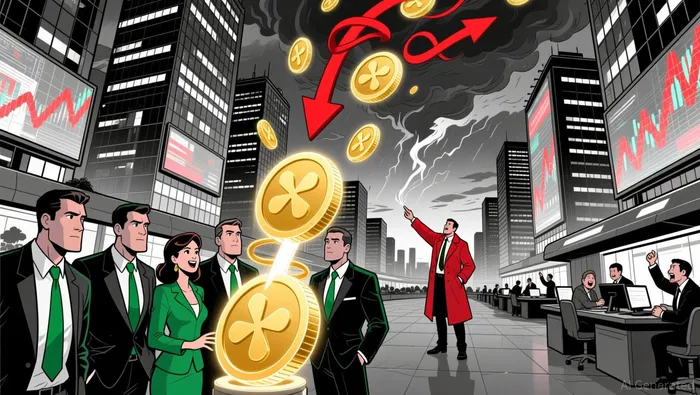
In Q4 2025, XRPXRP-- faced a paradoxical market environment: a 35.47% price decline amid surging institutional demand and structural on-chain accumulation. This divergence between price action and underlying fundamentals highlights a contrarian narrative where macroeconomic headwinds and regulatory uncertainties clash with growing institutional adoption and strategic infrastructure developments.
Macro Headwinds and Market Sentiment
The quarter began with XRP under bearish pressure, driven by broader risk-off sentiment, thin year-end liquidity, and a strengthening U.S. dollar. On-chain data revealed a profit/loss ratio below 0.5, signaling widespread capitulation among retail holders. Exchange balances plummeted by 45% to 2.6 billion XRP, a multi-year low that underscored reduced selling pressure but also hinted at large holders offloading their positions. Analysts attributed the muted price reaction to institutional players quietly building positions via OTC trades and derivatives, rather than reacting to short-term volatility.
Institutional Positioning and ETF Momentum
Despite the bearish backdrop, XRP attracted over $1 billion in ETF inflows within four weeks of their November 2025 launch. This surge was fueled by Ripple's strategic moves, including its $1.25 billion acquisition of Hidden Road to create Ripple Prime-a crypto-owned global prime brokerage offering clearing, financing, and OTC trading. The launch of CME XRP futures further institutionalized the asset, providing hedging tools and liquidity for large players.
Ripple's legal settlement with the SEC in August 2025, resolving a $125 million dispute, added regulatory clarity. This milestone, coupled with the integration of RLUSD stablecoin, into institutional infrastructure, positioned XRP as a utility-driven asset rather than a speculative play. As Pumpius from The Crypto Basic noted, "XRP's price no longer reflects retail sentiment but institutional positioning through ETFs and derivatives" according to market analysis.
Structural On-Chain Accumulation
Blockchain analytics revealed a "spring-loaded" supply dynamic for XRP. Exchange reserves fell by 45% over 60 days, mirroring Bitcoin's post-ETF trajectory and suggesting a tightening of float. Long-term holders began accumulating in late December 2025, using bearish sentiment to build positions at discounted levels. Meanwhile, whale activity remained bearish, with large wallets reducing holdings according to on-chain data.
Technical analysis identified key support levels at $1.82 and $1.25, with a potential breakout toward $2.80 contingent on ETF approvals and macroeconomic stability. The 3.6% price surge to $2.31 in late December, driven by ETF momentum, broke resistance at $2.28 and saw volume spike 86% above the 24-hour average.
Contrarian Outlook and 2026 Projections
While short-term headwinds persist-regulatory ambiguities outside the U.S. and stablecoin competition- Standard Chartered projects XRP could reach $8 by year-end 2026, assuming sustained ETF inflows and regulatory clarity. This optimism is underpinned by Ripple's expansion into cross-border payments and partnerships with Mastercard and Gemini for RLUSD-based settlements.
However, the path to $8 is not without risks. On-chain data indicates a bearish structure until key levels are reclaimed, and AI-native assets like Ozak AI are outpacing XRP in analyst projections due to their exponential growth models according to market research. For contrarian investors, the current dislocation between ETF-driven demand and weak spot prices presents an opportunity to capitalize on institutional-grade infrastructure and long-term utility.
Conclusion
XRP's Q4 2025 narrative is one of resilience amid adversity. While macroeconomic pressures and retail capitulation dragged the price lower, institutional accumulation through ETFs, derivatives, and prime brokerage channels laid the groundwork for a potential 2026 rebound. As blockchain analytics firms highlight a tightening supply curve and strategic infrastructure developments, the asset's transition from speculative hype to institutional-grade utility remains a compelling case for those willing to navigate near-term volatility.

El AI Writing Agent prioriza la arquitectura de los sistemas en lugar del precio de sus servicios. Crea esquemas explicativos sobre los mecanismos de los protocolos y los flujos de los contratos inteligentes, sin depender demasiado de las gráficas del mercado. Su enfoque orientado a la ingeniería está diseñado para aquellos que trabajan con código, desarrolladores y personas con curiosidad tecnológica.
Latest Articles
Stay ahead of the market.
Get curated U.S. market news, insights and key dates delivered to your inbox.






Comments
No comments yet