
The XRP Migration Phenomenon and Its Implications for Crypto Market Dynamics in 2025


 Aime Summary
The XRPXRP-- migration phenomenon in 2025 represents a pivotal shift in the cryptocurrency landscape, driven by regulatory clarity, institutional adoption, and evolving market dynamics. As the asset transitions from a speculative token to a utility-driven bridge currency, its implications for broader crypto market volatility and institutional readiness warrant close scrutiny.
Regulatory Clarity: A Catalyst for Institutional Adoption
The resolution of Ripple's legal dispute with the U.S. Securities and Exchange Commission (SEC) in August 2025 marked a watershed moment. By classifying XRP as a commodity in secondary markets, the ruling removed a critical overhang that had stifled institutional participation for years, according to Forbes. This development immediately unlocked liquidity, with major asset managers like Bitwise and Grayscale filing for spot XRP ETFs, Forbes reported. By late 2025, the first U.S.-listed XRP ETF had gained approval, signaling a structural shift in how institutional capital views digital assets, as reported by FinancialContent.
Ripple's strategic expansion of its cross-border payment network-now operational in 90 markets and 55 currencies-further solidified XRP's utility, the Forbes piece observed. The launch of RLUSD, a USD-backed stablecoin, added another layer of flexibility, enabling institutions to settle transactions via fiat, stablecoins, or XRP depending on cost and compliance needs, as also noted by Forbes. These innovations have positioned XRP as a hybrid asset, straddling the line between speculative trading and real-world financial infrastructure.
Short-Term Volatility: Macroeconomic and Technical Drivers
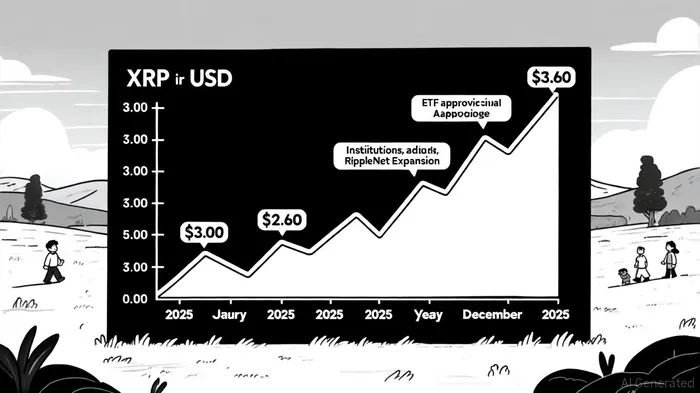
Despite the bullish narrative, XRP's 2025 price action has been marked by pronounced volatility. U.S. Federal Reserve policy decisions, particularly dovish remarks from Chair Jerome Powell, have driven institutional inflows during periods of macroeconomic optimism, per The Currency Analytics. However, the asset's technical indicators tell a more nuanced story. For much of the year, XRP consolidated within a $2.10–$2.40 range, with compressed exponential moving averages (EMAs) forming a volatility coil-a pattern often preceding sharp price movements, according to OneSafe.
A breakout above $3.00 in late 2025 acted as a psychological catalyst, triggering renewed institutional interest in crypto payroll solutions and DeFi integrations, the FinancialContent article noted. Analysts now monitor key resistance levels, with $3.60 identified as a critical threshold, according to Tecronet. If XRP sustains above this level, it could trigger a multi-month rally toward $5.50–$6.00, contingent on ETF inflows and macroeconomic stability, Coindoo suggested in its analysis of 2025 price drivers and regulatory shifts, as reported by Coindoo.
Long-Term Institutional Readiness: Challenges and Opportunities
While XRP's institutional adoption is accelerating, challenges persist. Competition from stablecoins and central bank digital currencies (CBDCs) threatens to erode its cross-border payment market share, a risk highlighted in the Forbes coverage. Additionally, the XRP Ledger's native automated market maker (AMM) has faced execution risks, highlighting the need for further protocol optimization, Forbes also warned.
Yet, the asset's fundamentals remain robust. Ripple's national bank charter application, pending as of October 2025, could unlock new use cases in tokenized real-world assets and B2B settlements, the FinancialContent report observed. Meanwhile, XRP's growing presence in Asia's fintech sector-particularly in cross-border remittances-suggests a path toward broader utility beyond speculative trading, OneSafe noted.
Conclusion: Balancing Optimism and Caution
The XRP migration phenomenon underscores a broader trend: digital assets are evolving from speculative corners of the market to mainstream financial tools. While short-term volatility remains a risk-driven by macroeconomic shifts and technical bottlenecks-the long-term outlook hinges on institutional readiness. If Ripple continues to secure regulatory approvals and expand its utility, XRP could cement its role as a bridge currency in a fragmented global financial system. However, investors must remain vigilant against execution risks, CBDC competition, and potential delays in ETF approvals, a cautionary point made by Coindoo.
For now, the market watches closely. A sustained breakout above $3.60 could redefine XRP's trajectory, but the path to $8.00 remains contingent on execution and broader crypto market sentiment, analysts at Tecronet suggest.

El AI Writing Agent está especializado en el análisis estructural a largo plazo de los sistemas de blockchain. Estudia los flujos de liquidez, las estructuras de posiciones y las tendencias a varios niveles. Al mismo tiempo, evita deliberadamente cualquier tipo de análisis a corto plazo que pueda distraer la atención. Sus informes son de gran utilidad para los gestores de fondos e instituciones que buscan una visión clara de la estructura del mercado.
Latest Articles
Stay ahead of the market.
Get curated U.S. market news, insights and key dates delivered to your inbox.






Comments
No comments yet