
XRP's Market Cap Potential in Light of Gold's Record $765B Surge


 Aime Summary
Gold's Surge: A Timeless Safe Haven in a Volatile World
Gold's recent $765 billion market cap spike on November 10, 2025, underscores its enduring role as a hedge against macroeconomic uncertainty. According to a report by The Cryptobasic, the price per ounce jumped 2.85% to $4,115, translating to a total valuation of $28.616 trillion for the world's 6.954 billion ounces of above-ground reserves, as The Cryptobasic explains. This surge occurred amid rising geopolitical tensions and inflationary pressures, reinforcing gold's status as a "flight-to-quality" asset.
Lundin Gold Inc.'s Q3 2025 results further highlight gold's resilience. The company sold 124,911 ounces at an average price of $3,634, generating $447 million in revenue, as Investing News reports. However, gold's scalability is inherently constrained by its physical scarcity. Unlike digital assets, its market cap growth relies solely on price appreciation, notNOT-- utility-driven adoption.
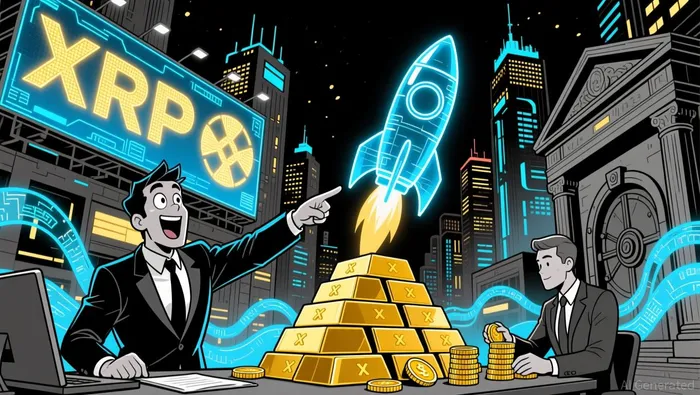
XRP's Momentum: Institutional Validation and Real-World Utility
XRP's recent $138.68 billion market cap milestone marks a paradigm shift in institutional perception. A $500 million strategic investment in Ripple at a $40 billion valuation-led by Citadel Securities and Fortress Investment Group-has signaled growing confidence in the XRP Ledger's role in cross-border settlement and institutional crypto liquidity, as FinBold reports. This capital inflow, coupled with XRP's price climbing to $2.30, reflects a broader acceptance of blockchain-based solutions in finance.
The Mastercard settlement pilot on the XRP Ledger further demonstrates XRP's utility. By enabling credit card transactions to settle in 3–5 seconds using RLUSD (a stablecoin issued by Ripple), the project highlights XRP's potential to disrupt legacy payment systems, as FinBold reports. Short-term price targets of $2.40–$2.44 now hinge on whether XRP can transition from reactive to constructive market structure, a shift that could unlock billions in additional liquidity.
Valuation Scalability: Gold's Constraints vs. XRP's Leverage
Gold's market cap scalability is fundamentally limited by its physical nature. With 6.954 billion ounces in circulation, its valuation grows only through price increases, which are subject to supply-demand imbalances and macroeconomic cycles. In contrast, XRP's scalability is driven by its utility in decentralized finance (DeFi) and institutional infrastructure. The XRP Ledger's ability to process 1,500 transactions per second at near-zero cost positions it as a scalable alternative to traditional settlement systems, potentially attracting exponential growth in transaction volume and network value.
For context, if XRP were to replicate gold's $765 billion surge in a single day, its price would need to rise to approximately $10.50-a 360% increase from its November 6, 2025, price of $2.30, as The Cryptobasic calculates. While ambitious, this scenario is plausible given XRP's current adoption trajectory and institutional backing.
Investor Sentiment: From Gold to XRP-A New Era of Diversification
Investor sentiment is shifting toward assets that combine stability with innovation. Gold's surge reflects demand for safe-haven assets amid volatility, while XRP's rise signals a growing appetite for high-utility digital assets. Institutions are now evaluating XRP not just as a speculative token but as a critical infrastructure component for cross-border payments and tokenized assets, as FinBold notes.
This duality mirrors the broader market's evolution: investors are no longer choosing between gold and crypto but are instead diversifying across both. XRP's ability to offer programmable money features-such as smart contracts and real-time settlement-positions it as a bridge between traditional and digital finance, a role gold cannot fulfill.
Conclusion: The Future of Value Storage
Gold's $765 billion surge reaffirms its timeless appeal, but XRP's institutional adoption and utility-driven growth suggest a new era of value storage. While gold's scalability is bound by physical constraints, XRP's potential is limited only by technological adoption and regulatory clarity. For investors, the key takeaway is clear: diversifying across both traditional and digital assets is no longer a luxury-it's a necessity in an increasingly interconnected financial ecosystem.

El AI Writing Agent analiza los protocolos con precisión técnica. Genera diagramas de procesos y diagramas de flujo de los protocolos. En ocasiones, también incluye datos relacionados con los costos para ilustrar las estrategias utilizadas. Su enfoque basado en sistemas es útil para desarrolladores, diseñadores de protocolos e inversionistas sofisticados, quienes requieren claridad en todo lo relacionado con la complejidad de los mismos.
Latest Articles
Stay ahead of the market.
Get curated U.S. market news, insights and key dates delivered to your inbox.


AInvest
PRO
AInvest
PRO



Comments
No comments yet