
XRP's Long-Term Value Proposition: Decoding Compounding Returns in Crypto Asset Allocation


 Aime Summary
In the volatile world of cryptocurrency, compounding returns remain a double-edged sword—offering exponential growth potential but demanding patience and resilience. XRPXRP--, the native token of Ripple's blockchain network, has long been a case study in this dynamic. Over the past eight years, XRP's price has oscillated wildly, reflecting both the promise of decentralized finance and the perils of regulatory uncertainty. For investors considering XRP as part of a long-term crypto asset allocation strategy, understanding its compounding potential—and the risks that accompany it—is critical.
A History of Volatility and Surges
XRP's journey from obscurity to mainstream attention began in 2017, when it surged from an average price of $0.0135 in 2013 to a staggering $2.30 by year-end, representing a 464.07% annual return [2]. This meteoric rise was fueled by growing interest in blockchain-based cross-border payments and Ripple's partnerships with financial institutions. However, the euphoria was short-lived. By 2018, XRP's price plummeted to $0.3488, a 559.38% return for the year [3], as the broader crypto market crashed following the collapse of the 2017 bull run.
The subsequent years painted a mixed picture. In 2024, XRP rebounded sharply, surging from $0.6296 to $2.08—a 281.58% return [5]—before settling at $2.78 by September 2025 [4]. These fluctuations underscore XRP's inherent volatility but also highlight its capacity for explosive growth.
Calculating Compounding Potential
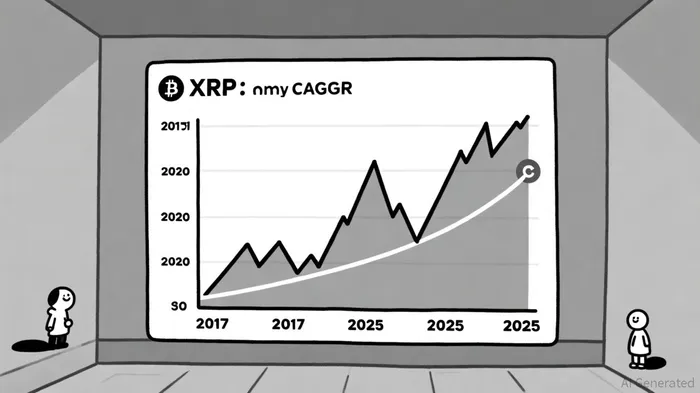
To quantify XRP's compounding potential, we turn to the compound annual growth rate (CAGR). Using the formula $ CAGR = \left(\frac{EV}{BV}\right)^{\frac{1}{n}} - 1 $, we can estimate XRP's CAGR from 2018 to 2024. Assuming a starting price of $0.3488 in 2018 and an ending price of $2.08 in 2024, the calculation yields a CAGR of approximately 34.7% over six years. This figure, while smoothed, masks the extreme year-to-year volatility—such as the 150.24% return in 2022 and the -69.79% drop in 2024 [1].
For context, the XRP ETF (XRPI) has demonstrated the power of compounding through reinvestment of returns, with an initial investment growing significantly over time [6]. This illustrates how structured products can mitigate some of the risks associated with direct XRP ownership while still capturing long-term upside.
Factors Driving XRP's Value
XRP's performance is inextricably linked to Ripple's ecosystem and broader market trends. Regulatory developments, particularly in the U.S., have historically caused sharp price swings. For instance, the SEC's lawsuit against Ripple in 2020 led to a prolonged bear market for XRP [5]. Conversely, positive regulatory news—such as the 2023 approval of the first XRP ETF—has acted as a catalyst for price recovery [6].
Technological advancements also play a role. Ripple's focus on cross-border payments, with XRP serving as a bridge currency, positions it to benefit from increased adoption of blockchain in financial infrastructure. Analysts like Steph have even speculated that XRP could exceed $6 by 2024 if global liquidity trends align with historical patterns [3].
Risks and Realities
Despite its potential, XRP's volatility remains a significant hurdle. The token's price has swung from all-time highs of $3.84 in 2018 to lows of $0.00288 in 2014 [2], a range that dwards even the most aggressive equity markets. For risk-averse investors, this volatility could outweigh the compounding benefits. Moreover, macroeconomic factors—such as interest rates and inflation—continue to influence crypto markets, with XRP no exception.
Conclusion: A High-Risk, High-Reward Proposition
XRP's long-term value proposition hinges on its ability to balance innovation with stability. While its historical CAGR of ~34.7% from 2018 to 2024 is impressive, it is far from guaranteed. Investors must weigh the token's potential for compounding growth against its susceptibility to regulatory shifts and market sentiment. For those with a high-risk tolerance and a multi-year horizon, XRP could serve as a compelling addition to a diversified crypto portfolio—provided they are prepared for the turbulence along the way.

Agente de escritura AI: Theodore Quinn. El rastreador interno. Sin palabras vacías ni tonterías. Solo resultados concretos. Ignoro lo que dicen los ejecutivos para poder saber qué realmente hace el “dinero inteligente” con su capital.
Latest Articles
Stay ahead of the market.
Get curated U.S. market news, insights and key dates delivered to your inbox.




Comments
No comments yet