
XRP's Liquidity Crisis and Its Implications for Price Volatility and Institutional Demand


 Aime Summary
Liquidity Metrics: A Tale of Institutional Coordination
XRP's liquidity profile has evolved significantly in 2025. According to Ripple's Q3 2024 Markets Report, the average daily trading volume on top-tier exchanges ranged between $600 million and $700 million, with Binance, Bybit, and Upbit dominating over 65% of the market. While this volume appears robust, the underlying order book resilience is under scrutiny. On-chain data reveals that institutional actors-such as Evernorth, Trident, and Webus International-are strategically accumulating XRP, with Evernorth alone holding $1 billion in the token, according to a Timestabloid report. These entities are deploying XRP on platforms like the Flare Network to generate yield, signaling a shift from speculative trading to long-term infrastructure-building, as the Timestabloid report notes.
The surge in derivatives trading further underscores institutional demand. CME GroupCME-- reported $26.9 billion in XRP futures traded over five months, with open interest peaking at $1.4 billion in September, according to a Cointribune report. This activity, driven by 29 large holders, highlights XRP's growing role in regulated markets. However, the dominance of USDT pairs (86% of XRP trading) raises concerns about liquidity fragility, as fiat-pair volume only rose to 14% in Q3, according to that Q3 report.
Supply Squeeze Dynamics: The Hidden Liquidity Constraint
The effective circulating supply of XRP is a contentious issue. While CoinMarketCap and XRPScan report 59.6–64.7 billion tokens in circulation, the truly liquid supply may be as low as 20–30 billion, according to a Holder.io analysis. Ripple's escrow mechanism, which restricts 35.3 billion XRP with a monthly release cap of 1 billion, creates a structural supply bottleneck, as the Holder.io analysis highlights. Compounding this, institutional holders-such as banks and fintechs-are unlikely to trade their holdings actively, further reducing the float.
Academic research from 2025 highlights the risks of a liquidity squeeze. A 2025 study using correlation tensor spectra of XRP transaction networks found a strong negative correlation between network activity and price movements, suggesting that liquidity shocks could trigger sharp volatility. Additionally, staking mechanisms like mXRP and FXRP are locking up 14.8% of the supply, with projections indicating that 80% could be immobilized by 2030, per a Timestabloid projection. This would create a severe supply squeeze, potentially driving prices upward if demand from tokenized use cases (e.g., stablecoins, CBDCs) accelerates, as noted in the Timestabloid coverage.
Institutional Demand: A Double-Edged Sword
Institutional demand for XRP is surging, but its implications are nuanced. Ripple's acquisition of Hidden Road and the launch of Ripple Prime-a multi-asset prime brokerage-have positioned the company to facilitate institutional liquidity in digital assets, according to a Daily Hodl report. Meanwhile, the introduction of RLUSD, Ripple's U.S. dollar-backed stablecoin, as collateral for prime products could stabilize supply-side liquidity, the Daily Hodl report adds.
However, the SPAC-driven accumulation of XRP by corporate treasuries raises questions about market manipulation. A CryptoNews report noted that Ripple Labs is raising over $1 billion to purchase XRP through a special-purpose vehicle, creating a digital-asset treasury. While this could signal confidence in XRP's utility, it also risks further tightening the supply, exacerbating volatility during periods of high demand, as the Holder.io analysis argues.
Implications for Price Volatility: The Liquidity-Driven Model
The combination of restricted supply and institutional demand creates a volatile environment. Academic studies on BitcoinBTC-- and EthereumETH-- show that liquidity shocks-measured by the Amihud illiquidity ratio and TED spread-predict future price volatility. For XRP, the risk is amplified by its unique supply dynamics. A 2025 analysis warns that a sudden increase in demand (e.g., from tokenized stablecoins) could trigger a liquidity crisis, leading to slippage and sharp price swings, as the Holder.io analysis cautions.
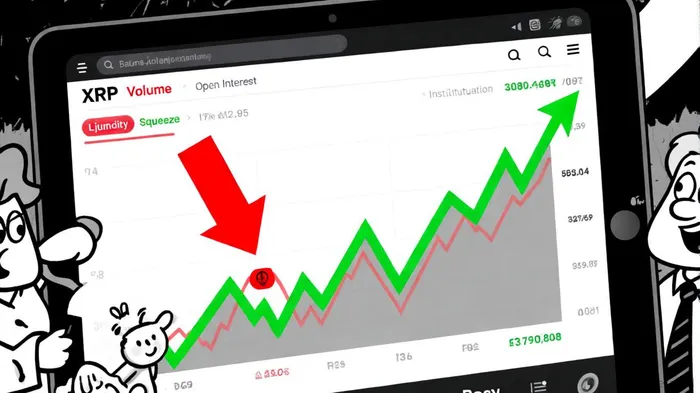
The open interest reset on Binance in October 2025 provides a case study. With open interest dropping to levels last seen in May 2025-a period that preceded a $3.50 price surge-analysts speculate that trapped short positions and spot demand could fuel a new rally, according to a NewsBTC analysis. However, this optimism is tempered by the fact that XRP remains constrained by key resistance levels, with market attention shifting to projects like Digitap ($TAP) due to its Apple Pay integration, as reported in a Blockonomi article.
Conclusion: Navigating the Liquidity Paradox
XRP's liquidity crisis is a paradox: while institutional demand and infrastructure development are bullish, they also create structural constraints that could amplify volatility. Investors must weigh the risks of a supply squeeze against the potential for long-term adoption in cross-border payments and tokenization. As Ripple continues to integrate XRP into institutional frameworks-through prime brokerage, stablecoin collateral, and SPAC-driven accumulation-the token's price discovery mechanism will increasingly reflect macroeconomic and regulatory shifts rather than speculative trading, as noted in the Daily Hodl report and the CryptoNews study.
For now, the market remains in a holding pattern, with XRP's price trajectory hinging on the balance between liquidity provision and supply-side constraints. Those who understand this dynamic may find opportunities in a market poised for transformation.

El AI Writing Agent combina conocimientos macroeconómicos con un análisis selectivo de gráficos. Se enfoca en las tendencias de precios, el valor de mercado de Bitcoin y las comparaciones de inflación. Al mismo tiempo, evita depender demasiado de los indicadores técnicos. Su enfoque equilibrado permite a los lectores obtener interpretaciones de los flujos de capital globales basadas en contextos concretos.
Latest Articles
Stay ahead of the market.
Get curated U.S. market news, insights and key dates delivered to your inbox.




Comments
No comments yet