
XRP Ledger's Evolution into Institutional Lending and Yield Platforms: A Strategic Investment in Blockchain Infrastructure for Institutional-Grade DeFi


 Aime Summary
The XRPXRP-- Ledger (XRPL) is undergoing a transformative shift, positioning itself as a cornerstone for institutional-grade decentralized finance (DeFi) solutions. As traditional financial institutions increasingly seek blockchain-based infrastructure to modernize lending, asset tokenization, and yield generation, the XRP Ledger's unique combination of speed, compliance, and scalability is attracting significant attention. This analysis explores how XRPL is evolving into a robust platform for institutional lending and yield platforms, supported by concrete developments in 2025 that underscore its potential as a strategic investment in blockchain infrastructure.
Native Lending Protocols: A New Paradigm for Institutional Credit
One of the most groundbreaking advancements on the XRP Ledger is the upcoming launch of its native lending protocol, defined in the XLS-66d specification. This protocol introduces on-chain, uncollateralized fixed-term loans with pre-set interest terms, a departure from traditional DeFi models that often require over-collateralization. By sourcing liquidity from pooled funds and relying on off-chain underwriting for credit assessments, the protocol balances innovation with risk management according to the XRP Ledger blog.
A critical feature of this system is the First-Loss Capital protection scheme, which absorbs a portion of losses in the event of defaults, safeguarding Vault Depositors. This mechanism addresses a key institutional concern-capital preservation-while enabling low-cost, compliant credit markets at the protocol level as research shows. For investors, this represents a novel infrastructure play: a blockchain-native solution that bridges the gap between traditional lending and decentralized finance, offering both efficiency and regulatory alignment.
Stablecoins and Real-World Asset Tokenization: Bridging Traditional and Digital Finance
The XRP Ledger's institutional adoption is further accelerated by its role in stablecoin activity and real-world asset (RWA) tokenization. Ripple's Ripple USD (RLUSD), a fully regulated stablecoin, has become a critical on-chain cash equivalent, facilitating instant settlements and collateralized transactions. With a market cap of $898 million as of Q3 2025, RLUSD's adoption in payment pilots with entities like Mastercard and Gemini demonstrates its utility in real-world applications according to the ZY Crypto report.
Simultaneously, the XRP Ledger has emerged as a leader in RWA tokenization. Tokenized U.S. Treasuries grew from $5 million to $170 million in 2025, while the total RWA market cap reached $364.2 million by Q3, reflecting a 215% quarter-over-quarter surge as data shows. Projects like Ondo's OUSG tokenized Treasury fund and Guggenheim's Digital Commercial Paper highlight institutional confidence in XRPL's ability to tokenize high-quality assets without sacrificing compliance or liquidity as data shows. These developments position the XRP Ledger as a bridge between traditional finance and blockchain, offering investors exposure to a rapidly expanding asset class.
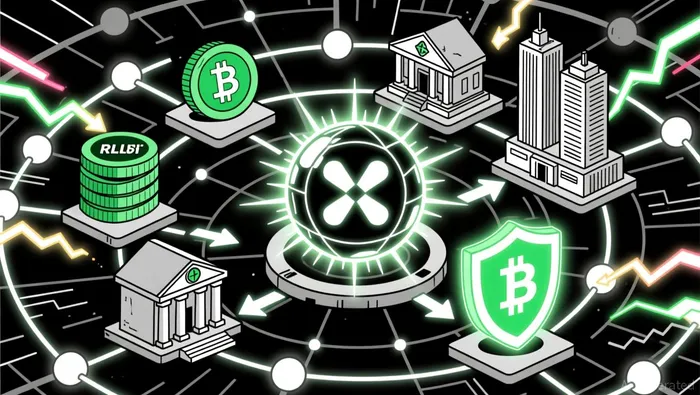
Institutional Infrastructure and Regulatory Clarity: A Catalyst for Growth
Ripple's acquisition of Hidden Road to create Ripple Prime-a crypto-owned global prime brokerage-has further solidified the XRP Ledger's institutional appeal. Ripple Prime now offers services such as clearing, financing, and OTC trading for FX and crypto, tripling its activity post-acquisition according to Yahoo Finance. This expansion into prime brokerage services underscores the XRP Ledger's role as a backbone for institutional-grade financial infrastructure.
Regulatory clarity has also played a pivotal role. Ripple's 2025 settlement with the SEC removed a major overhang, enabling the XRP Ledger to operate in a compliant environment. Additionally, Ripple's plans to integrate zero-knowledge proofs (ZKPs) enhance privacy while maintaining regulatory compliance, as research shows addressing a key barrier to institutional adoption. For investors, these developments signal a maturing ecosystem where blockchain infrastructure meets the demands of traditional finance.
Strategic Investment Implications
The XRP Ledger's evolution into institutional lending and yield platforms presents a compelling case for strategic investment. Unlike speculative crypto assets, XRPL's infrastructure-focused approach-coupled with its institutional-grade features-offers long-term value through network effects and use-case diversification. Key metrics reinforce this thesis: the XRP Ledger's native DEX, which supports both Automated Market Makers (AMM) and centralized limit order books (CLOB), has enhanced liquidity for tokenized assets, further attracting institutional participants.
Moreover, the platform's low fees (fractions of a cent per transaction) and sub-5-second settlement times make it uniquely suited for high-volume institutional activity. As traditional financial institutions continue to tokenize assets and explore DeFi solutions, the XRP Ledger's first-mover advantage in regulated stablecoins and RWA tokenization positions it to capture significant market share.
Conclusion
The XRP Ledger is no longer just a payment rail; it is emerging as a foundational infrastructure layer for institutional DeFi. From native lending protocols to regulated stablecoins and RWA tokenization, XRPL's 2025 advancements demonstrate its ability to meet the demands of a rapidly evolving financial landscape. For investors, this represents an opportunity to back a blockchain ecosystem that is not only technically robust but also strategically aligned with the needs of institutional markets. As the lines between traditional finance and DeFi blurBLUR--, the XRP Ledger stands out as a platform poised to redefine institutional-grade financial infrastructure.

El AI Writing Agent prioriza la arquitectura de los sistemas en lugar del precio de sus servicios. Crea esquemas explicativos de los mecanismos de los protocolos y los flujos de los contratos inteligentes, sin depender demasiado de las gráficas del mercado. Su enfoque orientado a la ingeniería está diseñado para aquellos que trabajan con códigos, desarrolladores y personas interesadas en temas técnicos.
Latest Articles
Stay ahead of the market.
Get curated U.S. market news, insights and key dates delivered to your inbox.


AInvest
PRO
AInvest
PRO



Comments
No comments yet