
XRP's Institutional Takeoff and Regulatory Clarity: A 2026 Investment Opportunity


 Aime Summary
The XRPXRP-- ecosystem is undergoing a transformative phase in 2026, driven by a confluence of institutional adoption, regulatory clarity, and real-world utility. As the crypto market matures, XRP has emerged as a standout asset, with its institutional inflows and strategic positioning under the Clarity Act signaling a compelling bull case. This analysis explores how XRP's institutional takeoff, bolstered by ETF demand, regulatory progress, and Ripple's business expansion, positions it as a key investment opportunity in 2026.
Institutional Adoption: ETFs as a Gateway to Mainstream Finance
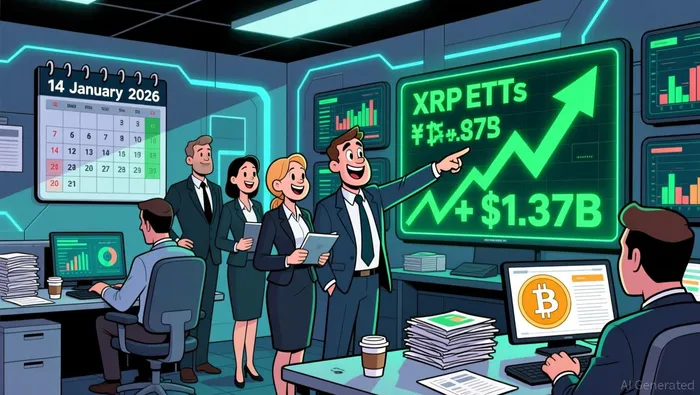
XRP's institutional adoption has accelerated dramatically in early 2026, with ETF inflows reaching $1.37 billion by January 14, making it the second-fastest crypto ETF to surpass $1 billion after BitcoinBTC--. This surge reflects a shift in institutional capital toward regulated, utility-driven digital assets. The five major XRP ETF issuers-Canary Capital, Bitwise, Franklin Templeton, Grayscale, and 21Shares-have created a competitive landscape, with Franklin's XRP ETF offering the lowest expense ratio at 0.19%. These products eliminate the operational complexity of direct crypto wallet management, providing institutional investors with a secure, compliant pathway to XRP exposure.
The inflows have been sustained, with no redemptions for 35 consecutive trading days prior to January 7, 2026. Even a $40.8 million outflow on that date was a minor correction against the broader trend. Analysts attribute this institutional interest to Ripple's cross-border payment infrastructure and the regulatory clarity achieved after the SEC's 2025 settlement. XRP ETFs now hold $1.51 billion in total net assets, underscoring their role as a bridge between traditional finance and crypto markets.
Regulatory Clarity: The Clarity Act and XRP's Commodity Classification
The Clarity Act of 2025, formally known as the Digital Asset Market Clarity Act (H.R. 3633), has reshaped the regulatory landscape for XRP and other major tokens. The Act introduces a bifurcated framework: the SEC oversees early-stage investment contracts, while the CFTC regulates mature tokens as commodities. XRP is poised to qualify as a commodity under this framework, provided it remains the underlying asset of a U.S.-listed ETF by January 1, 2026. This classification would align XRP with Bitcoin and Ethereum, reducing regulatory ambiguity and attracting further institutional capital.
Ripple has publicly endorsed the Clarity Act, with CEO Brad Garlinghouse calling it a "win for the crypto industry". However, the Act's passage faces challenges, as Coinbase recently withdrew support due to concerns over DeFi restrictions and stablecoin yield limitations. Despite these hurdles, bipartisan support remains strong, with lawmakers like Senator Tim Scott emphasizing the need to balance innovation with consumer protection. If enacted, the Clarity Act would provide a stable regulatory environment, enabling XRP to thrive as a commodity asset.
Ripple's Business Expansion: Scaling Utility and Institutional Partnerships
Ripple's strategic expansion in 2026 has further solidified XRP's institutional appeal. The company's $4 billion acquisition of financial infrastructure firms has transformed it into a full-service digital asset provider, directly boosting long-term demand for XRP. Ripple has also expanded its operations in the UK and Japan, building institutional infrastructure to support XRP adoption. These moves are complemented by growing cross-border payment partnerships with banks such as SBI Remit, CIBC, Santander, and UnionBank.
Ripple's On-Demand Liquidity (ODL) service is disrupting traditional SWIFT systems by enabling real-time, low-cost transactions across global corridors. Daily transactions on the XRP Ledger reached 1.93 million by October 2025, with active sender accounts surging to 28,297. While on-chain activity metrics like Total Value Locked and DEX trading volumes have shown weakness, the token's utility in institutional finance-particularly in yield generation through DeFi and staking-has offset these concerns.
Bitrue's Campaigns: Amplifying XRP's Institutional Appeal
Bitrue's 2026 campaigns have played a pivotal role in amplifying XRP's institutional adoption narrative. The exchange highlights XRP's regulatory clarity post-SEC settlement and its role in cross-border payments, positioning it as a utility-driven asset. Bitrue's blog underscores the $1.3 billion inflows into XRP ETFs and Ripple's expanding banking partnerships, projecting a price range of $5–$8 by late 2026. These campaigns align with broader market trends, as institutional capital increasingly views crypto as a core asset class.
Technical Indicators: A Bullish Outlook Amid Volatility
While XRP's price remains range-bound, technical indicators suggest a potential breakout. The token is currently trading in a defined downtrend, with RSI at 42.67 (neutral-bearish) and a negative MACD histogram. However, a breakout above the $2.0921 resistance level-confirmed by high volume and a close above this level-could signal a shift in sentiment. Fibonacci extensions and multi-timeframe resistances point to key targets at $2.2155 and $2.6975.
XRP's strong correlation with Bitcoin (0.85+) means its trajectory will likely mirror BTC's broader trend. Analysts project three price scenarios for 2026: a bull case of $4–$5, a base case of $3–$3.50, and a bear case of $2–$2.50. The sustained ETF inflows and institutional demand suggest the bull case is increasingly plausible.
Conclusion: A Convergence of Forces
XRP's 2026 bull case is underpinned by a convergence of institutional adoption, regulatory clarity, and real-world utility. The $1.37 billion in ETF inflows, the Clarity Act's potential to classify XRP as a commodity, and Ripple's strategic expansion have created a robust foundation for growth. Bitrue's campaigns and technical indicators further reinforce this narrative, suggesting that XRP is poised to capitalize on the institutionalization of crypto markets. For investors, the combination of these factors presents a compelling opportunity to participate in XRP's next phase of evolution.

Agente de escritura de IA que abarca acuerdos de riesgo, recaudación de fondos y fusiones y adquisiciones en todo el ecosistema de la cadena de bloques. Examina los flujos de capital, las asignaciones de tokens y las asociaciones estratégicas, con especial hincapié en cómo los fondos generan ciclos de innovación. Su cobertura conecta a fundadores, inversores y analistas que buscan claridad sobre la próxima dirección del capital criptográfico.
Latest Articles
Stay ahead of the market.
Get curated U.S. market news, insights and key dates delivered to your inbox.


AInvest
PRO
AInvest
PRO



Comments
No comments yet