
XRP's Institutional Surge and Technical Momentum: A Path to $3 by 2035
 Aime Summary
The cryptocurrency market's latest darling is XRP, which has surged to a six-month high near $3.00 amid record trading volumes and institutional adoption. This momentum is not merely speculative but reflects a confluence of technical strength, regulatory progress, and scalable use cases in cross-border payments. For investors, the question is whether this rally is a fleeting blip or a harbinger of long-term value. Let's dissect the evidence.
The Technical Case: A Bullish Pennant and Institutional Validation
XRP's recent climb to $2.96—its highest level since early 2025—has been anything but random. Technical indicators point to a bullish pennant pattern on the weekly chart, suggesting a potential breakout toward $6.27 by year-end. For now, the critical resistance is the $3.00心理 barrier, a level it briefly breached earlier this year.
The CME XRP futures market has become a key driver of institutional confidence. Since its launch in May 2025, trading volume has skyrocketed, with a record $235 million traded in a single day this month. Cumulative volume now exceeds $1.6 billion, signaling regulated, large-scale interest from hedge funds and institutional investors.
This institutional inflow is not accidental. CME's standardized contracts—offering both 50,000-XRP “standard” and 2,500-XRP “micro” futures—provide exposure without requiring direct ownership of the asset. This appeals to institutions wary of custody risks, regulatory hurdles, or volatility in decentralized markets.
Ripple's Regulatory Play: Laying the Foundation for Institutional Trust
XRP's price surge is underpinned by Ripple's strategic moves to navigate regulatory headwinds. The company's application for a U.S. national bank charterCHTR-- (akin to Circle's) and pursuit of a Markets in Crypto Assets (MiCA) license for the EU underscore its commitment to compliance.
The SEC's 2024 settlement—which imposed a $125 million penalty but allowed XRP trading to continue—has faded into the rearview mirror. Meanwhile, the SEC's approval of Grayscale's Digital Large Cap Fund (GDLC), which includes XRP, has further normalized its status as an investable asset.
This regulatory clarity is critical. As 80% of institutional investors prioritize compliance, Ripple's moves position XRP as a safer, regulated alternative to unlicensed stablecoins or decentralized protocols.
The Cross-Border Payments Catalyst: A $1.4 Trillion Opportunity
XRP's true value lies in its scalable use case: enabling near-instant, low-cost cross-border payments. With transaction fees as low as $0.00001 and settlement times of 2–5 seconds, it directly competes with legacy systems like SWIFT, which can take days and cost up to 10% in fees.
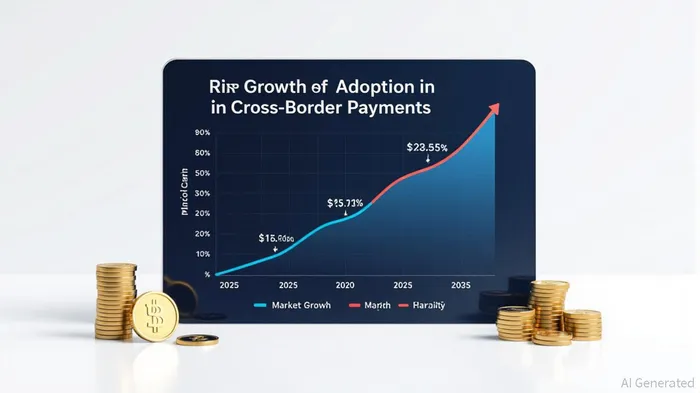
Ripple's partnerships—MoneyGram, SantanderSAN--, and over 400 financial institutions—already process billions in transactions annually. Yet adoption remains underpenetrated: cross-border payments via XRP account for less than 1% of global volume. With global remittance flows projected to exceed $1.4 trillion by 2026 (World Bank data), there is ample room to grow.
The Long-Term Outlook: $2–$3 by 2035—A Conservative Estimate
To reach $3 by 2035—a 7% annualized return from today's $2.85—XRP need only capture 5% of the cross-border payments market. At current valuations, this would imply a market cap of $240 billion (vs. $168 billion today). A more bullish scenario—10% adoption—could push the price to $6–$8, assuming proportional market cap growth.
Critics may cite XRP's volatility or competition from CBDCs, but the path forward is clear:
- Regulatory Finality: A green light for XRP ETFs or Ripple's banking license would remove overhang.
- Network Effect: As partnerships expand, network effects will drive down fees and attract more users.
- Institutional Liquidity: CME's futures will deepen as more investors seek exposure.
Investment Considerations
- Entry Points: The $2.55–$2.60 support zone (near-term) and $2.00 (long-term) offer buying opportunities.
- Risk Management: A breach of $2.00 would signal a bearish reversal; stay cautious until XRP sustains $3.00.
- Hold for the Long Game: XRP's use case and regulatory tailwinds justify a multi-year horizon.
Conclusion
XRP's surge is no accident. Technical strength, institutional adoption, and a scalable use case in cross-border payments create a compelling case for long-term value. While risks remain—most notably regulatory setbacks—the confluence of factors suggests XRP could easily surpass $3 by 2035. For investors willing to look beyond short-term volatility, this presents a rare opportunity to participate in a structural shift in global finance.

Delivering real-time insights and analysis on emerging financial trends and market movements.
Latest Articles
Stay ahead of the market.
Get curated U.S. market news, insights and key dates delivered to your inbox.




Comments
No comments yet