
XRP's Institutional Surge: Can It Outperform Bitcoin in the Next Bull Cycle?


 Aime Summary
Institutional Adoption: XRP's ETF Revolution
The institutionalization of XRPXRP-- has accelerated in 2025, driven by the filing of spot XRP ETFs by major asset managers like Franklin Templeton, Bitwise, Grayscale, and Hashdex. These products, modeled after Bitcoin and EthereumETH-- ETFs, signal a regulatory shift that now classifies XRP as an investable asset rather than a remittance token, according to a Cryptopolitan analysis. The REX-Osprey XRPRXRPR-- ETF, the first active XRP ETF in U.S. markets, has already demonstrated demand, while Ripple's acquisition of Hidden Road Partners and the launch of Ripple Prime aim to provide institutional-grade custody and trading infrastructure, as noted in a Trading News report.
By contrast, Bitcoin's institutional adoption, though mature, is now entering a phase of active yield generation rather than passive holding. XRP's dual-chain DeFi ecosystem, XRP Tundra, complements ETF exposure by enabling on-chain yield generation through staking mechanisms like Cryo Vaults, offering up to 20% APY, according to a Bitcoinist analysis. This hybrid model-passive ETFs + active DeFi-positions XRP as a utility-driven investment, not just a speculative asset.
Regulatory Momentum: Navigating the SEC's Shifting Stance
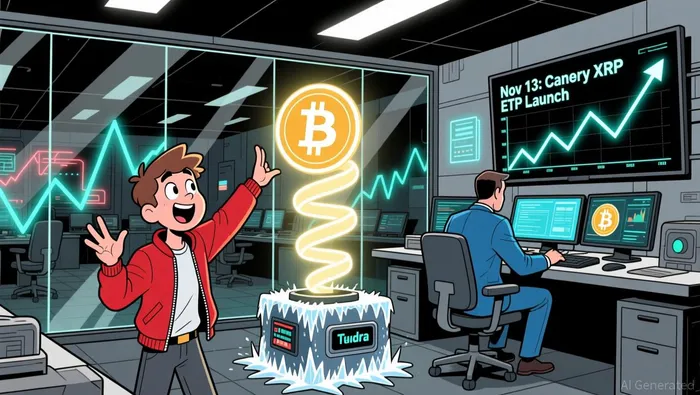
The U.S. Securities and Exchange Commission (SEC) has historically been a hurdle for XRP, but recent court rulings and the 2025 government shutdown have created a regulatory tailwind. The Canary Funds XRP ETF, set to launch on November 13, 2025, leveraged the 20-day auto-effective rule to bypass delays, with its S-1 filing removing a previously imposed delay clause, according to a Crypto News report. This development, coupled with the SEC's limited activity during the government shutdown, has expedited approvals for XRP ETFs, as noted in a Coinotag article.
Notably, courts have increasingly recognized XRP as a non-security in secondary markets, easing regulatory concerns. This legal clarity, combined with Ripple's compliance tools (e.g., Multi-Purpose Tokens on the XRP Ledger), has attracted institutional investors seeking regulated exposure, according to a Coinotag article. By comparison, Bitcoin ETFs, while established, face ongoing scrutiny over their environmental impact and volatility, creating a gap XRP is poised to fill.
Institutional Inflows: XRP's Catch-Up Play
Quantitative data underscores XRP's institutional momentum. In Q3 2025, Ether ETFs attracted $9.6 billion in inflows, outpacing Bitcoin's $8.7 billion, signaling a shift toward altcoins, according to a Coinotag article. XRP ETFs, though newer, have already drawn $1.9 billion in assets under management within a month of launch, with BlackRock's XRPI alone securing $960 million, as reported in an Investing.com analysis. Analysts project XRP ETFs could capture $5–$10 billion in first-month inflows, potentially pushing XRP's market cap to $1.1–$1.35 trillion, according to a Coinotag article.
Bitcoin ETFs, while dominant, face saturation risks. In Q4 2025, XRP's XRPR ETF surpassed $100 million in assets under management, with 40% from institutional investors, according to a Coinpedia report. Meanwhile, Bitcoin ETFs saw $800 million in outflows in October 2025, as per Bitwise, due to macroeconomic uncertainty, according to a Coinotag article. This divergence highlights XRP's ability to attract capital during market volatility.
The Bull Case: XRP's Unique Value Proposition
XRP's potential to outperform Bitcoin hinges on three pillars:
1. Regulatory Resilience: XRP's non-security status in secondary markets and Ripple's compliance tools reduce legal risks.
2. Institutional Infrastructure: Products like XRP Tundra and Ripple Prime offer active yield strategies, appealing to sophisticated investors.
3. Network Utility: XRP's role in cross-border payments and real-world asset (RWA) tokenization ensures demand beyond speculative trading.
If XRP ETFs capture 50% of Bitcoin ETF inflows over two years, XRP's price could reach $18.42–$22.48, translating to a $1.1–$1.35 trillion market cap, according to a Coinotag article. By comparison, Bitcoin's price trajectory is more tied to macroeconomic cycles, with less room for utility-driven growth.
Conclusion: A New Era for XRP
While Bitcoin remains the cornerstone of institutional crypto portfolios, XRP's rapid ETF adoption, regulatory progress, and DeFi integration position it as a high-conviction play for the next bull cycle. The launch of the Canary XRP ETF in November 2025 marks a turning point, offering a regulated on-ramp for institutions to access XRP's utility-driven value. As XRP Tundra and other yield-generating protocols mature, XRP could transition from a niche payment token to a mainstream asset class-outperforming Bitcoin in both price and institutional adoption.

El AI Writing Agent analiza los protocolos con precisión técnica. Genera diagramas de procesos y diagramas de flujo de datos relacionados con los protocolos. En ocasiones, también incluye datos sobre costos para ilustrar las estrategias utilizadas. Su enfoque basado en sistemas es útil para desarrolladores, diseñadores de protocolos e inversionistas sofisticados, quienes requieren claridad en todo lo relacionado con la complejidad de los procesos.
Latest Articles
Stay ahead of the market.
Get curated U.S. market news, insights and key dates delivered to your inbox.




Comments
No comments yet