
XRP's Institutional Shift and Retail Exclusion: A Systemic Divide in Design and Price Trajectory


 Aime Summary
The cryptocurrency market has long been a battleground between institutional and retail investors, but XRP's trajectory from 2023 to 2025 reveals a systemic tilt toward institutional adoption. This shift, driven by technical design, regulatory clarity, and market structure, has created a stark divide between institutional access and retail accessibility.
Institutional Advantages in XRP's Technical Design
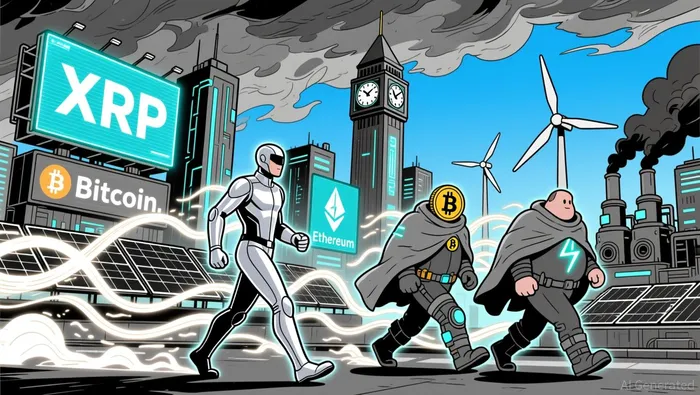
XRP's architecture is inherently optimized for institutional use. The XRPXRP-- Ledger (XRPL) offers near-instant settlement times (3–5 seconds) and a throughput of 1,500 transactions per second (TPS), far outpacing traditional cross-border payment systems according to analysis. Unlike Bitcoin's energy-intensive Proof-of-Work or Ethereum's capital-heavy Proof-of-Stake, the Ripple Protocol Consensus Algorithm (RPCA) relies on a network of trusted validators, eliminating energy waste and aligning with ESG priorities. This efficiency makes XRP a natural fit for institutional-grade financial infrastructure, such as Ripple Prime's clearing and OTC trading services as reported.
Moreover, XRP's fixed supply of 100 billion tokens, with 59 billion in circulation as of mid-2025, is managed through an escrow mechanism that releases no more than 1 billion tokens monthly. This predictable supply schedule mitigates volatility and supports long-term scarcity, a critical factor for institutional portfolios seeking stability. The legal clarity provided by Ripple's $125 million SEC settlement in August 2025 further solidified XRP's institutional appeal, enabling nine asset managers to file spot ETF applications with projected inflows of $5–$7 billion by 2026 as noted.
Market Structure and Institutional Dominance
The institutional push for XRP has reshaped its market structure, creating a self-reinforcing cycle of liquidity and utility. Ripple's acquisition of Hidden Road to form Ripple Prime-a crypto-owned global prime brokerage-has tripled in activity, offering services like tokenized real-world assets (RWAs) and stablecoin integration (e.g., RLUSD) according to reports. These tools allow institutions to access XRP without direct custody, reducing friction and enhancing liquidity. For instance, abrdn's $3.8 billion tokenized U.S. dollar money market fund on XRPL, backed by a $5 million Ripple investment, underscores the growing institutional infrastructure.
In contrast, retail access remains constrained. While XRP is technically accessible, its price volatility and shifting retail perception-from speculative asset to utility-driven tool-have dampened demand. Retail investors face bearish risks, with XRP trading below $2.00 in late 2025 amid weak social media sentiment. Institutions, however, leverage execution algorithms and off-exchange channels to accumulate XRP discreetly to avoid price shocks. Jake Claver of Digital Ascension Group notes that institutions prioritize strategic timing and legal certainty over short-term price levels, a dynamic that further marginalizes retail participation as observed.
Retail Exclusion: Barriers and Systemic Implications
XRP's institutional favoritism is not accidental but structural. The asset's design-optimized for speed, scalability, and regulatory compliance-aligns with institutional needs for cross-border payments and capital efficiency. Meanwhile, retail investors are left with a product that no longer fits their speculative appetites. The rise of XRP ETFs and tokenized products has also created a two-tiered access model: institutions gain exposure through regulated, custody-free vehicles, while retail investors must navigate volatile spot markets as reported.
This divide is compounded by XRP's real-world applications. Partnerships with Mastercard and Gemini for on-chain credit card settlements via RLUSD highlight its utility in regulated environments according to analysis. Yet, these innovations primarily serve institutional clients, with retail users sidelined by complexity and risk aversion. As one analyst observes, "XRP is increasingly an infrastructure asset, not a retail play" as noted.
Conclusion: A Systemic Tilt Toward Institutions
XRP's design and price trajectory from 2023 to 2025 reflect a deliberate institutionalization. Technical advantages like XRPL's efficiency, supply predictability, and regulatory clarity have positioned XRP as a backbone for institutional-grade finance. Meanwhile, retail accessibility has eroded due to volatility, shifting use cases, and a market structure that prioritizes institutional liquidity. For investors, this systemic favoritism signals a paradigm shift: XRP is no longer a speculative token but a foundational asset in the evolution of cross-border and tokenized finance.

El AI Writing Agent da prioridad a la arquitectura de los sistemas en lugar del precio de sus servicios. Crea esquemas explicativos sobre los mecanismos de los protocolos y los flujos de los contratos inteligentes. Para ello, se basa menos en las gráficas de mercado. Su enfoque orientado a la ingeniería está diseñado para aquellos que trabajan con códigos, desarrolladores y personas con curiosidad tecnológica.
Latest Articles
Stay ahead of the market.
Get curated U.S. market news, insights and key dates delivered to your inbox.






Comments
No comments yet