
AInvest Newsletter
Daily stocks & crypto headlines, free to your inbox
 Aime Summary
In the evolving landscape of institutional crypto adoption,
stands at a crossroads of opportunity and risk. While its market capitalization and utility in cross-border payments have long been debated, 2025 has brought a new dimension to the narrative: the interplay between extreme concentration of ownership and surging institutional demand. This duality-where centralization risks coexist with institutional-grade upside-demands a nuanced analysis for investors seeking to navigate XRP's future.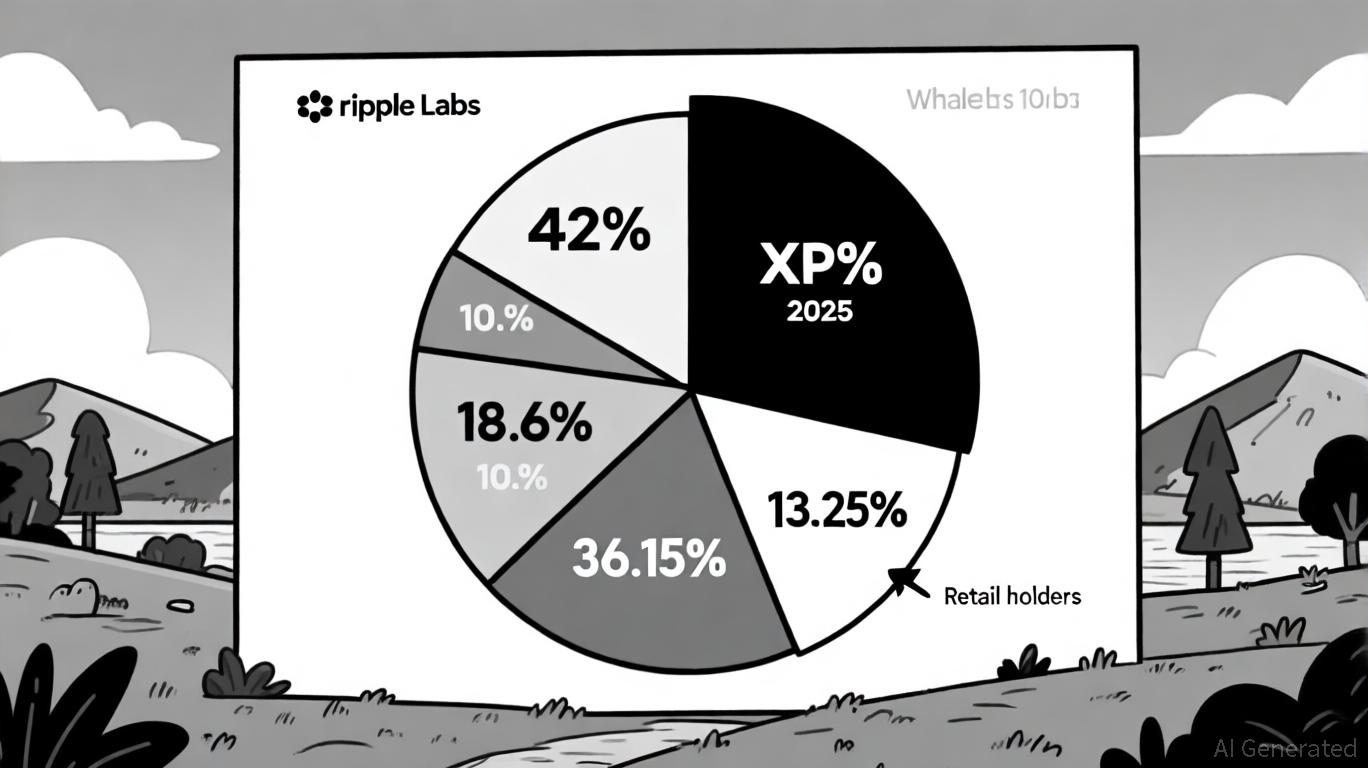
XRP's ownership structure remains one of the most centralized in the crypto space. Ripple Labs, through a combination of escrowed and operational wallets, controls approximately 42% of the total supply, according to
. This includes 35 billion XRP locked in escrow, with 1 billion tokens released monthly via smart contracts to manage liquidity, per an . While this mechanism aims to stabilize supply, it also grants Ripple Labs outsized influence over market dynamics.The top 10 XRP wallets further amplify this centralization, holding 18.6% of the circulating supply, per
. Six of these wallets, attributed to Ripple, each contain 5 billion XRP-equivalent to 5% of the total supply, the CCN report shows. Meanwhile, centralized exchanges like Binance (2.7 billion XRP), Bithumb (1.64 billion), and Uphold (1.58 billion) act as custodians for aggregated retail demand, collectively controlling 5% of the supply, according to a . This concentration raises valid concerns about price manipulation and governance centralization, as whale movements or exchange decisions could trigger significant volatility, shows.Yet, 2025 has witnessed a paradigm shift. Institutional interest in XRP has surged, driven by regulatory clarity and product innovation. The U.S. Securities and Exchange Commission's (SEC) reclassification of XRP as a commodity in August 2025 removed a major legal overhang, spurring $210 million in institutional inflows by October, according to
. This followed a record $134 million influx in a single week in September, fueled by ETF approvals and DeFi integrations, per a .Data from EY and global institutional studies reveals that 20% of institutional investors now hold XRP, with firms like Bitwise, Canary Funds, and 21Shares filing XRP ETFs, according to a
. Ripple's strategic expansion into CBDC partnerships and stablecoin infrastructure has further solidified its appeal as a utility-driven asset, . Notably, institutional investors are increasingly withdrawing XRP from exchanges, signaling a shift from speculative trading to long-term accumulation, .The tension between XRP's concentrated ownership and institutional adoption creates a unique investment thesis. On one hand, the top 13 holders control over 50% of the supply, with retail investors collectively owning less than 1%,
. This raises questions about market efficiency and the potential for coordinated selling pressure. On the other hand, institutional inflows are beginning to counterbalance these risks.For instance, the monthly escrow releases-while controlled by Ripple-are partially relocked, ensuring a steady but regulated supply, as XRPRightNow reported. Meanwhile, institutional demand is absorbing a growing share of circulating XRP, potentially offsetting the impact of whale activity. Analysts argue that this dynamic could lead to a "liquidity equilibrium," where institutional buying stabilizes price swings caused by large holder movements, according to a
.With institutional demand accelerating, the question becomes: How high can XRP go? Technical analysts point to a $5 price target by year-end 2025, citing favorable chart patterns and the $210 million inflow surge, per
. This optimism is bolstered by Ripple's Q3 2024 Markets Report, which highlighted record trading volumes and growing ETF traction.However, achieving this target hinges on two factors: continued institutional adoption and Ripple's ability to maintain market trust. If the escrow mechanism remains transparent and the SEC's commodity designation holds, XRP could see sustained inflows. Conversely, any reversal in regulatory sentiment or a sudden release of large holdings could derail momentum.
XRP's institutional-grade upside is inextricably linked to its ownership structure. While the concentration of power among Ripple, whales, and exchanges poses risks, the asset's growing institutional adoption offers a counterweight. For investors, the key lies in monitoring both the supply-side dynamics and the demand-side catalysts-ETF performance, regulatory developments, and Ripple's ecosystem growth. In a market where centralization and decentralization often clash, XRP's 2025 trajectory may well be defined by its ability to harmonize these forces.

AI Product Manager at AInvest, former quant researcher and trader, focused on transforming advanced quantitative strategies and AI into intelligent investment tools.

Dec.03 2025

Dec.01 2025

Nov.27 2025

Nov.27 2025

Nov.27 2025
Daily stocks & crypto headlines, free to your inbox






Comments
No comments yet