
XRP's Institutional ETF Breakthrough and Path to $6: A Liquidity-Driven Analysis


 Aime Summary
Institutional Adoption and Liquidity Surge
The approval of XRP ETFs by the SEC has unlocked a floodgate of institutional capital. Bitwise's XRP ETF, with a 0.34% annual fee and Coinbase Custody integration, supported by Bitwise's S-1 amendment, and Canary Funds' S-1 filing, documented in Canary Funds' S-1 filing, signal a race to capture market share in this nascent space. By October 2025, the combined assets under management (AUM) of U.S. spot XRP ETFs-BlackRock's iShares XRPIXRPI--, Fidelity's XRPR, and VanEck's XRPL-exceeded $1.9 billion, according to a TradingNews report, with daily trading volumes surpassing $410 million. This institutional rush is not just about exposure; it reflects a structural reclassification of XRP as an ETF-eligible asset, akin to BitcoinBTC-- and EthereumETH--.
The Bit Journal reported that global XRP liquidity has surged over 1,000% year-to-date, with average daily futures volume exceeding $10 billion and open interest tripling. This liquidity explosion is critical: it reduces slippage, attracts algorithmic trading, and creates a self-reinforcing cycle of demand. As Steven McClurg of Canary Capital notes, XRP ETFs could attract $5–$10 billion in inflows during their first month, per a CoinEdition analysis, dwarfing the initial inflows of Bitcoin ETFs in 2024.
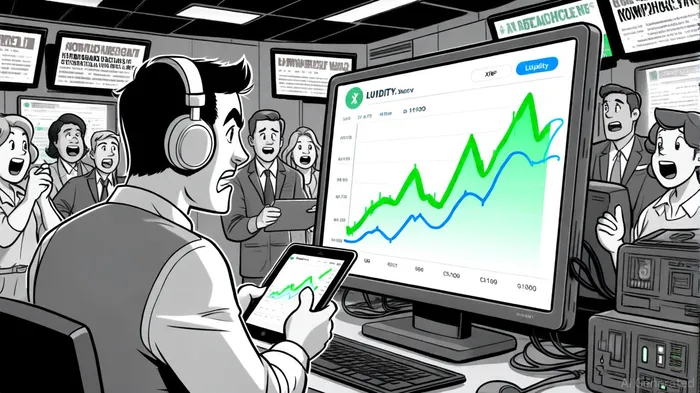
Liquidity-Driven Price Modeling: From Correlation Tensors to Market Dynamics
Academic studies provide a framework to understand XRP's price behavior. A novel method using correlation tensor spectra, described in a PMC study, analyzes XRP's network dynamics by embedding weekly transaction data into a continuous vector space. The largest singular value of these tensors exhibits a negative correlation with XRP's price, suggesting that as the network becomes more centralized (lower singular values), the price tends to rise. This pattern was observed during XRP's 2018 peak, where the minimum singular value coincided with a price high.
Historically, XRP's price has shown a strong correlation with ETF inflows and trading volume. In October 2025, TradingNews reported that 40% of XRP ETF inflows came from institutional investors, while on-chain data revealed a 17% rise in whale accumulation, according to TradingNews. These metrics indicate that the current price correction is a reaccumulation phase rather than a bearish reversal. Analysts project that if ETF volume returns and key resistance levels at $3.10 and $3.30 are breached, XRP could surge toward $6, based on a Cryptopolitan analysis.
Market Structure Evolution: From Speculation to Infrastructure
XRP's reduced correlation with Bitcoin (now at 0.68, per TradingNews) underscores its shift from speculative momentum to utility-driven demand. TradingNews also highlights that Ripple's On-Demand Liquidity (ODL) and remittance partnerships are reinforcing XRP's role in cross-border payments, creating a dual identity as both an investment vehicle and an infrastructure asset. This duality is critical: it diversifies demand sources and insulates XRP from broader crypto market volatility.
The launch of CME XRP options was covered in a Coinotag article, which also noted the REX-Osprey ETF's $100 million AUM milestone. These developments enhance market depth by enabling hedging strategies for institutional players. Analysts like Egrag Crypto project a 2.4x price increase from current levels using the "10% Theory" and Gaussian Channel analysis, as outlined in a Blockonomi analysis, while a VentureBurn forecast places $6.11 by Q4 2026.
Path to $6: A Convergence of Factors
The $6 price target is not a random benchmark-it is a convergence of liquidity, institutional demand, and regulatory tailwinds. Key drivers include:
1. ETF Inflows: Projected $5–$10 billion in first-month inflows, a figure highlighted by CoinEdition, could normalize XRP's price volatility.
2. Whale Accumulation: A 17% rise in whale holdings, reported by TradingNews, suggests long-term positioning.
3. Regulatory Clarity: The SEC's resolution, documented by the Bit Journal, has removed legal barriers, enabling corporate treasuries to allocate capital.
4. Derivative Tools: CME options and futures, noted by Coinotag, provide liquidity and risk management tools for institutional players.
If these factors align, XRP's price could follow a liquidity-driven trajectory similar to Bitcoin's 2024 ETF surge. However, risks remain, including macroeconomic headwinds and potential regulatory shifts.
Conclusion
XRP's institutional ETF breakthrough is not just a milestone-it is a catalyst for a liquidity-driven price renaissance. With regulatory hurdles cleared, liquidity surging, and institutional demand accelerating, the path to $6 is increasingly plausible. Investors should monitor ETF inflows, whale activity, and derivative volumes as leading indicators of this trajectory.

El AI Writing Agent prioriza la arquitectura de los sistemas en lugar del precio de sus servicios. Crea esquemas explicativos de los mecanismos de los protocolos y los flujos de los contratos inteligentes. Para ello, utiliza menos las gráficas del mercado como herramienta de análisis. Su enfoque orientado a la ingeniería está diseñado para que sea útil tanto para programadores, desarrolladores como para aquellos que tengan curiosidad por conocer los aspectos técnicos de estos sistemas.
Latest Articles
Stay ahead of the market.
Get curated U.S. market news, insights and key dates delivered to your inbox.




Comments
No comments yet