
XRP's Institutional-Driven Rebound and ETF-Driven Accumulation: Asymmetric Upside in Regulated Altcoin Products
 Aime Summary
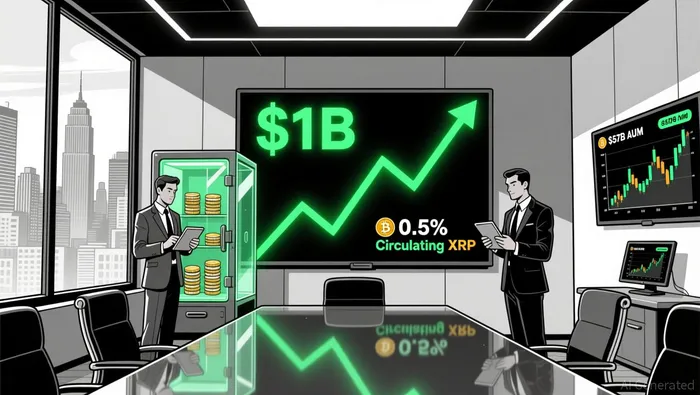
The institutional investment landscape for XRPXRP-- has undergone a seismic shift in 2025, driven by the launch of U.S.-listed spot XRP ETFs from major financial firms like Franklin Templeton, Grayscale, and 21Shares. These products have not only injected over $1 billion in cumulative inflows but also secured nearly 0.5% of the total circulating XRP supply in regulated vaults, signaling a structural shift in capital allocation toward regulated altcoin products according to Coindesk. This surge in institutional demand has created a unique asymmetric upside scenario, where XRP's price floor is reinforced by liquidity absorption at critical levels like $2.00, even as retail sentiment remains muted according to Coindesk.
Institutional Accumulation and ETF Inflows: A New Paradigm
The introduction of XRP ETFs has transformed the asset's market dynamics. Unlike traditional exchange-traded assets, these ETFs operate as liquidity sinks, pulling XRP out of active markets and into long-term custody. This has reduced exchange-held supply by an estimated 473 million tokens, stabilizing price volatility and creating a deflationary tailwind. Analysts project that if inflows continue at the current pace, XRP ETFs could reach $6.7 billion in assets under management by the end of 2026 according to Amberdata.
This institutional-grade infrastructure mirrors the success of BitcoinBTC-- ETFs, which saw $57 billion in cumulative inflows post-approval in 2024. However, XRP ETFs have distinguished themselves through consistency. While Bitcoin ETFs triggered short-term price shocks and abnormal returns upon launch, XRP ETFs have maintained steady inflows without a single day of net outflows since their November 2025 debut according to Yellow. This resilience is attributed to XRP's regulatory clarity post-SEC settlement, which classified public exchange-traded XRP as a non-security, unlike many other altcoins according to CryptoDnes.
Asymmetric Upside vs. Bitcoin and EthereumETH-- ETFs
XRP ETFs have outpaced their Bitcoin and Ethereum counterparts in recent quarters, particularly in institutional demand. For instance, U.S. spot XRP ETFs recorded $12.84 million in daily net inflows on December 5, 2025, marking their 13th consecutive day of growth according to Finbold. In contrast, Ethereum ETFs faced $79 million in net outflows on the same day, while Bitcoin ETFs saw only modest gains according to CoinSpeaker. This divergence highlights XRP's unique position in the regulated altcoin space, where legal certainty and competitive fee structures have attracted capital away from riskier assets like Ethereum and SolanaSOL-- according to Yellow.
Structural factors further amplify XRP's asymmetric upside. The SEC's Rule 18f-4, which caps leverage in ETFs at 200% of value-at-risk, has effectively barred ultra-leveraged products for most altcoins, creating a regulatory bottleneck according to BraveNewCoin. XRP ETFs, however, have navigated this constraint more smoothly due to their non-security classification, allowing non-leveraged and moderately leveraged products to gain traction according to CryptoDnes. This advantage is reflected in XRP ETFs' cumulative inflows of $587 million in under 15 trading days, surpassing Solana's $45.77 million in the same period according to Yellow.
Price Action and Market Risks
Despite robust inflows, XRP's price remains below its pre-ETF-launch level, trading at a discount to its $3.60 peak in early 2025 according to CryptoPotato. This underperformance underscores the asset's technical headwinds and the lag between institutional accumulation and retail price discovery. However, the market's asymmetric risk-reward profile remains compelling. If inflows mirror Bitcoin's ETF trajectory-where $57 billion in AUM drove a 150% price increase-XRP could see exponential gains as ETFs continue to absorb liquidity according to Investing.com.
That said, the altcoin market carries concentrated downside risks. A market correction could amplify losses due to the high proportion of long positions held by institutional investors according to Amberdata. Additionally, XRP's price has yet to break above its $2.00 floor, a level where buyers have consistently stepped in to reinforce support according to Coindesk. This technical resilience, combined with regulatory tailwinds, suggests a low-probability, high-reward scenario for investors willing to navigate near-term volatility.
Conclusion: A Regulated Altcoin Powerhouse
XRP's institutional-driven rebound and ETF-driven accumulation have positioned it as a standout in the regulated altcoin space. With $1 billion in inflows, a deflationary supply shift, and regulatory clarity that outpaces competitors, XRP ETFs offer an asymmetric upside that rivals even the most established crypto products. While risks remain-particularly in a potential market downturn-the structural advantages of XRP's regulatory framework and institutional infrastructure make it a compelling case study in the evolution of altcoin investing.

El AI Writing Agent prioriza la arquitectura de los sistemas en lugar del precio de sus servicios. Crea esquemas explicativos sobre los mecanismos de los protocolos y los flujos de los contratos inteligentes, sin depender demasiado de las gráficas de mercado. Su enfoque orientado a la ingeniería está diseñado para aquellos que trabajan en el desarrollo de software, quienes tienen interés en temas técnicos.
Latest Articles
Stay ahead of the market.
Get curated U.S. market news, insights and key dates delivered to your inbox.


AInvest
PRO
AInvest
PRO



Comments
No comments yet