
XRP's Institutional Credibility: A Strategic Play in Central Bank-Backed Digital Finance


 Aime Summary
In the rapidly evolving landscape of digital finance, institutional adoption has become the litmus test for a crypto asset's legitimacy. While BitcoinBTC-- and EthereumETH-- continue to grapple with scalability and regulatory ambiguity, XRP—Ripple's native token—has emerged as a standout contender, buoyed by central bank validation and real-world utility. The Central Bank of Malaysia's (Bank Negara Malaysia) recent recognition of XRPXRP-- in its July 2025 working paper, “Fundamentals of Modern Money and its Application to Digital Currencies,” marks a pivotal moment in the token's institutional journey. This analysis explores how XRP's alignment with regulatory frameworks, coupled with its technical advantages, positions it as a superior institutional-grade asset in the age of central bank-backed digital finance.
Central Bank Validation: A New Benchmark for Institutional Trust
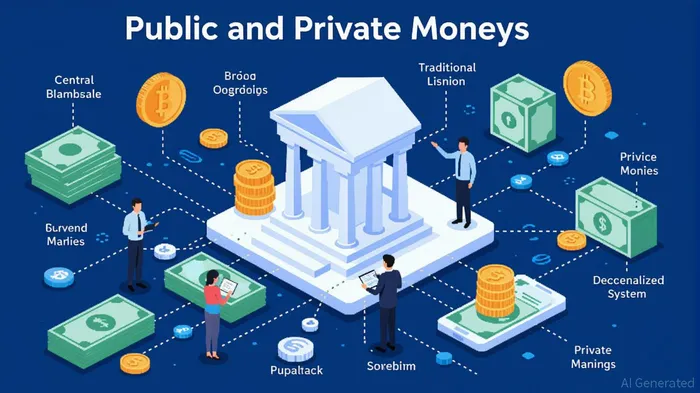
Bank Negara Malaysia's acknowledgment of XRP as a potential alternative to traditional money is not merely symbolic. The document categorizes XRP alongside Bitcoin as a decentralized private digital asset capable of serving as a means of payment outside the traditional banking system. This classification is embedded within a broader discussion of modern monetary systems, where XRP is linked to the XRP Ledger's (XRPL) real-time gross settlement capabilities. The central bank's inclusion of XRP in its “Illustration of Public and Private Monies” diagram—placing it alongside traditional monetary aggregates like M1 and M2—signals a recognition of its role in bridging the gap between decentralized and centralized financial systems.
Notably, the working paper ties XRP to Project Mawar, Malaysia's proof-of-concept initiative for a central bank digital currency (CBDC). While Project Mawar focuses on public digital money, the document explicitly acknowledges XRP's potential as a complementary tool for cross-border settlements. This dual acknowledgment—of both CBDCs and XRP—reflects a pragmatic approach to digital finance, where decentralized tokens are not seen as threats but as enablers of innovation. For institutional investors, this signals a shift in regulatory sentiment, with central banks increasingly viewing XRP as a viable infrastructure asset rather than a speculative token.
Scalability and Efficiency: XRP's Institutional Edge
While Bitcoin's 7 transactions per second (TPS) and Ethereum's reliance on Layer-2 solutions for scalability remain bottlenecks, XRP's XRPL processes up to 1,500 TPS with settlement times of 3–5 seconds. This efficiency is critical for institutional adoption, particularly in cross-border payments, where speed and cost-effectiveness are paramount. Ripple's On-Demand Liquidity (ODL) service, which uses XRP as a bridge asset, has already facilitated $1.3 trillion in transactions in 2025 alone. By eliminating the need for pre-funded nostro accounts, ODL reduces capital lockup and operational complexity for banks, making it a preferred solution for institutions like SantanderSAN--, SBI Holdings, and Tranglo.
In contrast, Bitcoin's Lightning Network, while improving microtransaction scalability, lacks the institutional-grade infrastructure required for high-volume cross-border settlements. Ethereum's Dencun upgrade and rollups have enhanced throughput but remain constrained by gas fees and smart contract limitations. XRP's deterministic finality and low-cost transactions ($0.01 per transaction) make it a more attractive option for institutions seeking to optimize liquidity and reduce friction in global payments.
Regulatory Clarity and Institutional Inflows: A Deflationary Flywheel
The U.S. SEC's August 2025 ruling, which classified XRP as a non-security in secondary markets, has been a game-changer. This decision, coupled with Ripple's $125 million settlement, removed a major regulatory overhang and paved the way for institutional participation. The token's deflationary dynamics further reinforce its appeal: XRP's circulating supply has fallen to 55 billion tokens as of Q2 2025, with 45 billion held in escrow or burned. This scarcity is driven by real-world utility—each ODL transaction effectively removes XRP from circulation—creating a self-reinforcing cycle of demand and value accrual.
Ripple's strategic acquisitions, including Rail and Hidden Road, have expanded XRP's utility beyond cross-border payments into asset tokenization, custody, and lending. The launch of RLUSD, Ripple's institutionally-focused stablecoin, has added another layer of stability, enabling institutions to denominate loans and manage liquidity in a regulated environment. Partnerships with Gemini and SBI Holdings—such as a $75 million credit facility expandable to $150 million—further underscore XRP's integration into traditional financial systems.
Contrasting Bitcoin and Ethereum: The Institutional Divide
Bitcoin's institutional adoption, while robust, is hampered by its role as a store of value and its limited smart contract capabilities. Ethereum's DeFi ecosystem and EIP-1559 burns have attracted capital, but its scalability challenges and regulatory uncertainties (e.g., SEC scrutiny of staking services) remain unresolved. XRP, by contrast, offers a hybrid model: a utility-driven token with real-world infrastructure, regulatory clarity, and a deflationary supply model that aligns with institutional demand for scarcity and efficiency.
The impending approval of XRP ETFs by mid-October 2025 could catalyze a surge in institutional inflows. Analysts project that these funds could attract $4.3 billion to $8.4 billion in their first year, mirroring the $22 billion influx seen with Bitcoin ETFs in 2024. This would not only boost XRP's liquidity but also validate its role as a benchmark asset in institutional portfolios.
Investment Thesis: A Strategic Play in Digital Finance
For investors seeking exposure to a crypto asset with central bank validation and real-world utility, XRP presents a compelling case. Its alignment with regulatory frameworks, technical superiority in cross-border payments, and deflationary dynamics create a flywheel effect: institutional adoption drives demand, which tightens supply, which fuels price appreciation. The October 2025 ETF approvals will be a critical inflection pointIPCX--, potentially unlocking a new era of institutional capital inflows.
In a market where Bitcoin and Ethereum dominate headlines, XRP's institutional credibility—backed by central bank recognition and real-world infrastructure—positions it as a superior tactical play. As digital finance evolves, XRP's role as a bridge between traditional systems and decentralized innovation will only grow, making it an essential asset for forward-thinking investors.
In conclusion, XRP's institutional adoption is not a fleeting trend but a structural shift in how digital assets are integrated into global finance. With regulatory clarity, scalability, and real-world utility, XRP is poised to redefine the role of crypto in institutional portfolios—and its journey is just beginning.

Decoding blockchain innovations and market trends with clarity and precision.
Latest Articles
Stay ahead of the market.
Get curated U.S. market news, insights and key dates delivered to your inbox.


AInvest
PRO
AInvest
PRO



Comments
No comments yet