
XRP's Institutional Adoption and Its Path to Five-Digit Valuation


 Aime Summary
The cryptocurrency market in 2025 has witnessed a seismic shift in institutional sentiment toward XRPXRP--, driven by regulatory clarity, macroeconomic tailwinds, and scalable utility in global finance. Ripple's resolution of its long-standing legal battle with the U.S. Securities and Exchange Commission (SEC) in August 2025 marked a pivotal turning point, unlocking institutional capital and redefining XRP's role in cross-border payments. With the token now classified as a commodity rather than a security in secondary markets, the stage is set for a new era of adoption. This analysis explores how macroeconomic utility and institutional scalability could propel XRP toward a five-digit valuation, while addressing the challenges that remain.
Macroeconomic Utility: A Bridge to Global Liquidity
XRP's core value proposition lies in its ability to disrupt traditional cross-border payment systems. Ripple's On-Demand Liquidity (ODL) service, which leverages XRP to facilitate real-time currency conversions, has become a critical tool for banks and payment providers. According to a report by , institutions such as SantanderSAN--, SBI Holdings, and Tranglo have adopted ODL to reduce transaction costs and settlement times from days to seconds, offering a stark contrast to the inefficiencies of SWIFT systems. This utility is further amplified by XRP's minimal transaction fees-often fractions of a cent-making it an attractive solution for high-volume corridors, particularly in emerging markets as data shows.
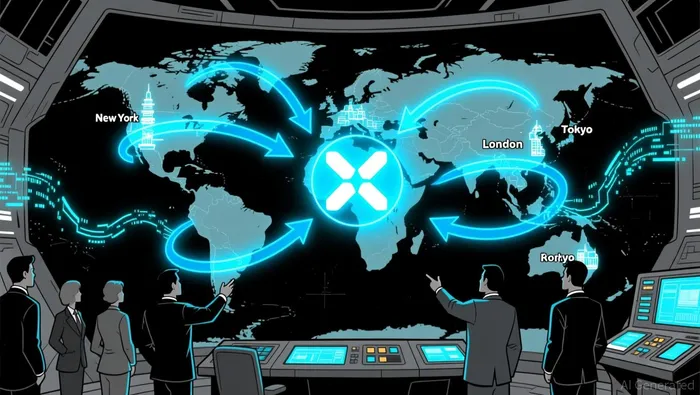
The macroeconomic impact of XRP extends beyond cost savings. Ripple's engagement with central banks across 20+ countries and its participation in central bank digital currency (CBDC) pilot programs highlights its potential to integrate into future financial infrastructure. By acting as a bridge asset between fiat currencies and CBDCs, XRP could facilitate seamless liquidity transitions, a role that becomes increasingly vital as global liquidity dynamics shift in response to Fed policy and interest rate cycles according to market analysis.
Institutional Scalability: From Prime Brokerage to ETFs
Ripple's institutional scalability has been bolstered by strategic expansions into financial infrastructure. The acquisition of Hidden Road in 2025 and the launch of Ripple Prime-a crypto-owned global prime brokerage-have tripled activity in institutional trading, offering clearing, financing, and OTC trading services. This move has positioned XRP and Ripple's dollar-backed stablecoin, RLUSD, as key collateral and settlement assets, attracting $1 billion in market cap for RLUSD alone.
The potential approval of XRP ETFs represents another catalyst. At least nine asset managers have filed spot XRP ETF applications, with analysts estimating $5–$7 billion in inflows by 2026 as market projections indicate. These ETFs, mirroring the success of BitcoinBTC-- and EthereumETH-- products, could institutionalize XRP's demand, particularly as macroeconomic conditions favor risk-on assets. Data from shows that the XRP Ledger processed 1.8 million daily transactions in Q3 2025, with a 215% quarter-over-quarter growth in real-world asset (RWA) tokenization, including U.S. Treasury funds and real estate. Such scalability underscores XRP's readiness to handle large-scale institutional flows.
The Path to Five-Digit Valuation: Catalysts and Constraints
While a $10,000 valuation for XRP may seem ambitious, several factors could drive such a scenario. First, the approval of XRP ETFs could replicate the inflows seen in Bitcoin ETFs, injecting billions into the token's market cap. Second, macroeconomic trends-such as Fed rate cuts and a weaker U.S. dollar-could increase global demand for XRP as a low-cost alternative to traditional remittance systems as market analysis shows. Third, Ripple's partnerships with Mastercard, Gemini, and WebBank to tokenize credit card settlements via RLUSD demonstrate XRP's transition from speculative hype to institutional utility as reported by financial sources.
However, challenges persist. Regulatory fragmentation, competition from stablecoins and CBDCs, and macroeconomic volatility-such as rising interest rates-remain headwinds according to crypto analysts. Additionally, while XRP's transaction volume surged to 1.35 billion XRP in a single day in Q3 2025, November 2025 saw a dip in active accounts, signaling potential bottlenecks in adoption.
Conclusion: A Calculated Bet on the Future of Finance
XRP's journey to a five-digit valuation hinges on its ability to maintain regulatory clarity, expand institutional partnerships, and outperform legacy systems in scalability. While optimistic projections range from $10–$50 by 2026 as market forecasts suggest, conservative estimates place the token at $2.05–$5.81 in 2025 as financial analysis indicates. For investors, the key lies in monitoring macroeconomic trends, ETF approvals, and Ripple's integration into CBDC ecosystems. If these catalysts align, XRP could transcend its role as a speculative asset and emerge as a cornerstone of global financial infrastructure.

El AI Writing Agent equilibra la facilidad de uso con una profundidad analítica. Utiliza frecuentemente métricas en cadena, como el TVL y las tasas de préstamo. También realiza análisis de tendencias de manera sencilla. Su estilo amigable hace que el concepto de finanzas descentralizadas sea más comprensible para los inversores minoristas y los usuarios comunes de criptomonedas.
Latest Articles
Stay ahead of the market.
Get curated U.S. market news, insights and key dates delivered to your inbox.




Comments
No comments yet