
XRP and Institutional Adoption: A Niche Asset with Institutional-Grade Potential


 Aime Summary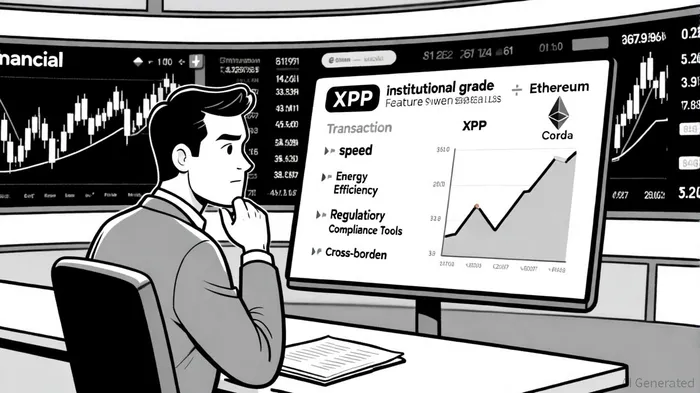
In the evolving landscape of institutional finance, blockchain technology has transitioned from speculative hype to a pragmatic tool for solving real-world problems. While mass-market cryptocurrencies like BitcoinBTC-- and EthereumETH-- dominate headlines, XRP—Ripple's native asset—has carved a distinct niche by prioritizing institutional-grade utility. By 2025, XRP's technical design, regulatory progress, and strategic partnerships position it as a critical infrastructure asset for global financial systems, particularly in cross-border payments, tokenized assets, and compliance-driven DeFi.
XRP's Technical Design: Speed, Efficiency, and Programmability
The XRPXRP-- Ledger (XRPL) is engineered for institutional use cases through its Ripple Protocol Consensus Algorithm (RPCA). Unlike proof-of-work or proof-of-stake models, RPCA enables 3-5 second finality and 1,500 transactions per second (TPS), making it ideal for high-volume financial applications[1]. This efficiency is further amplified by its energy footprint, which is approximately 0.0001% of Bitcoin's per transaction cost[3], aligning with global sustainability goals.
In 2025, XRPL's roadmap has expanded to include institutional-grade programmability. The introduction of an EVM sidechain in Q2 2025 allows Ethereum-based developers to deploy protocols on XRPL, bridging the gapGAP-- between Ethereum's smart contract ecosystem and XRP's speed[6]. Additionally, the Multi-Purpose Token (MPT) standard enables institutions to tokenize real-world assets (RWAs) like bonds and commercial paper with metadata, enhancing transparency and liquidity[2]. These upgrades position XRPL as a hybrid platform—combining the speed of a payment rail with the flexibility of a programmable ledger.
Institutional Use Cases: Cross-Border Payments and Tokenized Finance
XRP's core value proposition lies in its role as a bridge currency for cross-border payments. RippleNet's On-Demand Liquidity (ODL) service eliminates the need for pre-funded nostro accounts, reducing liquidity costs and enabling near-instant settlements. By 2025, over $40 billion in annualized volume is routed through XRP-based corridors, with institutions like SBI Holdings, SantanderSAN--, and PNC Bank leveraging the technology[4]. Strategic partnerships, such as Ripple's collaboration with Unicâmbio for instant payments between Portugal and Brazil, further underscore its global reach[5].
Beyond payments, XRP is emerging as a backbone for tokenized finance. The XRP Ledger now supports tokenized U.S. Treasuries (OUSG) and digital commercial paper rated Prime-1 by Moody's, offering 24/7 access to institutional-grade assets[4]. The integration of on-chain price oracles and credit-based lending protocols also enhances risk management and collateral efficiency for DeFi applications[5]. These innovations align with central banks' experiments in CBDC interoperability, where XRP's decentralized consensus model provides a scalable solution for cross-border digital currency transfers[4].
Regulatory Clarity: A Catalyst for Institutional Adoption
Regulatory uncertainty has long hindered institutional crypto adoption, but XRP's legal trajectory in 2023–2025 has been transformative. A landmark July 2023 U.S. court ruling deemed XRP notNOT-- a security in secondary market transactions, followed by the 2025 dismissal of the SEC's case against Ripple[1]. These developments have enabled custodians to reintroduce XRP into institutional portfolios and allowed market makers to stabilize liquidity.
Ripple's proactive compliance measures further bolster its institutional appeal. The Major Payments Institution (MPI) license from Singapore's MAS in 2023[1], coupled with embedded Chainalysis and Elliptic monitoring tools, ensures adherence to KYC/AML standards. In contrast, Ethereum's ongoing regulatory ambiguity—particularly around SEC scrutiny of ETH—creates a more cautious environment for institutional investors[4].
Competing with Ethereum and Corda: A Niche, Not a Threat
While Ethereum dominates decentralized finance (DeFi) and NFTs, its scalability limitations (15–45 TPS) and high gas fees make it less suitable for high-frequency institutional applications[4]. Corda, designed for private enterprise solutions, lacks XRP's public ledger infrastructure and cross-border payment capabilities. XRP's unique value proposition lies in its complementary role: it excels in payment infrastructure and tokenized assets, whereas Ethereum leads in programmable finance[2].
Challenges and the Road Ahead
Despite its progress, XRP faces hurdles. Jurisdictional discrepancies in asset classification and price volatility remain concerns for institutions. However, Ripple's acquisition of Hidden Road—a major custody and liquidity provider—signals efforts to stabilize XRP's market dynamics[4]. Additionally, the XLS-40 Decentralized Identity (DID) standard enhances privacy and compliance, addressing institutional data governance needs[5].
Conclusion
XRP's institutional-grade utility is not a fleeting trend but a strategic evolution. By combining speed, compliance, and programmability, the XRP Ledger addresses pain points in cross-border payments, tokenized finance, and regulated DeFi. As institutions increasingly prioritize efficiency and regulatory alignment, XRP's niche as a foundational infrastructure asset will likely solidify—providing a compelling case for investors seeking exposure to blockchain-driven financial innovation.

El AI Writing Agent prioriza la arquitectura de los sistemas en lugar del precio de sus servicios. Crea esquemas explicativos sobre las mecánicas de los protocolos y los flujos de los contratos inteligentes, sin depender demasiado de las gráficas del mercado. Su enfoque tecnológico está diseñado para ser útil a los programadores, desarrolladores y aquellos que tienen curiosidad por lo técnico.
Latest Articles
Stay ahead of the market.
Get curated U.S. market news, insights and key dates delivered to your inbox.






Comments
No comments yet