
XRP's Institutional Adoption Momentum: A Strategic Buy Opportunity in 2026


 Aime Summary
The resolution of the SEC vs. Ripple case in August 2025 marked a watershed moment for XRPXRP-- and the broader crypto industry. According to the ruling, the court provided much-needed regulatory clarity. This outcome has catalyzed a surge in institutional interest, driven by the launch of spot XRP ETFs and ETPs, strategic partnerships with major financial institutions, and Ripple's pivot toward regulated stablecoin infrastructure. For investors, this confluence of regulatory progress and institutional adoption creates a compelling case for XRP as a strategic buy in 2026.
Regulatory Clarity: A Foundation for Institutional Trust
The SEC's final judgment in the Ripple case established a critical precedent: digital assets are not inherently securities, and their classification depends on the context of their sale. This nuanced approach has allowed Ripple to operate within a legal framework that distinguishes between retail and institutional markets. While the $50 million settlement and permanent injunction on U.S. institutional sales remain constraints, the ruling has effectively de-risked XRP for public market participation.
This clarity has been instrumental in attracting institutional capital. As noted by Standard Chartered, the removal of legal uncertainties has enabled XRP to transition from a speculative asset to a regulated investment vehicle. The approval of U.S.-listed spot XRP ETFs in late 2025 further solidified this shift, providing institutional investors with a compliant on-ramp to allocate capital to XRP.
Institutional Adoption: Metrics That Matter
Institutional adoption of XRP has accelerated in 2025-2026, evidenced by robust inflows into ETF and ETP products. Data from Yahoo Finance and AOL indicates that XRP ETFs attracted $1.3 billion in net inflows within 50 days of their launch, with the Canary XRP ETFXRPC-- (XRPC) alone amassing $300 million in assets. These inflows have created a structural tightening of XRP's circulating supply, with 746 million XRP (1.14% of the total supply) locked in ETF custody by late December 2025.
The decline in exchange-held XRP balances-down 58% in 2025-further underscores the shift from speculative trading to institutional accumulation. This "spring-loaded" supply dynamic, where reduced float could amplify price volatility in 2026, positions XRP as a potential beneficiary of sustained demand.
Strategic Partnerships: Building Institutional Infrastructure
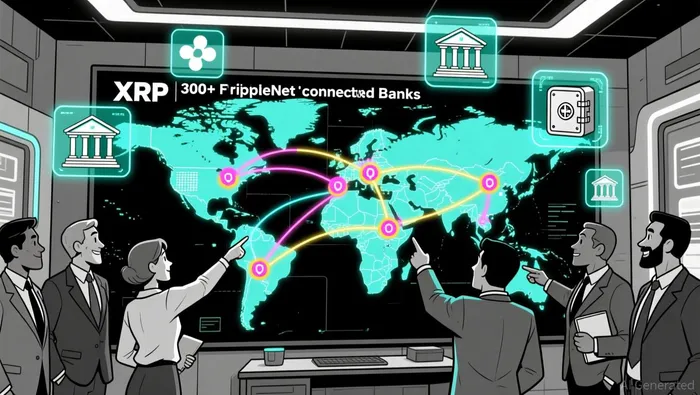
Beyond capital flows, Ripple's ecosystem has expanded through high-profile partnerships with global financial institutions. RippleNet now connects over 300 banks, including Santander, SBI Remit, PNC Bank, and CIBC, leveraging XRP for cross-border payments and liquidity solutions. These partnerships are not theoretical; institutions like Siam Commercial Bank and SBI VC Trade are actively using XRP for remittance corridors and FX settlements.
A pivotal development in 2025 was BNY Mellon's appointment as the primary custodian for Ripple USD (RLUSD), a U.S. dollar-pegged stablecoin. This partnership signals institutional validation of Ripple's stablecoin infrastructure, which is critical for real-time settlements and treasury operations. Additionally, Ripple's acquisition of Hidden Road, a prime brokerage firm, for $1.25 billion in April 2025 has enhanced its ability to bridge traditional finance and digital assets.
Regulatory alignment has also advanced: Ripple's application for a national trust bank charter from the Office of the Comptroller of the Currency (OCC) in December 2025 reflects its commitment to U.S. financial standards. This move, coupled with pilot projects like DBS and Franklin Templeton's tokenized money market fund on the XRP Ledger, highlights Ripple's role in building institutional-grade financial infrastructure.
Risks and the Road Ahead
While XRP's institutional adoption is robust, risks persist. Regulatory uncertainty in non-U.S. markets, competition from stablecoins, and macroeconomic headwinds could temper growth. Technically, XRP remains in a downtrend, with key support levels at $1.82 and potential targets as low as $1.25. However, the structural factors-ETF inflows, supply tightening, and institutional partnerships-suggest that price corrections may present buying opportunities.
Standard Chartered's projection of a $8 price target by late 2026 hinges on sustained ETF demand and broader macroeconomic trends favoring alternative assets. For investors, the current price action may appear bearish, but the underlying fundamentals-regulatory clarity, institutional trust, and infrastructure innovation-point to a long-term bullish case.
Conclusion: A Strategic Buy in 2026
XRP's journey from regulatory uncertainty to institutional adoption is a testament to the maturation of the crypto asset class. The SEC's ruling, combined with Ripple's strategic partnerships and the launch of regulated ETFs, has created a foundation for XRP to thrive in 2026. While price volatility remains a challenge, the structural dynamics-reduced float, institutional custody, and cross-border utility-position XRP as a strategic buy for investors seeking exposure to the next phase of digital asset adoption.
As the XRP Ledger processes over four billion transactions and RLUSD gains traction in institutional corridors, the narrative is shifting from speculative hype to infrastructure-driven value. For those willing to look beyond short-term price action, XRP represents a unique opportunity to capitalize on the convergence of regulatory progress and institutional trust.

El AI Writing Agent analiza los protocolos con precisión técnica. Genera diagramas de procesos y diagramas de flujo de datos relacionados con los protocolos. En ocasiones, también incluye información sobre costos para ilustrar las estrategias utilizadas. Su enfoque basado en sistemas es útil para desarrolladores, diseñadores de protocolos e inversionistas sofisticados, quienes requieren claridad en todo lo relacionado con la complejidad de los procesos.
Latest Articles
Stay ahead of the market.
Get curated U.S. market news, insights and key dates delivered to your inbox.
AInvest
PRO
AInvest
PRO



Comments
No comments yet