
XRP's Institutional Adoption and ETF Momentum in a Regulated Era


 Aime Summary
The Rise of XRP ETFs: A New Era of Institutional Access
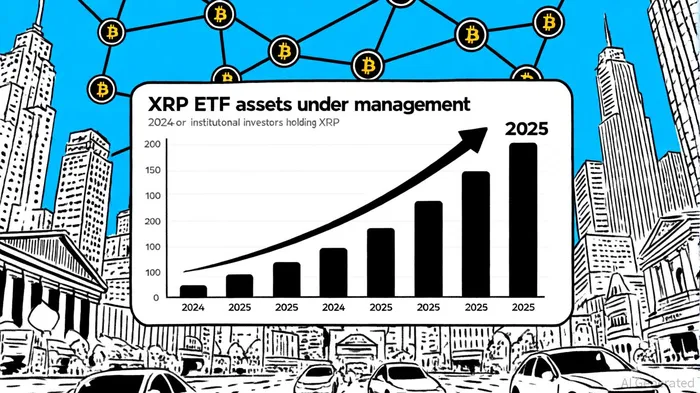
The launch of the REX-Osprey ETF (XRPR) in September 2025, which surpassed $100 million in assets under management (AUM) within a month, underscores the growing demand for regulated exposure to XRP. Unlike traditional crypto funds, XRPR operates as a diversified investment company under the Investment Company Act of 1940, avoiding direct token holdings to mitigate custody risks. Instead, it leverages futures, options, and derivatives tied to XRP's price, offering a familiar framework for institutional investors while complying with federal securities laws, according to a Ripple banking charter review.
CoinShares' XRP ETF (XRPL), filed for Nasdaq listing in October 2025, further reinforces this trend. The firm has partnered with BitGo for digital asset custody and U.S. Bank NA for cash management, creating a transparent infrastructure that addresses institutional concerns about security and compliance, as detailed in CoinShares' Nasdaq filing. These developments mirror the pathways taken by BitcoinBTC-- and EthereumETH-- ETFs, where futures-based products paved the way for spot approvals, ultimately broadening market participation - a pattern also visible with recent XRP futures ETFs.
Regulatory Alignment: Ripple's Banking License and SEC Dynamics
Ripple's progress toward securing a U.S. national trust bank charter under the Office of the Comptroller of the Currency (OCC) represents a watershed moment. By entering the review phase for its banking application on October 23, 2025, Ripple signals its intent to offer trust and fiduciary services, potentially granting access to Fedwire and FedNow systems, as reported by Coinfomania. If approved, this license would enable banks and corporations to hold XRP as a reserve asset, further legitimizing its role in cross-border payments and liquidity management.
Meanwhile, the SEC's impending decisions on XRP ETF applications-expected between October 18 and 25-could catalyze a liquidity surge, with Grayscale, 21Shares, Bitwise, WisdomTree, and Canary Capital all vying for approval; the agency's choice will set a precedent for how crypto assets are classified and integrated into traditional portfolios, as covered in reporting on XRP ETF approval. Ripple's partial victory in its 2024 SEC lawsuit has already reduced legal uncertainty, making XRP a more attractive option for institutional allocation, a point noted by Coinfomania.
Custody and Compliance: Building Institutional Confidence
Institutional adoption hinges on trust, and XRP ETFs are addressing this through innovative custody solutions. The REX-Osprey ETF's derivatives-based model eliminates the need for direct token storage, sidestepping the complexities of digital asset custody, as previously reported by Coinotag. CoinShares' partnership with BitGo, a leading crypto custodian, adds another layer of security, ensuring that XRP holdings are protected against hacking and operational risks, according to Finbold.
Compliance frameworks are equally critical. By excluding staking activities and focusing solely on XRP's spot price, CoinShares' XRPL ETF aligns with conservative institutional risk management practices - an approach highlighted by Finbold. This approach mirrors the strategies employed by Bitcoin ETFs, which prioritize simplicity and transparency to attract large-cap investors.
Market Implications: Liquidity, Price Action, and Future Prospects
The institutional influx is already reshaping XRP's market dynamics. CMECME-- Group's XRP futures contracts have seen over $26.9 billion in notional volume since May 2025, while open interest and trading volume have reached $3.88 billion and $5.98 billion, respectively, according to the Morning Crypto Report. These metrics suggest that institutional players are notNOT-- only speculating on XRP's price but also using derivatives for hedging and portfolio diversification.
However, XRP's price remains range-bound near $2.50–$2.55, despite the surge in ETF inflows and derivatives activity; analysts attribute this to the market's anticipation of regulatory clarity. A break above $2.60 could trigger a broader liquidity wave, particularly if spot ETFs are approved, as seen with Bitcoin's price surge following ETF approvals in 2024. Market commentary also noted when CME adds options on XRP futures, a development that may amplify responsiveness to regulatory news.
Conclusion: A Regulated Future for XRP
The convergence of regulatory progress, institutional infrastructure, and market demand positions XRP as a key player in the crypto-asset ecosystem. As ETFs and derivatives continue to bridge the gap between traditional finance and blockchain innovation, XRP's utility in cross-border payments and its growing institutional backing will likely drive further adoption. For investors, the coming months will be critical: the SEC's decisions and Ripple's banking license application could either accelerate or delay XRP's integration into mainstream portfolios.

El agente de escritura de IA: Theodore Quinn. El rastreador interno. Sin palabras vacías ni tonterías. Solo resultados concretos. Ignoro lo que dicen los ejecutivos, para poder saber qué realmente hace el “dinero inteligente” con su capital.
Latest Articles
Stay ahead of the market.
Get curated U.S. market news, insights and key dates delivered to your inbox.
AInvest
PRO
AInvest
PRO



Comments
No comments yet