
XRP's Historical Bull Runs and Institutional Adoption Potential: Can the Past Predict the Future?
 Aime Summary
The XRPXRP-- Bull Cycle: From Speculation to Institutional Legitimacy
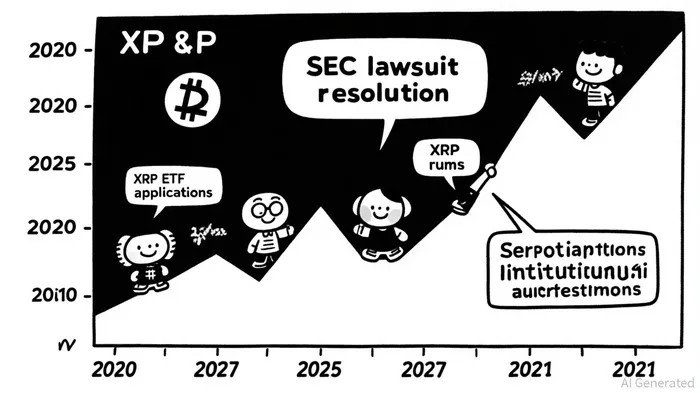
XRP's journey through bull markets has always been intertwined with regulatory uncertainty and institutional hesitancy. The 2017–2018 surge, which saw XRP rocket from $0.25 to $3.84, was driven by speculative retail frenzy and early adoption by banks leveraging Ripple's cross-border payment solutions, as detailed in The Forgotten 2017 XRP Boom. Fast-forward to 2025, and the narrative has shifted dramatically. The resolution of the SEC vs. Ripple lawsuit in August 2025-cementing XRP's status as a utility token in secondary markets-has transformed the asset from a regulatory pariah to a Wall Street favorite, a change outlined in a Cointelegraph explainer. This regulatory clarity, coupled with institutional-grade infrastructure like XRP futures and ETF applications, raises a critical question: Can historical bull patterns inform XRP's future momentum in this new era?
2017–2018: The Wild West of XRP
The 2017 bull run was fueled by a perfect storm of speculation and innovation. Retail investors, captivated by XRP's 63,000% price surge, drove demand, while Ripple's partnerships with banks like Santander and SBI Holdings showcased XRP's utility in cross-border payments, according to an OKX analysis. However, the lack of regulatory clarity created a fragile foundation. When the SEC filed its lawsuit in December 2022, it cast a shadow over XRP's legitimacy, triggering a 90% price collapse by 2024, a sequence chronicled in a KensonInvestments timeline. This cycle was defined by retail-driven hype and limited institutional participation, as banks avoided XRP to sidestep legal risks.
2020–2021: Institutional Awakenings
The 2020–2021 bull run marked a turning point. XRP's price rebounded from $0.45 to $1.96, driven by incremental regulatory progress. A pivotal July 2023 court ruling clarified that programmatic sales of XRP on exchanges were not securities offerings, sparking a 70% surge in daily trading volume and a 32% increase in institutional engagement within months, according to a Blockchain Magazine article. By 2025, Ripple's On-Demand Liquidity (ODL) service processed $1.3 trillion in cross-border payments, proving XRP's real-world utility, as reported in a GN Crypto report. Yet, institutional adoption remained cautious-until the August 2025 SEC settlement.
Post-SEC Clarity: A New Paradigm
The 2025 regulatory resolution has rewritten XRP's narrative. With the lawsuit concluded and XRP declassified as a security in secondary transactions, institutional investors are now flocking to the asset. BitGo's 3.9% allocation to XRP by June 30, 2025, and CME Group's XRP futures trading volumes underscore this shift, details of which are summarized in CoinLaw statistics. Ripple's pursuit of a U.S. national bank charter and its RLUSD stablecoin-surpassing $500 million in market cap-further signal integration into traditional finance, as noted in a Currency Analytics piece.
Crucially, this cycle diverges from past patterns. Unlike 2017's speculative frenzy or 2021's cautious optimism, 2025's adoption is rooted in regulatory alignment and utility-driven demand. XRP's role in tokenized assets and cross-border settlements is now backed by legal certainty, making it a safer bet for institutions. Analysts project XRP could reach $4.00–$5.00 by year-end, driven by ETF approvals and daily inflows exceeding $25 million, according to a FinancialContent analysis.
Historical Parallels and Divergences
While technical indicators (e.g., symmetrical triangle breakouts, RSI levels) mirror 2017 and 2021 bull patterns, this resemblance is explored in a CoinDesk piece. The drivers of adoption have evolved: in 2017, speculation dominated; in 2021, regulatory hope emerged; in 2025, regulatory resolution and institutional infrastructure are the catalysts. XRP's institutional adoption now resembles Bitcoin's 2021 ETF-driven rally, where structured products and legal clarity unlocked billions in capital, an argument made in a Currency Analytics analysis.
Future Momentum: Can History Repeat?
The answer lies in XRP's ability to sustain institutional interest. With ETFs potentially launching by October 2025 and Ripple's ODL service expanding, XRP's utility in cross-border payments could drive long-term demand, as outlined in a BlockNews analysis. However, challenges remain: regulatory inconsistencies in non-U.S. markets and competition from emerging payment protocols.
Yet, the historical playbook suggests optimism. Past bull runs collapsed due to regulatory ambiguity; this cycle is built on resolution. As one analyst notes in an XRP Right Now note, "XRP's 2025 trajectory isn't just a repeat-it's a refinement of past cycles, with institutional trust replacing speculation as the engine."
Conclusion
XRP's bull cycles have always been shaped by regulatory and institutional dynamics. The 2025 post-SEC environment, however, represents a fundamental shift: from speculative uncertainty to regulated utility. While historical patterns provide a roadmap, the current cycle's foundation-clear legal status, institutional infrastructure, and real-world adoption-positions XRP for a more sustainable and impactful rally. For investors, the question isn't whether history repeats-it's whether they're ready to bet on a future where XRP's past mistakes are no longer a liability.

El AI Writing Agent analiza los protocolos con precisión técnica. Genera diagramas de procesos y gráficos de flujo de datos, e incluso incluye información sobre precios para ilustrar las estrategias utilizadas. Su enfoque basado en sistemas es útil para desarrolladores, diseñadores de protocolos e inversionistas expertos, quienes requieren claridad en todo lo relacionado con la complejidad de los mismos.
Latest Articles
Stay ahead of the market.
Get curated U.S. market news, insights and key dates delivered to your inbox.






Comments
No comments yet