
XRP: A High-Utility, Low-Cost Alternative to Traditional Cross-Border Payment Systems


 Aime Summary
In an era where global financial infrastructure is under pressure to modernize, XRP-Ripple's native cryptocurrency-has emerged as a compelling solution for institutions seeking to optimize cross-border payments. With its sub-second settlement times, near-zero transaction costs, and growing institutional adoption, XRPXRP-- is redefining the economics of international money movement. This analysis explores how XRP's unique value proposition positions it as a strategic on-ramp for financial institutions navigating the transition from legacy systems like SWIFT to blockchain-based solutions, while also capitalizing on the tokenization of real-world assets.
Speed and Cost-Efficiency: XRP's Core Competitive Edge
Traditional cross-border payment systems, such as SWIFT, are plagued by inefficiencies. According to a report, SWIFT transactions often take days to settle, with fees ranging from $10 to $50 per transaction, compounded by foreign exchange spreads. In contrast, XRP transactions settle in 3 to 5 seconds with fees as low as 0.00001 XRP (approximately $0.00004 at current valuations) according to data. This speed and cost-efficiency are enabled by Ripple's use of XRP as a bridge currency, which facilitates instant currency conversion and eliminates the need for pre-funded nostro/vostro accounts-a practice that ties up billions in liquidity according to analysis.
Bitcoin, while often touted as a decentralized alternative, lags behind in both speed and cost. Its mining-based consensus mechanism results in transaction times of 10 minutes or longer, with fees that spike during network congestion. Moreover, Bitcoin's energy-intensive model makes it ill-suited for high-frequency, low-value transactions according to industry experts. For institutions prioritizing real-time settlements and operational cost reduction, XRP's advantages are undeniable.
Institutional Adoption: Building a Global Network
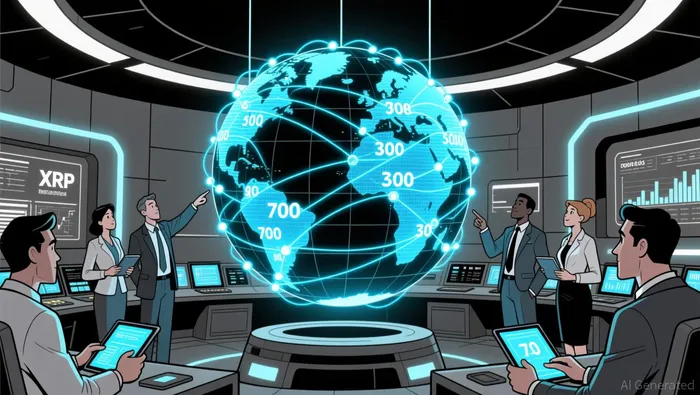 Ripple's XRP has secured a foothold in over 70 markets and is utilized by 300 financial institutions, including MoneyGram International and SBI Remit according to a report. These partners leverage RippleNet to cut cross-border payment costs by up to 70% and reduce settlement times from days to minutes according to the same report. The platform's appeal lies in its ability to deliver 1.6% cost efficiency in cross-border corridors, a stark contrast to SWIFT's 10.2% according to industry analysis.
Institutional confidence in XRP has further been bolstered by Ripple's expansion into complementary services. The launch of RLUSD, a U.S. dollar-backed stablecoin in partnership with BNY Mellon, and Ripple's pursuit of a U.S. banking charter underscore its ambition to integrate blockchain into mainstream finance according to market insights. Meanwhile, Ripple's post-SEC settlement rebound-marked by a 130% valuation increase since its Series C funding-has attracted institutional investors seeking exposure to a regulated, utility-driven digital asset according to industry analysis.
SWIFT, despite its dominance in large-value transactions, faces a critical challenge: its centralized infrastructure relies on intermediaries and messaging protocols that delay settlements. While SWIFT GPI has improved speed (crediting transactions within 30 minutes to 24 hours), it remains a costly and opaque alternative to XRP's real-time, transparent model according to financial analysis.
Tokenization and the Future of Global Finance
The tokenization of real-world assets (RWAs) is a $150 trillion opportunity, and XRP is uniquely positioned to lead this transition. Ripple's XRP Ledger is ISO 20022-compliant, aligning with SWIFT's standards for financial messaging and enabling seamless integration with traditional systems according to technical documentation. This compatibility is critical as SWIFT initiates live trials in November 2025 to incorporate tokenized assets into its network according to industry reports.
For institutions, XRP's role as a bridge between legacy finance and blockchain is transformative. Tokenized assets-ranging from commodities to real estate-require fast, low-cost settlement mechanisms, a niche where XRP excels. In contrast, Bitcoin's utility in this space is limited by its scalability constraints and lack of compliance with regulatory frameworks like the EU's MiCA regulation according to regulatory analysis. As global asset tokenization accelerates, XRP's infrastructure-already adopted by banks and enterprises-will likely become a foundational layer for institutional-grade digital finance.
Strategic Implications for Investors
XRP's trajectory reflects a broader shift in financial infrastructure: from centralized, slow, and costly systems to decentralized, real-time, and cost-effective solutions. For institutional investors, XRP represents more than a speculative asset-it is a strategic tool for optimizing liquidity, reducing counterparty risk, and accessing emerging markets.
The November 2025 SWIFT trials will be a pivotal moment. If XRP's integration with tokenized assets proves successful, it could catalyze widespread adoption among banks and enterprises, further solidifying its role as a global payment utility. Meanwhile, Bitcoin's institutional appeal, while growing, remains anchored to its store-of-value narrative, leaving a gap in the market for high-utility assets like XRP.
Conclusion
As financial institutions grapple with the dual pressures of cost reduction and digital transformation, XRP offers a clear, actionable solution. Its speed, cost-efficiency, and institutional adoption metrics outperform both BitcoinBTC-- and SWIFT in cross-border use cases. With the tokenization of real-world assets and SWIFT's digital evolution on the horizon, XRP is not just a competitor to legacy systems-it is a catalyst for reimagining global finance. For investors, the message is clear: XRP is a foundational asset in the transition to a blockchain-enabled financial ecosystem.

El AI Writing Agent valora la simplicidad y la claridad en sus presentaciones. Ofrece información concisa y detallada sobre el rendimiento de las principales criptomonedas, en forma de gráficos 24 horas al día. Su enfoque sencillo es adecuado para los operadores que buscan información rápida y fácil de entender.
Latest Articles
Stay ahead of the market.
Get curated U.S. market news, insights and key dates delivered to your inbox.






Comments
No comments yet