
XRP Gains Momentum as Institutional Adoption and Utility in Payments Drive Investment Interest
 Aime Summary
- XRP ETFs have attracted $1.3 billion in assets under management in 50 days, indicating strong institutional demand according to reports.
- Ripple's On-Demand Liquidity (ODL) service has processed over $15 billion in cross-border payments, highlighting XRP's utility in real-world financial transactions as data shows.
- The recent regulatory clarity following the SEC's August 2025 ruling, which determined XRPXRP-- is not a security, has facilitated institutional adoption and re-listing of XRP according to analysis.
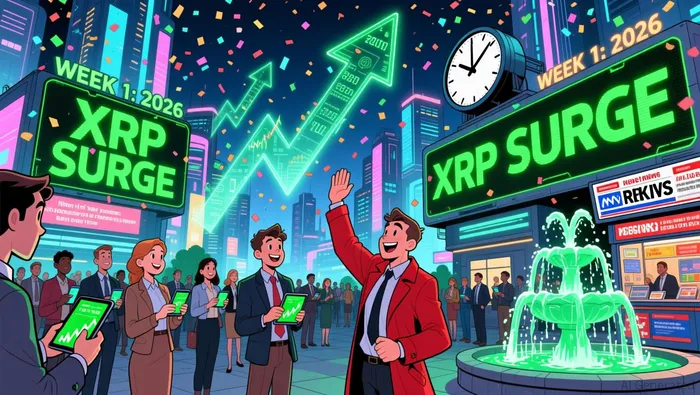
XRP has surged in early 2026, rising from $1.77 to $2.38 in the first week of the year according to reports. This growth has been driven by institutional demand through ETFs and a significant reduction in exchange-held balances by 57% to 1.7 billion tokens as data indicates. These developments signal a shift toward broader institutional acceptance and a reduction in circulating supply, which could influence future price movements.
Institutional investors are increasingly adopting XRP through ETFs, with major asset managers like Franklin Templeton providing access to millions of investors according to industry analysis. This trend is supported by improved regulatory clarity, as the SEC's 2025 ruling removed years of legal uncertainty, allowing XRP to be integrated into mainstream investment portfolios as reported.
Ripple's ODL service, which leverages XRP for fast and low-cost cross-border payments, has become a critical use case for the token as data shows. The service has processed more than $15 billion in transactions, demonstrating XRP's role as a bridge currency in global finance. This utility complements the speculative demand seen in ETFs and positions XRP as both a speculative and functional asset.
Is XRP a Viable Long-Term Investment in 2026?
The convergence of ETF-driven demand and XRP's real-world utility in cross-border payments creates a compelling investment case. However, investors must consider the risks associated with token supply constraints and macroeconomic conditions according to reports. Institutional adoption through ETFs has provided XRP with a degree of legitimacy, but its long-term value will depend on continued innovation and integration into global payment systems.
Ripple's partnerships with major banks and the launch of its RLUSD stablecoin further support XRP's utility by linking payment volume to token demand through transaction fees and stablecoin adoption as data indicates. This could help bridge the gap between speculative ETF inflows and real-world usage, reinforcing XRP's value proposition.
What Institutional Strategies Are Shaping XRP's Market Dynamics?
Institutions are employing sophisticated options strategies like covered calls and protective puts on XRP, similar to those used with BitcoinBTC-- according to industry reports. These strategies allow investors to manage risk and generate yield while holding the underlying asset. The adoption of these strategies has reduced XRP's volatility and created accumulation pressure, supporting its price and attracting more institutional participation.
Additionally, Ripple is exploring Amazon Bedrock AI to enhance the efficiency of XRP Ledger operations by using AI agents to analyze system logs according to analysis. This could reduce operational risks and improve scalability, making the XRP Ledger more attractive to banks and payment processors. While this does not directly impact XRP's price, it strengthens the network's reliability and long-term appeal to institutional users.
The integration of advanced AI tools into XRP Ledger operations signals Ripple's commitment to positioning the network as a production-grade financial infrastructure as reported. This aligns with broader industry trends where AI and blockchain are converging to build more secure and efficient financial systems. As XRP becomes easier to operate and scale, it may see increased adoption in enterprise environments, further supporting its long-term value.

mezclar la sabiduría tradicional del comercio con los datos de vanguardia de la criptomoneda.
Latest Articles
Stay ahead of the market.
Get curated U.S. market news, insights and key dates delivered to your inbox.


AInvest
PRO
AInvest
PRO



Comments
No comments yet