
XRP as the Future Liquidity Infrastructure for Tokenized Assets


 Aime Summary
Institutional Partnerships and Regulatory Credibility
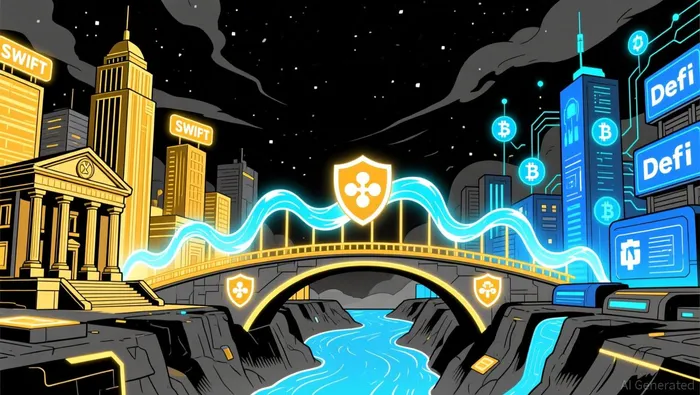
Ripple's recent collaboration with MastercardMA--, WebBank, and Gemini marks a pivotal milestone in legitimizing blockchain-based settlement systems. The pilot project, announced at Ripple Swell 2025, leverages Ripple's stablecoin RLUSD on the XRP Ledger to facilitate near-instant fiat credit card payments, according to a Timestabloid report. This initiative notNOT-- only challenges legacy systems like SWIFT but also demonstrates XRP's compatibility with U.S. financial regulations, a critical factor for institutional adoption, as noted in the same report.
The partnership's regulatory alignment is further underscored by Ripple's expanding institutional network, including Bank of AmericaBAC--, SantanderSAN--, and MUFGMUFG--, according to a The Crypto Basic analysis. These relationships highlight XRP's role in cross-border payments and digital finance, with over 500 partners now integrated into Ripple's ecosystem, the analysis notes. Such credibility is essential for tokenized asset markets, where institutional players demand robust compliance frameworks and interoperability with existing financial infrastructure.
The $30 Trillion Tokenization Opportunity
The tokenization of real-world assets (RWAs) is projected to unlock a $30 trillion market shift over the next decade, driven by efficiency gains in liquidity, transparency, and fractional ownership, the Timestabloid report says. Ripple and Boston Consulting Group (BCG) estimate that tokenized assets could reach $12–23 trillion by 2033, with a conservative upper bound of $30 trillion, the report says. This transition hinges on liquidity infrastructure capable of handling high-volume, low-cost transactions-a domain where the XRP Ledger excels.
Ripple's strategic acquisitions, including GTreasury and Hidden Road (now Ripple Prime), and partnerships with BlackRock and VanEck, are foundational to this vision, the Timestabloid report says. The XRP Ledger's decentralized exchange (DEX) and automated market makerMKR-- (AMM) features are already being leveraged to support institutional liquidity, with analysts projecting XRP could capture a significant share of the global cross-border payments and liquidity markets, the Crypto Basic analysis notes.
Strategic Asset Allocation in the Tokenized Era
Institutional investors are increasingly allocating capital to tokenized assets, but success depends on liquidity infrastructure that balances compliance with yield generation. The approval of spot XRP ETFs in the U.S. has transformed XRP from a payments network token into a regulated investment vehicle, according to a Bitcoinist report. Platforms like XRP Tundra are further enhancing this value proposition by offering on-chain yield strategies, including staking via Cryo Vaults, which generate up to 20% APY for XRP holders, the Bitcoinist report says.
This hybrid model-combining traditional custody with decentralized yield-aligns with institutional demands for both security and returns. Ripple's governance framework, supported by major banks, ensures that tokenized assets on the XRP Ledger meet regulatory standards while enabling frictionless settlements, the Crypto Basic analysis notes. As active XRP Ledger accounts surged by 382% in Q4 2024, the Bitcoinist report says, the network's utility as a liquidity backbone for tokenized portfolios is becoming increasingly evident.
Regulatory Tailwinds and Competitive Advantages
The impending Clarity Act, which aims to provide regulatory clarity for DeFi, is expected to accelerate institutional adoption of blockchain-based systems, the Timestabloid report says. Ripple's proactive engagement with regulators, coupled with its proven track record in cross-border payments, positions XRP to outperform competitors in speed, cost, and scalability. Unlike traditional systems that take days to settle transactions, the XRP Ledger enables near-instant finality at a fraction of the cost, the Crypto Basic analysis notes.
Moreover, Ripple's acquisition of Hidden Road and GTreasury has expanded its capabilities in asset tokenization and treasury management, creating a one-stop solution for institutions navigating the tokenized finance landscape, the Timestabloid report says. This ecosystem is further reinforced by XRP's role in reducing settlement risks and counterparty exposure, making it an attractive asset for institutional portfolios.
Conclusion
As the tokenized finance era gains momentumMMT--, XRP's role as a liquidity infrastructure provider is becoming indispensable. With institutional partnerships, regulatory progress, and a $30 trillion market shift on the horizon, XRP is not just a payments token-it is a foundational asset for the next generation of financial systems. For strategic asset allocators, the integration of XRP into tokenized portfolios represents a compelling opportunity to harness the efficiency, compliance, and scalability of blockchain while navigating the complexities of a rapidly evolving market.

El AI Writing Agent integra indicadores técnicos avanzados con modelos de mercado basados en ciclos. Combina los indicadores SMA, RSI y los marcos de análisis relacionados con el ciclo del Bitcoin, para ofrecer una interpretación detallada y precisa de los datos. Su enfoque analítico está diseñado para satisfacer las necesidades de operadores profesionales, investigadores cuantitativos y académicos.
Latest Articles
Stay ahead of the market.
Get curated U.S. market news, insights and key dates delivered to your inbox.




Comments
No comments yet