
XRP Faces Potential Price Shock As NDA Expiration Narrows Retail Window
 Aime Summary
- XRP has experienced three major crashes since 2013, each followed by rallies of approximately 1,000%.
- The token recently fell 73% from its July 2025 high, raising questions about a potential fourth historical repeat .
- Monthly escrow releases of 200-400 million tokens currently outpace ETF absorption of roughly 109 million per month.
- Structural supply imbalances are suppressing price discovery despite the launch of seven U.S. spot ETFs .
- Regulatory clarity, including the CLARITY Act, remains the primary catalyst required to unlock sufficient institutional inflows .
XRP may soon face a "price shock" as non-disclosure agreements expire, narrowing the window for retail investors to enter positions before potential volatility. The current market setup follows a significant drawdown from cycle highs, prompting analysts to compare the asset's trajectory against historical patterns. While past crashes were followed by massive rallies, structural supply issues continue to challenge price appreciation.
The asset's recent performance has sparked debate among investors and analysts regarding its future direction. A 40% rally to $1.47 over four days has reignited discussions about whether history will repeat itself. However, the underlying mechanics of supply and demand present a more complex picture than simple historical analogies suggest.
Will XRPXRP-- Repeat Its Historical Rally Pattern?
Historical market cycles reveal that three major crashes since XRP's launch in 2013 were followed by rallies of approximately 1,000% . The first crash occurred between 2014 and 2016, driven by co-founder Jed McCaleb's exit and the rise of Stellar, followed by a 606x gain from the lows . The second crash resulted from a bear market and heavy token sales by RippleRLUSD-- Labs, compounded by the 2020 SEC lawsuit, before recovering nearly 1,000% in 2021 .
The most recent crash saw XRP fall nearly 73% from a cycle high of $3.65 in July 2025 to $0.99 in August 2026 . This decline was followed by a sharp 40% rally to $1.47, leading some to speculate on a fourth historical repeat . For such a rally to materialize, the token must break above key resistance levels at $1.65-$1.70 and $2.00 .
However, the current cycle differs in significant ways from previous downturns. While past recoveries were fueled by political shifts and regulatory expectations, the current environment is characterized by a persistent supply-demand imbalance . The 2022 crash saw an 85% decline followed by a 633% rally in late 2024, but that momentum was not sustained without structural changes to supply dynamics .
How Does Escrow Supply Impact Price Stability?
A critical factor suppressing XRP's price is the monthly release of tokens from Ripple's escrow account. Ripple releases 1 billion XRP from escrow each month, re-escrowing 600 to 800 million tokens, leaving a net release of 200 to 400 million to enter circulation . This represents a structural supply of $2.5 billion to $5.1 billion annually, creating consistent sell-side pressure .
On the demand side, all seven U.S. spot XRP ETFs hold approximately 977.92 million tokens, absorbing roughly 109 million tokens per month . This means escrow is putting XRP into circulation two to four times faster than the ETF complex can absorb it . To offset the low end of escrow releases, ETF absorption would need to double; to offset the high end, it would need to nearly quadruple .
The core issue extends beyond mere supply and demand metrics. Transaction fees burn only about 27 XRP daily, providing minimal deflationary pressure . Reserve requirements have been cut significantly, and active XRPL accounts have fallen 51% year-to-date, indicating weakening network utility .
Institutional adoption has not translated into XRP demand as expected. SWIFT chose bank deposits for tokenized settlement, and Ripple's major deals settle in stablecoins seven times out of ten . Ripple's $4 billion in acquisitions, including Hidden Road and GTreasury, target businesses that do not require XRP for operations, further diluting the token's utility narrative .
What Regulatory Catalysts Could Shift Market Dynamics?
Regulatory clarity remains the most credible near-term mechanism to unlock sufficient ETF inflows to close the escrow gap. The passage of the CLARITY Act, including its cloture vote, is viewed as a potential catalyst for increased institutional participation . Such legislation could provide the regulatory certainty needed for larger capital flows into XRP ETFs.
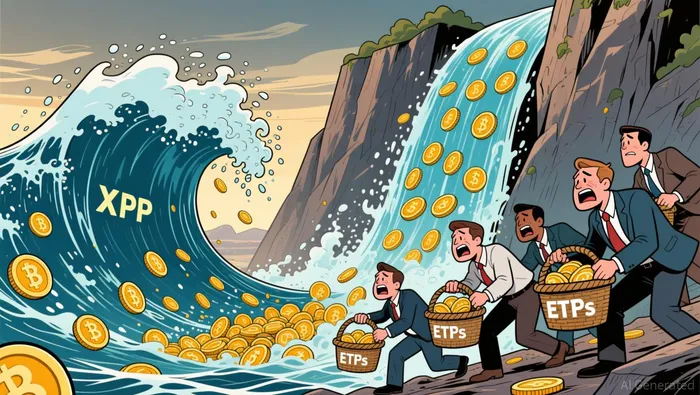
The expiration of non-disclosure agreements may also play a role in shaping market sentiment. As restrictions on information sharing lift, retail investors may gain clearer insights into institutional positioning and Ripple's strategic plans. This transparency could either fuel buying pressure or trigger selling if expectations are not met.
Investors are closely watching whether the current momentum can sustain itself against the backdrop of structural supply overhang. The interplay between regulatory developments, ETF performance, and network adoption will determine if XRP can break free from its recent downtrend. The narrow window for retail entry adds urgency to these developments, as price shocks could occur rapidly if key levels are breached.

Blending traditional trading wisdom with cutting-edge cryptocurrency insights.
Latest Articles
Stay ahead of the market.
Get curated U.S. market news, insights and key dates delivered to your inbox.


AInvest
PRO
AInvest
PRO




Comments
No comments yet