
XRP Faces Growing Challenges From RLUSD and Market Dynamics
 Aime Summary
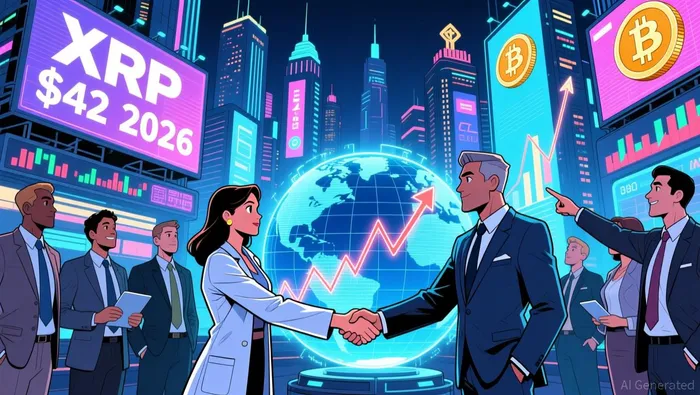
- Analyst EGRAG predicts XRPXRP-- could reach $42 in 2026 based on a recurring chart pattern since 2014, though this would require unprecedented institutional adoption.
- Ripple's stablecoin RLUSD has grown to a $1.56 billion market cap, potentially reducing XRP's role as a bridge asset and drawing attention from institutional investors according to reports.
- Daily transactions on the XRP Ledger surged to 2.5 million in early 2026, indicating growing utility despite a subdued price as data shows.
XRP's price trajectory is being analyzed through multiple lenses. Technical analysts are watching for a potential breakout based on historical chart patterns, suggesting a $42 price target if institutional adoption accelerates as predicted by analysts. This outcome would require XRP to become a dominant asset in global cross-border settlements, a scenario seen as extreme but not impossible. However, such a projection also implies a market cap of $2.56 trillion, surpassing the total crypto market today.
Meanwhile, XRP's core value proposition is being challenged by Ripple's own RLUSD. The stablecoin's adoption has grown significantly since 2025, from $132 million to $1.56 billion, offering a stable alternative for cross-border transactions according to financial analysis. Institutions, which prioritize stability, are increasingly favoring RLUSD over XRP. This shift could reduce XRP's utility within the RippleRLUSD-- ecosystem, potentially limiting long-term price upside.
Infrastructure developments and on-chain activity present mixed signals. The XRP Ledger has seen a resurgence in daily transactions, reaching nearly 2.5 million, driven by wallet adoption and decentralized services as reported. Xaman Wallet alone reported onboarding over 50,000 new users in early 2026, reflecting growing user engagement. However, XRP lacks smart contract functionality and mining capabilities, putting it at a disadvantage compared to BitcoinBTC-- and EthereumETH-- according to market analysis.
Will XRP's Fundamentals Support Price Recovery?
XRP remains in a stronger position than in previous downturns, with Ripple expanding its infrastructure through acquisitions in custody, brokerage, and payment services as industry reports indicate. The company has launched seven spot ETFs and secured over 75 global licenses, signaling institutional confidence. Despite a 62% price decline from its peak, XRP ETFs have recorded $1.44 billion in inflows, locking 785 million XRP in custody. Analysts suggest XRP could reach $3 or higher if Bitcoin remains above $75,000, though the $42 target remains speculative.
The XRP Ledger's structured token issuance process also supports broader use cases such as decentralized finance and tokenized assets according to technical documentation. This capability, combined with low transaction costs and fast settlement times, attracts developers and users. However, without smart contract support, XRP cannot match the versatility of Ethereum or the scarcity model of Bitcoin, both of which have clearer growth trajectories as market research shows.
How Will Market and Regulatory Factors Influence XRP's Future?
Regulatory clarity has improved for XRP, but challenges remain. While the SEC lawsuit concluded, the judge ruled that XRP is still considered a security when sold to institutional investors according to legal analysis. This classification could limit institutional accumulation and increase legal risks for Ripple. Additionally, macroeconomic headwinds, including inflation and geopolitical tensions, are likely to dampen demand for risk assets in the near term as economic forecasts indicate.
The growing popularity of self-custody solutions is also shaping XRP adoption. Xaman Wallet has become a key on-ramp for new users, emphasizing control and security over centralized platforms according to user reports. As more developers launch projects on the XRP Ledger, wallets like Xaman will continue to serve as entry points for a broader user base. However, without institutional demand or regulatory certainty, XRP's price may remain volatile and capped in the short term.
Investors are watching for a balance between bullish on-chain activity and bearish structural and regulatory constraints. While the technical outlook suggests potential, the fundamental case for XRP remains uncertain. The market will need to resolve these tensions before a clear direction emerges.

Blending traditional trading wisdom with cutting-edge cryptocurrency insights.
Latest Articles
Stay ahead of the market.
Get curated U.S. market news, insights and key dates delivered to your inbox.


AInvest
PRO
AInvest
PRO



Comments
No comments yet