
XRP's Evolving Utility: From Payments to Passive Income via Cloud Mining


 Aime Summary
In 2025, XRPXRP-- has transcended its speculative origins to become a cornerstone of global financial infrastructure. Ripple's XRP Ledger (XRPL) is no longer just a buzzword in crypto circles—it is a proven solution for cross-border payments, trade finance, and treasury operations. With institutional adoption accelerating and regulatory clarity emerging, XRP's utility is expanding into new frontiers, including passive income generation through innovative tools like the Gemini XRP MastercardMA-- and cloud mining contracts. For investors, this evolution presents a compelling case for XRP as both a functional asset and a strategic investment.
XRP as a Global Payment Infrastructure
The XRP Ledger's real-world adoption is anchored in its ability to solve pain points in traditional finance. Ripple's On-Demand Liquidity (ODL) service has become a critical tool for banks and payment processors seeking to replace slow, costly correspondent banking systems. Institutions like SantanderSAN--, SBI Holdings, and Tranglo are leveraging XRP to enable real-time cross-border transactions, reducing settlement times from days to seconds while slashing costs by up to 70%.
A landmark example is Linklogis, a Hong Kong-listed fintech platform that processed $2.9 billion in cross-border trade assets on the XRP Ledger in 2025. By tokenizing trade receivables, Linklogis demonstrated XRP's potential to unlock liquidity in emerging markets, where traditional systems often fail due to infrastructure gaps. This use case underscores XRP's role as a bridge between legacy finance and blockchain-based solutions, particularly for high-volume corridors in Asia, Africa, and Latin America.
Passive Income: The Gemini XRP Mastercard and Cloud Mining
While XRP's institutional adoption is well-documented, its utility for retail investors is equally transformative. The Gemini XRP Mastercard, launched in 2025, allows users to earn rewards in XRP while making everyday purchases. Unlike traditional credit cards, this tool integrates spending, earning, and value appreciation into a single ecosystem. Users earn XRP-based rewards based on purchase categories, effectively turning daily expenses into a compounding income stream. This innovation aligns with Ripple's broader vision of making cryptocurrency a practical, real-world currency.
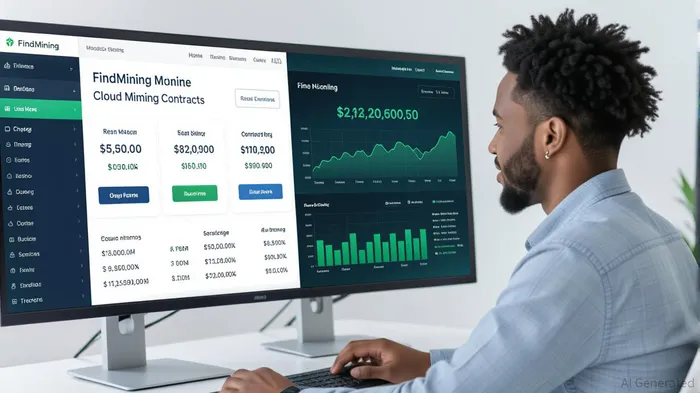
Simultaneously, cloud mining platforms like FindMining and SolMining have democratized access to XRP-based passive income. These platforms offer user-friendly contracts that let investors leverage their XRP holdings to generate returns without technical expertise. For instance, the "Quantum Miner" contract requires a $150,000 investment and yields $2,850 daily in returns over 47 days. Smaller contracts, such as the "Beginner Miner," cater to retail investors with lower capital, offering a daily return of $3.50 for a $100 investment.
What sets these contracts apart is their automated settlement system, which distributes earnings daily to users' wallets. This eliminates the need for manual tracking and ensures transparency. Additionally, the ability to pay for contracts using XRP or Ripple USD (RLUSD) reduces exposure to price volatility, making the process more accessible to a broader audience.
Regulatory Clarity and Institutional Legitimacy
A critical catalyst for XRP's adoption has been the U.S. SEC's 2025 ruling that XRP is not a security in secondary trading. This decision removed a major barrier for institutional adoption, enabling banks and financial entities to integrate XRP into their operations without legal uncertainty. Ripple's push for XRP-based ETFs further cements its legitimacy as a strategic asset, attracting institutional capital and long-term investors.
Moreover, XRP's role in bridging traditional finance with digital assets is gaining traction. Central banks and financial institutionsFISI-- are exploring its potential as a neutral bridge asset for CBDCs, stablecoins, and tokenized real-world assets (RWAs). This interoperability positions XRP as a linchpin in the next phase of financial innovation, where blockchain and legacy systems coexist.
Investment Implications
For investors, XRP's dual utility—functional infrastructure and passive income generation—creates a unique value proposition. Unlike speculative assets that rely solely on price appreciation, XRP offers tangible use cases that drive demand. The growing adoption by enterprises, coupled with tools like the Gemini Mastercard and cloud mining contracts, ensures that XRP's value is underpinned by real-world utility rather than market sentiment alone.
However, investors should approach with a balanced strategy. While XRP's institutional adoption and passive income mechanisms are promising, the crypto market remains volatile. Diversification and risk management are essential. For those seeking exposure to blockchain-driven finance, XRP's ecosystem provides a compelling blend of innovation, scalability, and practicality.
Conclusion
XRP's journey from a speculative token to a foundational financial infrastructure asset is a testament to Ripple's vision and the XRP Ledger's capabilities. As enterprises, banks, and individuals increasingly adopt XRP for cross-border payments, trade finance, and passive income, its value proposition becomes more robust. For investors, the convergence of real-world utility and income-generating tools like the Gemini XRP Mastercard and cloud mining contracts offers a unique opportunity to participate in the future of finance. In a world where blockchain is reshaping global systems, XRP stands out as a bridge between tradition and innovation—a role that is likely to define its trajectory in the years ahead.

Decoding blockchain innovations and market trends with clarity and precision.
Latest Articles
Stay ahead of the market.
Get curated U.S. market news, insights and key dates delivered to your inbox.




Comments
No comments yet