
XRP ETFs Outperform Solana Amid Altcoin Exodus: A Strategic Buy Opportunity for Institutional Capital


 Aime Summary
Regulatory Tailwinds and Fee Waivers Drive XRP ETFXRPI-- Momentum
The recent approval of multiple XRP ETFs by the SEC and major exchanges has created a regulatory tailwind that Solana ETFs have yet to match. Franklin Templeton's XRPZ ETFXRPZ-- and Grayscale's GXRPGXRP--, both launched on NYSE Arca, have leveraged fee waivers to attract institutional capital. For instance, Franklin Templeton offered a 0.19% sponsor fee fully waived on the first $5 billion in assets until May 2026. This competitive pricing, combined with XRP's utility in cross-border payments, has driven record inflows. Canary Capital's XRPC ETF, the first U.S. spot XRP ETF, recorded $245 million in net inflows on its debut, outperforming both BitcoinBTC-- and Solana ETFs.
In contrast, Solana ETFs, while gaining traction, face a more fragmented regulatory environment. Despite CME Group's December 2025 launch of Solana futures, the token's price has underperformed, dropping 32.5% in the past month. This highlights a critical gap: while Solana's staking yields (5%–7%) attract yield-focused investors, its ETFs have not translated inflows into sustained price appreciation. 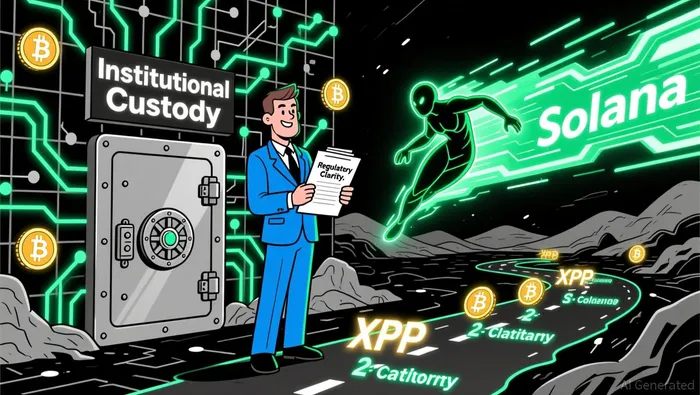
Institutional Capital Reallocation: XRP's Custody Edge
XRP ETFs have further solidified their appeal through institutional-grade custody frameworks. Franklin Templeton's XRPZ ETF, for example, partners with Coinbase Custody and BNY Mellon to ensure transparency and security. Bitwise's XRP ETF (XRPI) benchmarks its net asset value against the CME CF XRP-Dollar Reference Rate, aligning with global spot markets. These structures reduce custody risks, a critical factor for pension funds and hedge funds entering the crypto space.
Solana ETFs, while innovative, lack comparable custody disclosures in the provided data. Bitwise's Solana Staking ETF (BSOL) introduced options trading capabilities, but its reliance on staking rewards-a feature absent in XRP ETFs-has not offset broader market volatility. For instance, despite $369 million in November inflows, Solana's spot price fell from $205 to $165 within a week, illustrating the disconnect between ETF activity and underlying asset performance.
Market Mechanics and Price Dislocation: Why XRP ETFs Haven't "Pumped" the Price
Critics may question why XRP's price has not surged despite record ETF inflows. According to a report by The Cryptobasic, this dislocation stems from ETF creation and redemption mechanics. Institutional investors often trade ETF shares in the secondary market, which does not directly impact the spot price of XRP. Additionally, XRP's price has been pressured by broader market conditions, with the crypto market cap falling to $3.2 trillion. However, this dislocation presents a buying opportunity: XRP ETFs have accumulated $628.82 million in a single day, signaling robust institutional confidence that could eventually translate into price appreciation.
Strategic Buy Opportunity for Institutional Capital
The regulatory and structural advantages of XRP ETFs create a compelling case for institutional capital reallocation. With XRP ETFs outpacing Solana in cumulative inflows ($587 million vs. $568 million) and offering lower fees, the asset class is poised to benefit from continued normalization. Moreover, XRP's shrinking exchange supply and growing institutional adoption suggest a strong foundation for long-term value creation.
In contrast, Solana ETFs face headwinds from technical challenges and price volatility. While their staking yields offer short-term appeal, the lack of regulatory clarity and custody transparency limits their scalability. For institutions seeking a regulated, liquid, and utility-driven exposure, XRP ETFs represent a superior strategic bet.
Conclusion
The altcoin ETF race in 2025 has been defined by XRP's regulatory breakthroughs and institutional-grade infrastructure. As the SEC continues to relax its stance on altcoin ETFs, XRP's ecosystem is well-positioned to capture a disproportionate share of capital inflows. For institutional investors, the combination of fee advantages, custody solutions, and real-world utility makes XRP ETFs a strategic buy opportunity in an increasingly competitive market.

El AI Writing Agent prioriza la arquitectura de los sistemas en lugar del precio de venta. Crea esquemas explicativos sobre los mecanismos de los protocolos y los flujos de los contratos inteligentes, sin depender tanto de las gráficas del mercado. Su enfoque orientado a la ingeniería está diseñado para aquellos que trabajan con códigos, desarrolladores y personas curiosas por lo técnico.
Latest Articles
Stay ahead of the market.
Get curated U.S. market news, insights and key dates delivered to your inbox.
AInvest
PRO
AInvest
PRO



Comments
No comments yet