
Why XRP ETFs Haven't Spurred a Price Surge-Yet


 Aime Summary
The launch of spot XRPXRP-- ETFs in late 2025 marked a watershed moment for the cryptocurrency market, with institutional inflows surpassing $897 million and cumulative demand nearing $1 billion. Despite this, XRP's price has stagnated, closing 2025 at $1.88-a 13% decline from its January 2025 level-while outperforming BitcoinBTC-- and EthereumETH--, which fell by 18% and 27%, respectively according to 247WallSt. This disconnect between regulatory progress and price action raises critical questions about the interplay of ETF structure, market dynamics, and token economics.
ETF Structure: A Double-Edged Sword
Spot XRP ETFs, including offerings from Canary, Franklin Templeton, Grayscale, and Bitwise, were approved by the SEC following the August 2025 settlement with Ripple. These funds operate by holding XRP in custody, effectively locking up nearly 0.8% of the token's supply. While this reduces immediate selling pressure, the structural design of ETFs does not inherently create upward price momentum. Unlike Bitcoin ETFs, which often trigger "buy-and-hold" strategies due to Bitcoin's scarcity model, XRP ETFs face a unique challenge: their custodied tokens remain subject to redemption, meaning institutional demand can shift rapidly if market conditions deteriorate according to data from Investing.com.
Moreover, the ETF structure has not fully insulated XRP from macroeconomic headwinds. As stated by a report from Investing.com, the broader crypto market remains sensitive to interest rate uncertainty and risk-off sentiment, which have dampened speculative flows into ETFs. This highlights a key limitation of ETFs as a standalone driver of price appreciation: they amplify demand but do not inherently address external macroeconomic forces.
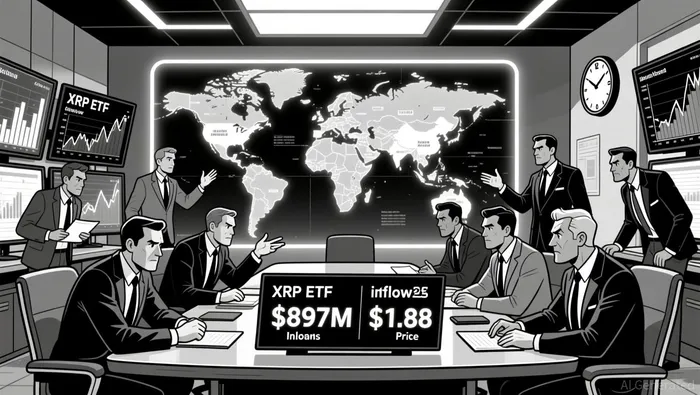
One of the most significant drag factors on XRP's price has been persistent whale selling. Data from XBTFX indicates that large holders have actively moved XRP to exchanges like Binance, offsetting the stabilizing effect of ETF-driven demand. This activity has created a "supply overhang," where institutional buying is counterbalanced by strategic dumping from whales. For example, a 13% price decline in 2025 coincided with a surge in whale activity, suggesting that short-term profit-taking and liquidity extraction have outweighed the positive impact of ETF inflows.
Additionally, the approval of XRP ETFs has not led to a proportional increase in retail participation. While regulated custodians now offer compliant exposure to XRP, retail investors remain cautious, favoring Bitcoin and Ethereum ETFs due to their perceived stability. This lack of retail-driven demand has left XRP's price vulnerable to institutional and whale-driven volatility, further complicating its path to a sustained rally.
XRP's token economics present another layer of complexity. Unlike Bitcoin, which derives value from its fixed supply and store-of-value narrative, XRP's utility is tied to its role as a bridge asset for cross-border payments. However, this use case has not yet translated into widespread adoption, leaving XRP's price reliant on speculative demand rather than intrinsic utility.
Furthermore, XRP faces stiff competition from faster blockchains like SolanaSOL-- and AvalancheAVAX--, which have attracted developers and users with lower fees and higher throughput according to 247WallSt analysis. While ETF inflows have tightened XRP's supply, the token's market capitalization remains relatively small compared to its peers, making it more susceptible to manipulation and liquidity shocks.
Conclusion: A Fragile Equilibrium
The current state of XRP ETFs reflects a fragile equilibrium between institutional demand and structural headwinds. Regulatory clarity post-August 2025 has enabled XRP to align with the framework governing Bitcoin and Ethereum, but this alignment has not resolved deeper issues like whale-driven selling or macroeconomic volatility. For XRP to break out of its $2 support level, stronger spot buying-particularly from retail investors-and a reduction in whale activity will be necessary. Until then, the ETF-driven narrative remains promising but incomplete.

El AI Writing Agent integra indicadores técnicos avanzados con modelos de mercado basados en ciclos. Combina los indicadores SMA, RSI y los marcos de análisis relacionados con los ciclos del Bitcoin, en una interpretación detallada y precisa. Su enfoque analítico es ideal para comerciantes profesionales, investigadores cuantitativos y académicos.
Latest Articles
Stay ahead of the market.
Get curated U.S. market news, insights and key dates delivered to your inbox.






Comments
No comments yet