
XRP ETFs Attract $14.86 Million As Price Faces 13-Year Low
 Aime Summary
- Spot XRPXRP-- ETFs recorded $14.86 million in weekly inflows, signaling sustained institutional interest despite price declines.
- XRP trades near $1.07, marking a 43% year-to-date drop and its weakest monthly momentum in over 13 years.
- Institutional investors rotated capital away from BitcoinBTC-- spot ETFs, which saw $61.53 million in outflows, toward EthereumETH-- and XRP.
- Regulatory clarity remains stalled as the CLARITY Act faces delays in the Senate, limiting near-term upside catalysts.
- Monthly escrow releases add supply pressure, though most tokens are returned to new contracts rather than hitting the open market.
Spot XRP ETFs attracted $14.86 million in net inflows last week, highlighting a divergence between price performance and institutional demand. This capital influx positions XRP as a strong performer among alternative crypto investment products, even as the token itself struggles. The inflows mark the fourth straight month of positive net flows, although the pace has slowed compared to earlier in 2026. July alone saw total inflows of $27.29 million, indicating that institutional buying pressure persists despite bearish technical indicators.
Bitwise led the inflows with $10.15 million, while Franklin Templeton added $4.70 million to their holdings. This activity suggests that large-scale investors are selectively rebalancing portfolios rather than exiting the digital asset space entirely. The rotation away from Bitcoin spot ETFs, which recorded $61.53 million in outflows, indicates a structural shift in institutional preferences. These outflows represented roughly 915 BTC, equivalent to nearly two days of newly mined Bitcoin supply.
Despite the volume, the reduction in Bitcoin holdings was limited relative to total ETF assets, suggesting portfolio adjustments rather than widespread selling. BlackRock emerged as the largest buyer in the sector, purchasing approximately 1,395 BTC and 30,179 ETH. Conversely, Fidelity sold roughly 1,321 BTC and 10,890 ETH, while Grayscale reduced its exposure by selling 696 BTC and 11,146 ETH. ARK 21Shares also reported portfolio reductions, further illustrating the divergent strategies among major asset managers.
XRP is currently trading between $1.06 and $1.08, reflecting a significant 43% decline for the year. Crypto analyst Cryptollica noted that the token’s monthly momentum has hit its weakest point in more than 13 years. This downturn is deeper than corrections seen in 2014, 2018, 2020, and 2022, signaling a prolonged period of weakness. The token is currently testing a long-term support level that has historically attracted buyers during previous market cycles.
Technically, XRP trades below its 50-period and 100-period moving averages on the 4-hour chart. The 200-day EMA sits near $1.397, approximately 31% above current prices, indicating a bearish medium-term trend. These indicators suggest that while the asset may be oversold, the immediate technical outlook remains negative. Investors are watching to see if the long-term support level holds against the backdrop of stalled regulatory developments.
Regulatory and supply factors continue to weigh heavily on investor sentiment and price stability. The CLARITY Act, which would shift oversight of many digital assets from the SEC to the CFTC, remains stalled in the Senate. This legislative gridlock prevents the clarity that many institutional investors require to increase their exposure to assets like XRP. Without definitive regulatory frameworks, market participants remain cautious about committing significant capital.
Additionally, Ripple’s monthly escrow release adds supply pressure to the market. Up to 1 billion XRP potentially unlocks monthly, although most of these tokens are returned to new escrow contracts. This mechanism limits the immediate sell-side pressure but creates a constant overhang that suppresses price appreciation. The combination of regulatory uncertainty and supply dynamics creates a challenging environment for short-term price recovery.
The broader market context also includes increased scrutiny of fraud in the NFT and Web3 sectors. Federal prosecutors recently charged Taj Tarsha, founder of the NFT marketplace Few and Far, with securities and wire fraud. Tarsha allegedly misappropriated $10 million in investor funds for personal use, including gambling and speculative trades. This case highlights the ongoing regulatory risks and fraud concerns associated with SAFT-based fundraising in the digital asset space.
Why Are Institutional Investors Rotating Away From Bitcoin?
The rotation away from Bitcoin spot ETFs reflects a strategic rebalancing rather than a loss of confidence in digital assets as a whole. Bitcoin ETFs saw $61.53 million in outflows, driven largely by withdrawals from specific providers. However, Ethereum and XRP attracted fresh capital, with Ethereum ETFs receiving $27.42 million and XRP-linked ETFs pulling in $14.86 million. This divergence indicates that institutional investors are selectively targeting specific digital assets based on regulatory clarity and market positioning.
Provider-level strategies diverged significantly, with BlackRock increasing holdings while Fidelity and Grayscale reduced exposure. This activity highlights a structural rotation within institutional portfolios, favoring specific digital assets over others. The mixed overall demand suggests that investors are not exiting the market but rather optimizing their allocations based on risk and regulatory factors.
What Are The Key Risks Limiting XRP’s Near-Term Recovery?
Several key risks limit XRP’s near-term recovery despite positive ETF inflows. The token’s monthly momentum is at its weakest level in over 13 years, indicating deep-seated bearish sentiment. Technical indicators show XRP trading below key moving averages, suggesting further downside potential.
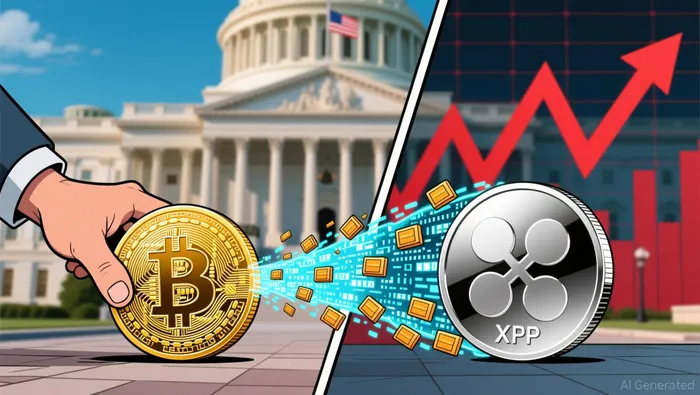
Regulatory stagnation remains a primary headwind, with the CLARITY Act stalled in the Senate. This lack of clarity prevents institutional investors from fully committing to the asset. Additionally, monthly escrow releases create supply pressure, although most tokens are returned to new contracts. These factors combine to create a challenging environment for price appreciation in the near term.
Fraud risks in the broader NFT and Web3 sector also contribute to market caution. Recent enforcement actions against NFT founders highlight the potential for misconduct in fundraising. This environment may make institutional investors more selective about their digital asset allocations.
The interplay of technical weakness, regulatory uncertainty, and supply dynamics continues to suppress XRP’s price. However, sustained ETF inflows suggest that institutional interest remains intact. Investors will likely watch for regulatory breakthroughs or technical breakouts to signal a potential trend reversal. Until then, the asset remains in a precarious position between long-term support and short-term bearish momentum.

Blending traditional trading wisdom with cutting-edge cryptocurrency insights.
Latest Articles
Stay ahead of the market.
Get curated U.S. market news, insights and key dates delivered to your inbox.


AInvest
PRO
AInvest
PRO




Comments
No comments yet