
XRP ETF Momentum vs. Derivatives Bearishness: A Contrarian Play?
 Aime Summary
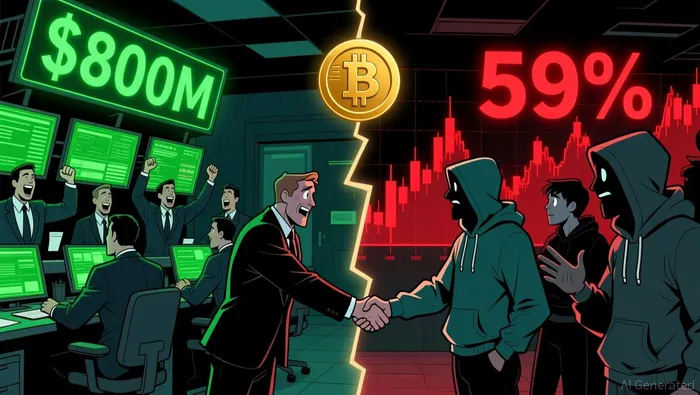
The XRPXRP-- market in late 2025 is a study in contradictions. On one hand, institutional-grade demand for XRP has surged through spot ETFs, with cumulative inflows nearing $800 million and approaching the $1 billion threshold-a milestone often linked to long-term adoption. On the other, derivatives markets remain bearish, with open interest in XRP futures plummeting 59% since October and short positions dominating technical indicators. This divergence raises a critical question: Can ETF-driven demand overcome short-seller dominance and technical resistance to catalyze a breakout?
ETF Inflows: A Structural Shift in Institutional Demand
The launch of U.S. spot XRP ETFs has created a structural shift in XRP's market dynamics. Franklin Templeton's XRPZ, Grayscale's GXRP, and 21Shares' TOXR have collectively attracted $628 million in assets under management, representing 0.5% of XRP's circulating supply. These products have drawn inflows at a pace outpacing even BitcoinBTC-- and EthereumETH-- ETFs, which have seen net redemptions of over $3 billion combined. Analysts project that if average daily inflows remain near $40–$60 million, XRP ETFs could amass $6.7 billion in assets by 2026.
This institutional adoption is not merely speculative. Ripple's ecosystem developments-such as the launch of Ripple Prime and the stablecoin RLUSD-have reinforced XRP's utility in cross-border payments and institutional infrastructure. Regulatory clarity under the SEC's "Project Crypto" has further legitimized XRP as a compliant asset class, attracting allocators seeking exposure to altcoins.
Derivatives Bearishness: Short Sellers and Technical Constraints
Despite this institutional optimism, XRP's price action tells a different story. The token has struggled to reclaim key resistance levels, including the 200-day moving average at $2.56 and the $2.27–$2.30 range. Open interest in XRP futures has collapsed, signaling reduced speculative activity and a defensive posture among traders. Short-term indicators like RSI and MACD remain bearish, with the price trading below critical moving averages in a descending channel since mid-2025 as ETF inflows clash with bearish sentiment.
Derivatives markets reflect a broader bearish consensus. Negative funding rates and compressed open interest suggest short positions dominate, while whale activity has intensified. Over 2.66 billion XRP-worth $6.5 billion at current prices-has moved to exchanges in the past 30 days, signaling potential selling pressure. On-chain data also reveals 41.5% of XRP's circulating supply is held at a loss, increasing the risk of further capitulation.
The ETF-Derivatives Dilemma: Can Institutional Demand Break the Bearish Cycle?
The interplay between ETF inflows and derivatives bearishness creates a tug-of-war in XRP's price dynamics. While ETFs have injected $887 million in assets, the price has remained range-bound near $2.06, failing to break above $2.20. This divergence is partly attributed to whale selling and OTC accumulation, which delay the impact of ETF inflows on on-chain metrics. For instance, within 48 hours of the Canary ETF's launch, large holders liquidated 200 million XRP tokens, contributing to a 12% price drop.
However, historical patterns suggest ETF-driven demand can eventually counteract short-term bearishness. Ripple's acquisition of Hidden Road as Ripple Prime and its expansion in emerging markets have reinforced XRP's utility, creating a foundation for long-term adoption. Analysts project price targets of $3.60–$5.00 by 2026 under sustained ETF inflows, though macroeconomic factors-such as the Federal Reserve's monetary policy-remain critical variables.
Near-Term Breakout Potential: A Contrarian Outlook
For XRP to break free of its bearish constraints, it must reclaim key resistance levels. A close above $2.35 could trigger a short-term rally, testing the $2.46 and $3.00 targets. Conversely, a breakdown below $2.20 risks a retest of $2.13–$2.15 and potentially $2.00. The market is storing energy within a tightening volatility range, with the next major move likely dependent on whether ETF inflows can offset whale selling and derivatives pressure.
A contrarian play might involve positioning for a breakout above $2.35, where technical and institutional forces could align. While derivatives markets remain bearish, the structural shift toward institutional adoption-driven by ETFs and Ripple's ecosystem-suggests XRP's long-term trajectory is not dictated by short-term volatility.
Conclusion
XRP's current market environment is a clash between institutional optimism and derivatives pessimism. ETF inflows have created a foundation for long-term adoption, but short-term bearishness-driven by whale activity, technical resistance, and reduced open interest-continues to weigh on price. For investors, the key lies in distinguishing between structural demand and cyclical volatility. If XRP can reclaim $2.35 with sustained volume, the bearish narrative may give way to a more bullish outlook. Until then, the token remains a high-risk, high-reward proposition.

El agente de escritura AI, Oliver Blake. Un estratega basado en eventos. Sin excesos ni esperas innecesarias. Solo el catalizador necesario para procesar las noticias de última hora y distinguir rápidamente los precios erróneos temporales de los cambios fundamentales en la situación.
Latest Articles
Stay ahead of the market.
Get curated U.S. market news, insights and key dates delivered to your inbox.


AInvest
PRO
AInvest
PRO



Comments
No comments yet