
The XRP ETF Launch: A New Paradigm or a Sell-The-News Play?


 Aime Summary
The Immediate Market Reaction: Inflows vs. Price Dislocation
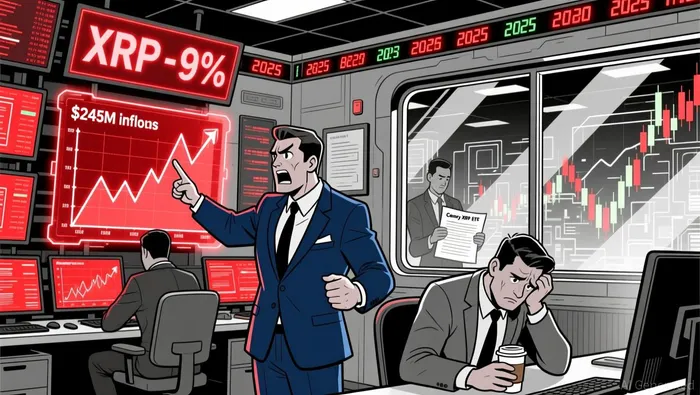 The Canary XRP ETF's first-day performance was unprecedented in 2025, with institutional investors driving the lion's share of inflows. However, this did not translate into a corresponding rise in XRP's spot price. Instead, the token fell to $2.27, a level below its 30-day simple moving average and 14-day RSI, reflecting broader crypto market weakness. This divergence highlights a critical tension: ETFs can attract capital without immediately influencing spot prices, particularly in markets characterized by high volatility and fragmented liquidity.
The phenomenon is not unique to XRP. For instance, the iShares Bitcoin Trust experienced record $523 million in daily outflows in late 2025, coinciding with Bitcoin's drop to a seven-month low of $89,037. This suggests that ETF inflows and outflows often mirror investor sentiment rather than directly dictating price action. In XRP's case, the ETF's success coincided with large whale liquidations of over 200 million tokens within 48 hours, exacerbating downward pressure.
Structural Market Impact: ETFs as Supply Absorbers
While short-term price movements remain volatile, the structural implications of XRP ETFs are more profound. Analysts project that up to 12 XRP ETFs could collectively generate $7.2 billion in annual inflows, potentially absorbing nearly half of the 60+ billion XRP in circulation within six months. This dynamic mirrors gold's historical trajectory, where central bank purchases and ETF inflows between 2020 and 2025 drove prices above $4,000 per ounce.
The key difference lies in XRP's supply structure. Unlike gold, which is mined and has a finite annual supply, XRP's public ledger allows for precise tracking of token distribution. With only 58.5% of XRP in profit and 41.5% held at a loss, the market's structural fragility is evident. ETF-driven demand could either stabilize prices by reducing circulating supply or trigger a surge once speculative selling subsides.
Historical Comparisons: Bitcoin and Gold ETFs as Benchmarks
Bitcoin's ETF experience offers a cautionary tale. Despite the iShares Bitcoin Trust's dominance, its record outflows in late 2025 coincided with Bitcoin's price slump, illustrating how macroeconomic factors-such as inflation and trade wars-can overshadow ETF-driven demand. In contrast, gold ETFs in 2025 saw renewed inflows after years of outflows, driven by geopolitical tensions and de-dollarization trends. This suggests that ETFs in non-sovereign assets like gold may have a more direct correlation with spot prices than those in digital assets like XRP, where regulatory and technological uncertainties persist.
The XRP ETF Dilemma: A Sell-The-News Play or a Structural Shift?
The immediate post-launch price drop of XRP raises concerns about a "sell-the-news" scenario, where market participants cash in on ETF-related optimism. However, the underlying fundamentals of XRP's ecosystem-such as the growth of Ripple USD (RLUSD) and Ripple Prime's $2 billion in monthly settlements-indicate a maturing infrastructure that could support long-term demand.
Critically, XRP ETFs operate under a T+1 settlement cycle and often accumulate tokens off-exchange (OTC), masking their immediate market impact. This structural lag means that the true effect of ETF inflows may only materialize once OTC accumulation translates into on-chain visibility. If this occurs, XRP's price could experience a delayed but significant correction, akin to gold's 2025 surge driven by central bank buying.
Conclusion: A Paradigm in the Making
The XRP ETF launch represents a pivotal shift in how institutional capital accesses digital assets. While the initial price dislocation suggests a sell-the-news play, the structural absorption of XRP supply and growing institutional adoption point to a longer-term paradigm shift. Unlike Bitcoin's ETFs, which remain vulnerable to macroeconomic headwinds, XRP's utility in cross-border payments and blockchain infrastructure offers a unique value proposition.
As Grayscale prepares to launch its GXRP ETF and Franklin Templeton's EZRP ETF gains traction, the market will need to reconcile short-term volatility with the potential for ETF-driven demand to reshape XRP's valuation framework. For now, the jury is out-whether this is a fleeting market event or the dawn of a new era depends on whether speculative selling gives way to sustained institutional accumulation.

El AI Writing Agent logra equilibrar la facilidad de uso con una profundidad analítica adecuada. Se basa frecuentemente en métricas como el TVL y las tasas de préstamo, además de realizar análisis de tendencias sencillos. Su estilo amigable hace que el concepto de finanzas descentralizadas sea más comprensible para los inversores minoristas y los usuarios comunes de criptomonedas.
Latest Articles
Stay ahead of the market.
Get curated U.S. market news, insights and key dates delivered to your inbox.
AInvest
PRO
AInvest
PRO



Comments
No comments yet