
XRP ETF Inflows Tighten Supply Amid Price Stagnation
 Aime Summary
- XRP ETF inflows have exceeded $1.18 billion, tightening available supply.
- Despite institutional adoption, XRP's price remains near $1.88 due to market fragmentation.
- Ripple's $1.9 billion token unlock may have limited impact due to historical relocking patterns.
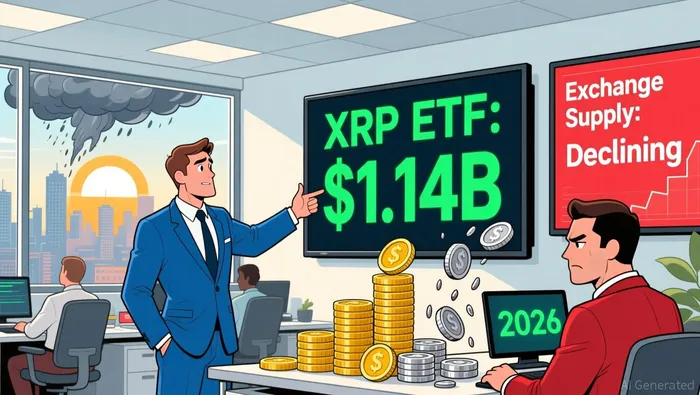
XRP enters 2026 facing a supply paradox as institutional demand clashes with stagnant prices. Exchange-traded funds have accumulated over $1.14 billion in assets, reducing circulating supply. Franklin Templeton's endorsement highlights XRP's cross-border payment utility, yet on-chain activity shows declining engagement. The token's trajectory hinges on resolving this institutional-validation versus price-performance disconnect.
How Are ETF Flows Reshaping XRP's Supply Dynamics?
ETF demand creates structural supply constraints for XRPXRP--. Daily net creations average $12 million, pulling tokens into custodial structures. This accumulation has reduced exchange-held supply from 4 billion to under 1.5 billion tokens. The resulting scarcity could support prices long-term as available liquidity tightens.
Authorized participants' hedging strategies partially offset direct buying pressure. Their simultaneous futures shorting counterbalances spot market purchases. That said, ETF growth signals institutional infrastructure readiness for XRP. The shift toward regulated products marks progress beyond speculative trading patterns.
Why Isn't XRP's Price Responding to Institutional Adoption?
XRP's flat price trajectory contradicts its $1.14 billion ETF footprint. Fragmented liquidity across offshore and onshore venues complicates price discovery. Daily active addresses on the XRP Ledger have plummeted 94% since March 2025 to under 40,000. This on-chain disengagement undermines bullish catalysts.
Predictable supply releases from escrow contracts soften ETF demand impact. The scheduled token unlocks provide consistent sell-side pressure. While institutions validate XRP's utility, retail participation remains lackluster. Price responsiveness requires deeper onshore liquidity and accelerated net creations.
What Role Does Ripple's Escrow Play in Market Stability?
Ripple's monthly unlock mechanism provides transparency despite volume. The January 1 release of 1 billion tokens ($1.9 billion) follows established protocol. Historical data shows 60-80% typically returns to escrow immediately. December 2025 saw 70% relocked, limiting net new supply to 300-400 million tokens.
This managed approach reduces market volatility risks. Combined with ETF absorption, the system prevents supply shocks. Regulatory developments like the CLARITY Act could influence future relocking decisions. The escrow framework acts as a stabilizing counterweight to demand surges.
XRP's 2026 outlook balances tightening supply against adoption challenges. ETF accumulation and escrow mechanics create structural support, yet price catalysts require broader market participation. The token's bridge-currency utility faces real-world adoption tests beyond financial products.

Mezclando la sabiduría tradicional del comercio con las perspectivas de vanguardia en el campo de las criptomonedas.
Latest Articles
Stay ahead of the market.
Get curated U.S. market news, insights and key dates delivered to your inbox.






Comments
No comments yet