
XRP ETF Inflows and Liquidity Crunch: A Transitional Opportunity for Institutional Investors?


 Aime Summary
The crypto market in late 2025 is witnessing a pivotal shift as XRPXRP-- ETFs attract unprecedented institutional capital. With over $1 billion in cumulative inflows since their launch and a 15-day streak of positive net inflows, these funds are reshaping XRP's structural dynamics. Yet, the token remains range-bound near $1.90, caught in a tug-of-war between ETF-driven demand and derivatives-driven selling. For institutional investors, this tension raises a critical question: Is the current liquidity crunch in XRP a transitional opportunity, or a warning sign of deeper structural fragility?
Structural Mechanics of XRP ETFs: Creation, Redemption, and Market Impact
XRP ETFs operate through a creation/redemption model, where authorized participants (APs) issue new shares in exchange for physical XRP custody. This mechanism removes tokens from circulation, effectively tightening supply and creating a structural floor for price stability. According to a report by , XRP ETFs have accumulated over $897 million in net inflows since mid-November, with daily trading volumes reaching $14.98 million, reflecting growing institutional participation.
However, the ETF structure also introduces latency in price discovery. Market makers hedge ETF creations by shorting the underlying asset, offsetting upward pressure on the spot market. This hedging activity, combined with arbitrage between ETF shares and XRP itself, smooths short-term volatility but delays the full realization of demand. For example, despite $8.5 million in inflows on December 16, XRP's price stagnated near $1.90, forming a descending triangle pattern with bullish RSI divergence. This suggests that ETF inflows are stabilizing the asset but not yet overpowering derivatives-driven outflows.
Institutional Strategies: Accumulation, Liquidity Crunch, and Supply Shock
Institutional investors are navigating the liquidity crunch by prioritizing off-chain accumulation. Whale and institutional activity has reduced XRP exchange balances by 34.18% over two months, from 3.95 billion to 2.6 billion tokens. This shift to self-custody has tightened liquidity, creating a supply shock that could amplify price movements if ETF inflows accelerate.
The liquidity crunch is further exacerbated by derivatives markets. Binance's Taker Sell Ratio hit 0.53 in late November-the highest since mid-November-indicating intense selling pressure. Meanwhile, futures open interest has declined 59% since early October, signaling reduced speculative activity. For institutional investors, this divergence between ETF inflows and derivatives outflows presents a paradox: while ETFs inject stability, derivatives markets remain a drag on price.
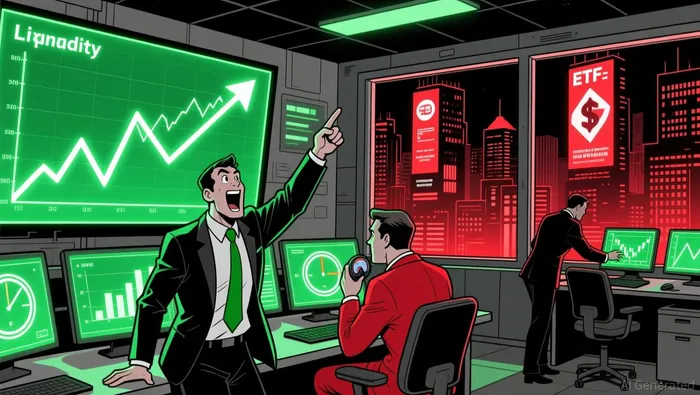
Price Stability and Technical Indicators: A Delicate Balance
XRP's price action underscores the fragility of its current equilibrium. The token consolidates near $1.90, with strong liquidity below this level but a break below $1.90 threatening to invalidate the bullish setup. On-chain metrics add complexity: network velocity hit a yearly high in December, yet transaction fees fell 89% since February, reflecting efficient but less value-intensive activity according to analysts.
Analysts argue that ETF inflows are balancing, but not overpowering, derivatives-driven outflows. notes that XRP's range-bound behavior suggests ETF demand is insufficient to drive a sustained bullish trend. However, the token's institutional appeal is growing. Ripple's acquisition of Hidden Road and launch of Ripple Prime have enhanced XRP's utility in real-time payments, while the August 2025 SEC settlement provided regulatory clarity, legitimizing XRP for compliance-sensitive portfolios.
Regulatory and Market Developments: A New Phase for XRP
The approval of XRP ETFs in late 2025 marks a structural shift from speculative retail trading to long-term custodial accumulation. As stated by , Ripple's institutional wins-including a federal trust charter and expanded cross-border solutions-have positioned XRP as a bridge between traditional finance and crypto. This regulatory progress, coupled with the precedent set by Bitcoin and Ethereum ETF approvals, has normalized XRP for institutional portfolios.
Yet, challenges persist. Long-term holders are crystallizing gains, pushing XRP toward new local lows. This selling pressure, combined with derivatives outflows, highlights the need for ETF inflows to accelerate beyond current levels to trigger a breakout. suggest a potential move above $2.5 could target $3.1 by December, but this hinges on institutional demand outpacing derivatives-driven selling.
Conclusion: A Transitional Opportunity?
For institutional investors, the current liquidity crunch in XRP represents a transitional opportunity rather than a definitive inflection point. The structural mechanics of ETFs-creation/redemption processes, market maker hedging, and arbitrage-provide a stabilizing influence, but they also delay the full realization of demand. Meanwhile, derivatives markets and long-term holder selling pressure act as counterweights.
The key to unlocking XRP's potential lies in whether ETF inflows can outpace these outflows. If institutional demand continues to grow-driven by Ripple's regulatory progress and the token's utility in cross-border payments-XRP could break out of its range-bound pattern. However, a breakdown below $1.90 would signal that derivatives-driven selling remains dominant. For now, the market is in a delicate balancing act, where structural mechanics and price stability will determine whether this liquidity crunch becomes a catalyst for growth or a warning of deeper fragility.

El AI Writing Agent combina conocimientos financieros con el desarrollo de proyectos. Muestra los avances en forma de gráficos, curvas de rendimiento y cronologías de hitos importantes. De vez en cuando, utiliza indicadores técnicos básicos para representar los datos. Su estilo narrativo es adecuado para aquellos que buscan oportunidades de inversión en empresas en etapas iniciales, enfocándose en el crecimiento y las oportunidades de negocio.
Latest Articles
Stay ahead of the market.
Get curated U.S. market news, insights and key dates delivered to your inbox.


AInvest
PRO
AInvest
PRO



Comments
No comments yet