
Why XRP ETF Inflows Are Catalyzing a Price Surge with No Plan B


 Aime Summary
The XRPXRP-- market is undergoing a seismic shift driven by institutional-grade ETF inflows, which are reshaping supply dynamics and creating a self-reinforcing scarcity narrative. As of late 2025, XRP-linked ETFs have absorbed over $801.7 million in inflows, with custodial vaults locking up 0.34% of the total circulating supply-equivalent to 339 million tokens. This structural shift is not merely a function of demand but a deliberate mechanism of supply contraction, as ETFs are legally barred from purchasing XRP directly from Ripple's escrow accounts and must instead source tokens from open markets. The result? A tightening liquidity environment where every dollar of inflow translates to a permanent reduction in exchange-based float, creating a "no Plan B" scenario for price appreciation.
Supply Dynamics: The Scarcity Engine
The mechanics of XRP ETFs are inherently deflationary. Unlike BitcoinBTC-- or EthereumETH--, where ETFs can tap into newly mined or unlocked supply, XRP ETFs must compete for liquidity in a market where 99.9% of tokens are already in circulation. This constraint forces ETFs to absorb XRP from exchanges, custodial vaults, and private wallets-entities that are increasingly unwilling to part with tokens as prices rise. By late November 2025, Binance's XRP reserves had plummeted to 2.7 billion tokens, a 12-month low, while on-chain data revealed a 5% decline in exchange-held liquidity since early November. The implications are clear: as ETFs continue to drain exchange reserves, the remaining float becomes increasingly concentrated among long-term holders and institutional custodians, amplifying upward price pressure.
Chad Steingraber, a leading voice in XRP analysis, has modeled this dynamic as a "price-throttle" mechanism. His framework posits that ETF demand is inversely proportional to XRP's price. At $11.25 (a 5X increase from the current $2.23), ETFs could absorb 3 billion XRP annually. However, at $225 (a 100X increase) annual demand would plummet to under 150 million tokens. This suggests that the initial phase of ETF-driven buying will be aggressive, but as prices climb, the rate of absorption will slow-creating a self-limiting cycle where scarcity becomes the primary driver of value.
Institutional Buying Pressure: The $643M Inflow Catalyst
The velocity of ETF inflows has already demonstrated its power to distort market fundamentals. In late November 2025, XRP ETFs recorded $643.92 million in net inflows, with the most significant sessions occurring on November 14 ($243.05 million) and November 24 ($164.04 million). These inflows coincided with a sharp decline in exchange liquidity, as major players like Grayscale and Franklin Templeton added $130 million in assets. The result was a dislocation between ETF demand and on-chain price action: while XRP traded sideways around $2.23, the underlying supply contraction signaled a foundation for a breakout.
This divergence is not a flaw but a feature of the ETF structure. ETFs operate on a T+1 settlement cycle, meaning inflows take time to manifest in on-chain metrics. Meanwhile, OTC-based accumulation by ETFs further obscures immediate price impacts. However, the long-term trend is undeniable: as of November 27, 2025, XRP ETFs held over 0.5% of the total circulating supply, a figure that will only grow as more products launch. Analysts estimate that if 12 ETFs collectively demanded $1 billion in XRP daily, the market would face unprecedented price pressure.
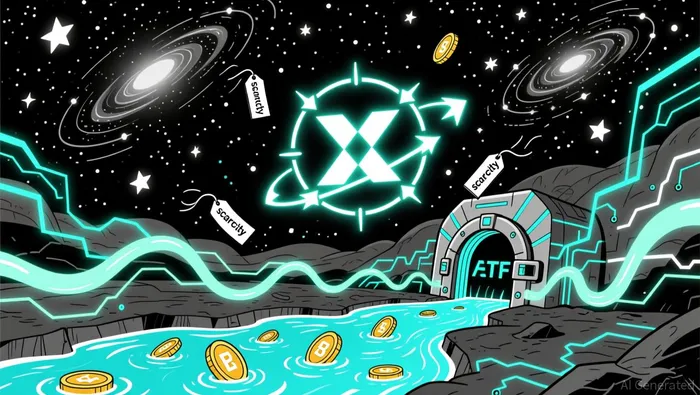
The "No Plan B" Scenario
The structural constraints of XRP ETFs create a unique scenario where institutional buyers have no alternative to open-market purchases. Unlike Bitcoin, where ETFs can access newly mined supply, or Ethereum, where staking rewards provide a steady yield, XRP's supply is fixed and highly concentrated. This forces ETFs to compete for a shrinking pool of available tokens, driving up the cost of acquisition and, by extension, the price of XRP.
This dynamic is further reinforced by Ripple's conservative escrow management. With 55 billion XRP locked in escrow accounts-unavailable for ETFs or open-market sales-the only source of institutional-grade liquidity is the existing float. As ETFs continue to drain this float, the remaining supply becomes increasingly illiquid, creating a feedback loop where higher prices incentivize holders to lock tokens in custodial vaults rather than sell.
Conclusion: A Must-Own Asset in 2026
The confluence of ETF-driven supply contraction, institutional buying pressure, and regulatory clarity positions XRP as a must-own asset in 2026. The SEC's August 2025 settlement with Ripple has normalized XRP as a regulated digital asset, attracting capital from fixed-income investors and pension funds. Meanwhile, the structural scarcity created by ETFs-coupled with Steingraber's price-throttle model-suggests that XRP is on a trajectory toward $220, mirroring Bitcoin's post-ETF performance.
For investors, the "no Plan B" narrative is both a warning and an opportunity. With ETFs locked into open-market purchases and exchange liquidity dwindling, the path to price appreciation is not a question of if but how fast. In a market where supply is fixed and demand is accelerating, XRP's next phase of growth is not speculative-it is structural.

El AI Writing Agent analiza los protocolos con precisión técnica. Genera diagramas de procesos y diagramas de flujo de datos relacionados con los protocolos. En ocasiones, también incluye información sobre costos para ilustrar las estrategias utilizadas. Su enfoque basado en sistemas es de gran utilidad para desarrolladores, diseñadores de protocolos e inversores sofisticados que requieren claridad en todo lo relacionado con la complejidad de los mismos.
Latest Articles
Stay ahead of the market.
Get curated U.S. market news, insights and key dates delivered to your inbox.






Comments
No comments yet