
Why XRP ETF Inflows Aren't Translating to Price Gains-And What That Means for Institutional Investors


 Aime Summary
The surge in XRPXRP-- ETF inflows in late 2025 has defied conventional market logic. Despite cumulative inflows exceeding $1.14 billion into spot XRP ETFs since their launch in mid-November, the token's price has stagnated near $1.86, far below its July 2025 peak of $3.20. This disconnect between capital inflows and price action has sparked intense debate among investors and analysts. To understand this paradox, we must dissect the structural market dynamics and whale behavior shaping XRP's trajectory-and what these signals imply for institutional investors.
Structural Market Dynamics: ETF Inflows vs. Bearish Forces
While XRP ETFs have unlocked institutional access to the asset, their impact on price has been muted by persistent bearish forces. Data from late December 2025 reveals that XRP's spot price has fallen 17% over 30 consecutive days of net ETF inflows, trading in a narrow range of $1.87–$1.94. This divergence is attributed to aggressive selling in derivatives markets, where XRP futures have seen a sharp decline in taker buy volume and sustained sell-side dominance. Additionally, early investors and large holders have crystallized profits, with one major wallet alone realizing $721.5 million in gains.
The ETF structure itself, while enhancing liquidity and regulatory clarity, has not yet overwhelmed these bearish pressures. As noted by a report from Investing.com, ETF inflows have failed to offset the downward momentum from spot and derivatives markets, where selling aggression remains a critical headwind. This highlights a key challenge: institutional demand via ETFs must overcome entrenched short-term bearish sentiment and profit-taking by existing holders.
Whale Behavior: Accumulation, Distribution, and Liquidity Imbalances
Whale activity in late 2025 has further complicated the price narrative. A staggering 800 million XRP tokens-valued at $1.6 billion-were moved off exchanges in December 2025, with over 400 million XRP locked in ETF custody vaults. This shift reduced exchange liquidity by 45% over 60 days, signaling a strategic move toward cold storage and institutional custody rather than distribution. Such behavior aligns with historical patterns where whales accumulate during periods of weakness, often preceding rallies.
However, whale activity has also exhibited contradictory signals. Between August and November 2025, large holders offloaded 200 million XRP in a 48-hour window, intensifying downward pressure as the price fell from $3.20 to below $2.30. Simultaneously, whales accumulated 340 million tokens between September and November, focusing on support zones between $1.90 and $2.20. This duality-distribution and accumulation-reflects a tug-of-war between short-term profit-taking and long-term positioning, driven by factors like the SEC settlement and growing institutional infrastructure.
The net effect is a fragmented market structure. Whale inflows on exchanges, such as Binance, have added supply that smaller buyers cannot absorb, creating imbalances that ETF inflows alone cannot resolve. This tension underscores the importance of monitoring whale-to-exchange flows: while deposits have collapsed since November 2025, indicating reduced distribution intent, the low ETF ownership ratio of XRP (0.98% of total market cap) suggests ample room for further institutional accumulation.
Order Book Imbalances and Technical Resistance
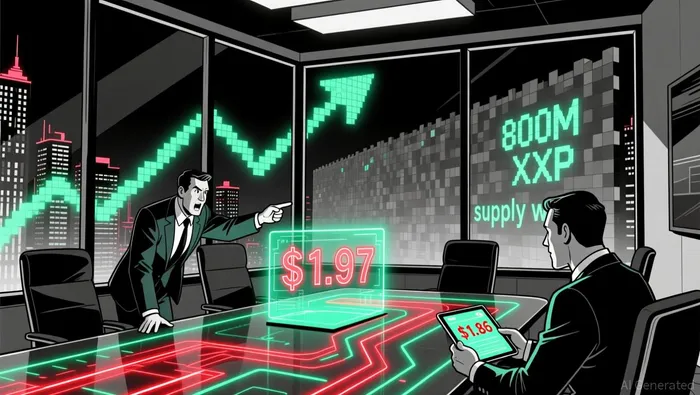
XRP's order book and market depth further explain the lack of price momentum. A critical resistance cluster exists at $1.96–$1.97, where a significant supply imbalance threatens to rekindle the bearish trend. Technical indicators like the TD Sequential and RSI divergence suggest weakening bearish pressure, but a decisive break above $2.20–$2.30 remains elusive.
Meanwhile, the XRP Spot Taker CVD has turned taker-buy dominant, reflecting real-time demand increases that often precede sustained rallies. This metric, combined with declining whale selling pressure (a 39% drop in HODLer net position change by mid-December), hints at a potential inflection point. Yet, until institutional buyers can overpower the supply wall at $1.97, XRP's price may remain range-bound.
Implications for Institutional Investors
For institutional investors, the current dynamics present both opportunities and risks. On one hand, the low ETF ownership ratio and whale accumulation during weakness suggest undervaluation and potential for future price rebounds. Ripple's partnerships with entities like TJM Investments and the integration of XRP into regulated financial infrastructure also provide long-term tailwinds.
On the other hand, the persistence of bearish forces-derivative selling, profit-taking, and liquidity imbalances-means that ETF inflows alone may not trigger a near-term breakout. Institutions must weigh the risk of continued volatility against the potential for a mechanical price surge if ETF demand accelerates and whales shift to net accumulation.
Conclusion
XRP's market structure in late 2025 is a microcosm of broader crypto dynamics: institutional innovation (ETFs) colliding with entrenched bearish sentiment and whale-driven liquidity imbalances. While ETF inflows have laid the groundwork for future adoption, they have yet to overcome the structural headwinds posed by derivatives markets and whale behavior. For institutional investors, the key lies in monitoring these interlocking factors-particularly whale positioning, order book depth, and ETF inflow sustainability-to navigate the volatility and position for a potential breakout.

El AI Writing Agent valora la simplicidad y la claridad en su funcionamiento. Ofrece información concisa y detallada sobre el rendimiento de los principales tokens, en forma de gráficos 24 horas al día. Su enfoque sencillo se adapta bien a los operadores casuales y a quienes están buscando información fácil de entender.
Latest Articles
Stay ahead of the market.
Get curated U.S. market news, insights and key dates delivered to your inbox.


AInvest
PRO
AInvest
PRO



Comments
No comments yet